📰 Trending Topics
Google News - Trending
Google News - Technology
Amazon Prime Big Deal Days Offers Major Discounts on AirPods, iPads, and Much More - MacRumors
2026-10-06 13:58
- Amazon Prime Big Deal Days Offers Major Discounts on AirPods, iPads, and Much More MacRumors
- 34+ Amazon Prime Day tech deals: Save over 50% on top products from Apple, Sony, Bose and more NBC News
- Apple’s new M6 Mac Mini is over $100 off The Verge
- Apple AirPods Max 2 Are $120 Off Right Now WIRED
- Amazon M6 Mac mini with 512GB storage hits $949.99, $150 off AppleInsider
Google ‘Fitbit Edge’ reportedly costs around $180 as specs & features leak - 9to5Google
2026-10-06 13:50
- Google ‘Fitbit Edge’ reportedly costs around $180 as specs & features leak 9to5Google
- Google's new Fitbit watch with a screen just leaked again Mashable
- New leaks reveal more details about the Fitbit Edge including its price The Verge
- Exclusive: This Is the Fitbit Edge, Google's Next Fitness Tracker Android Headlines
- Fitbit Edge Leak: What We Know About Google’s Next Fitness Tracker TechRepublic
We Found the 156 Best Live Prime Day Tech Deals From Apple, Dell, HP, Samsung, Sony, and More - PCMag
2026-10-06 16:27
- We Found the 156 Best Live Prime Day Tech Deals From Apple, Dell, HP, Samsung, Sony, and More PCMag
- I found the 19 best Prime Day laptop and computer deals based on 13 years of testing CNN
- Geekom is selling discounted, highly-rated mini PCs for Prime Big Deal Days Windows Central
- Best Prime Day laptop deals: 20+ models we recommend from Apple, Lenovo, HP, and more ZDNET
- Why Wait for Prime Day When You Can Already Score Up to $800 Off Top-Rated Laptops? CNET
Pixel 11 users might have Gemini call friends and family members - PhoneArena
2026-10-06 04:36
- Pixel 11 users might have Gemini call friends and family members PhoneArena
- Forget booking restaurant reservations — Gemini could soon call your mom for you Android Authority
- Gemini Call for Me might tell your mom you’re running late The Verge
- Google is prepping Gemini to call your friends and family instead of you Android Police
- APK reveals Gemini Calling screen for possible personal calls — The Verge UA.NEWS
Today's biggest TV deal? $2,000 off a 100-inch Hisense TV (yes, really) - USA Today
2026-10-06 11:43
- Today's biggest TV deal? $2,000 off a 100-inch Hisense TV (yes, really) USA Today
- At $2,000 off, this TV could be the best deal of Amazon Prime Day — but should you buy it? Yahoo Tech
- Don’t Miss These 25+ October Prime Day TV Deals Chosen by Our Pixel-Peeping Experts CNET
- All Hisense U7 QLED TVs Are 50% Off for October Prime Day 2026 Lifehacker
- I test top TVs, and I’ve covered every Prime Day ever. Here are the 15 best sales CNN
NASA - Breaking News
Astronomers Solve Cosmic Cold Case with NASA Hubble Data
2026-10-06 16:09

Diligent sleuthing by astronomers uncovered a surprising chemical clue that indicates the white dwarf star HS 0209+0832 may host a second-generation planet. This artist’s concept released on Oct. 5, 2026, depicts that possible explanation.
The white dwarf is the “dead” core of a star that burned through all of its nuclear fuel and lost its outer envelope of gas and dust to space. The second-generation planet formed from that cast-off gas and dust, which is why its chemical content is very different from a planet that formed as its host star was forming.
Learn more about this scientific discovery.
Image credit: NASA, ESA, Leah Hustak (STScI)
NASA’s Curiosity Rover Catches Stunning Martian Dawn
2026-10-06 15:30
3 min read
Preparations for Next Moonwalk Simulations Underway (and Underwater)
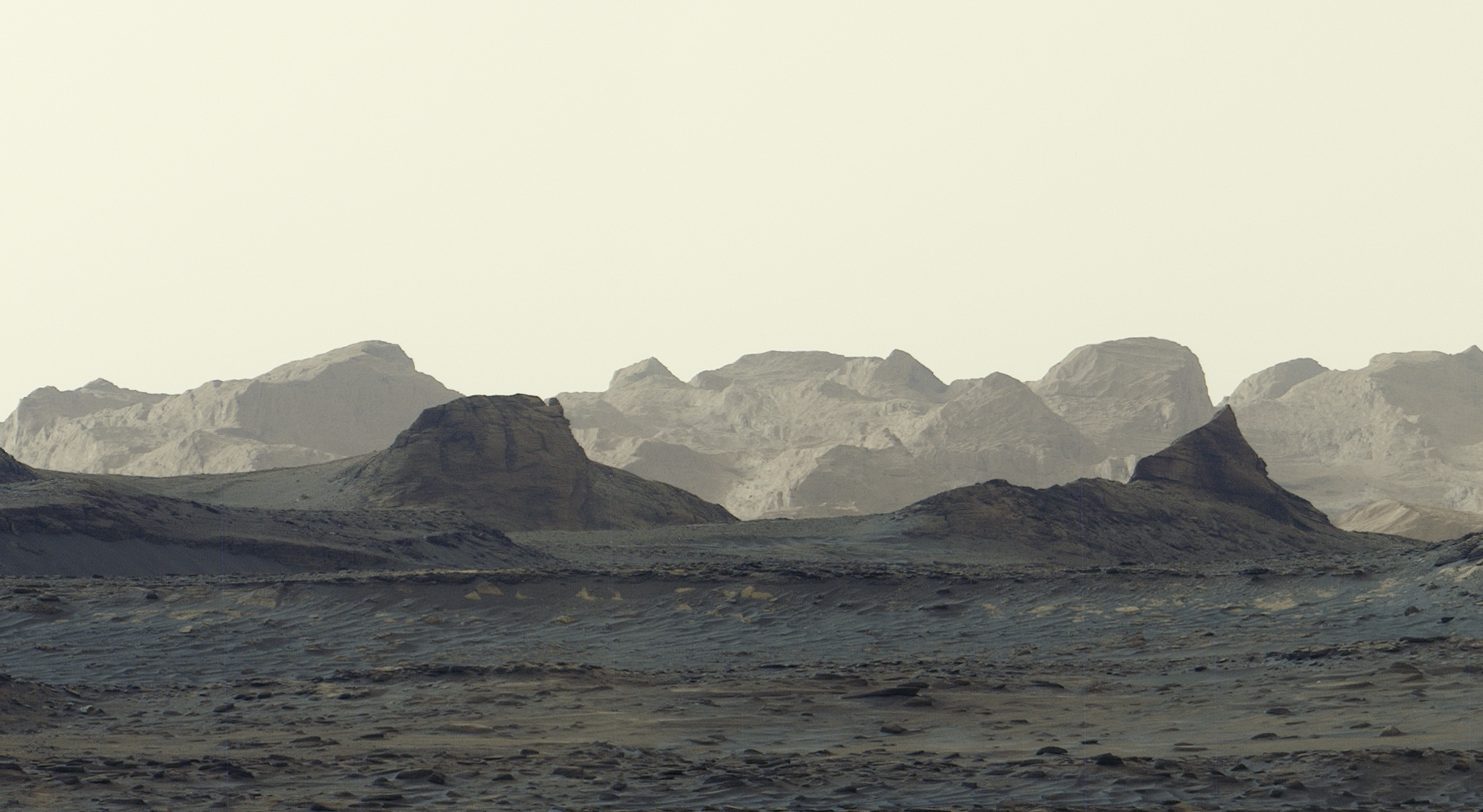
A newly released panorama captured by NASA’s Curiosity rover offers the most detailed view yet of distant, wind-carved Martian cliffs, highlighting features the mission’s scientists have long been waiting to see up close. The scene was snapped at 8:30 a.m. local Mars time, showing striking blue hues in the foreground as bright morning light illuminates crags known as yardangs on the horizon.
The panorama was captured by Curiosity’s Mastcam on Aug. 11, the 4,982nd Martian day, or sol, of the mission, and comprises six individual images that were stitched together after being sent to Earth. Unlike most of Curiosity’s Mastcam images, this one was processed without white balancing, preserving the early morning appearance.

The yardang layer extends roughly 10 miles (16 kilometers) across the northwestern reaches of Mount Sharp, a 3-mile-tall (5-kilometer-tall) mountain that Curiosity has been ascending since 2014. In fact, the rover recently passed another milestone in its ascent, reaching 0.6 miles (1 kilometer) of elevation — the most ever climbed on Mars. As it draws ever-closer to the yardangs, mission scientists expect to get even more amazing imagery — and, they hope, answers to how these cliffs were created.
Mount Sharp is made up of layers, each recording a distinct period of Mars’ history. By studying them, scientists have been able to learn more about lakes and streams that covered this part of the Red Planet billions of years ago. Eventually, the water dried up and left salty minerals behind. After new material stopped settling on the mountain, some of it may have been stripped away by wind, giving rise to the yardangs.


“The yardang layer looks out of place. It’s the wrong color, the layers tilt at an odd angle, and it almost appears plastered on,” said Ashwin Vasavada, Curiosity project scientist of NASA’s Jet Propulsion Laboratory in Southern California. “But that’s what makes it exciting to reach. No one is sure exactly what created this layer, but one idea is it may be ash deposited by ancient volcanic eruptions.”
Curiosity is in the second year of its fifth extended mission, which started with an exploration of the spiderweb-like boxwork ridges. The rover will spend most of the next year or so driving through layers enriched with sulfates and carbonates, both signs of ancient drying on the surface. Sometime in 2027, scientists hope to reach the base of the yardangs, where Curiosity will be able to use its robotic arm to collect one-of-a-kind data on these mysterious features.
More about Curiosity
Curiosity was built by NASA JPL, which is managed by Caltech in Pasadena, California. NASA JPL leads the mission on behalf of the agency’s Science Mission Directorate in Washington as part of its Mars Exploration Program portfolio. Malin Space Science Systems in San Diego built and operates Mastcam.
To learn more about Curiosity, visit:
https://science.nasa.gov/mission/msl-curiosity
News Media Contacts
Andrew Good
Jet Propulsion Laboratory, Pasadena, Calif.
818-393-2433
andrew.c.good@jpl.nasa.gov
Karen Fox / Alana Johnson
NASA Headquarters, Washington
240-285-5155 / 202-672-4780
karen.c.fox@nasa.gov / alana.r.johnson@nasa.gov
2026-067
Share
Details
Related Terms
Explore More




NASA’s Webb Captures Commotion From Nebula’s Stellar Jets
2026-10-06 13:00
NASA’s Webb Captures Commotion From Nebula’s Stellar Jets
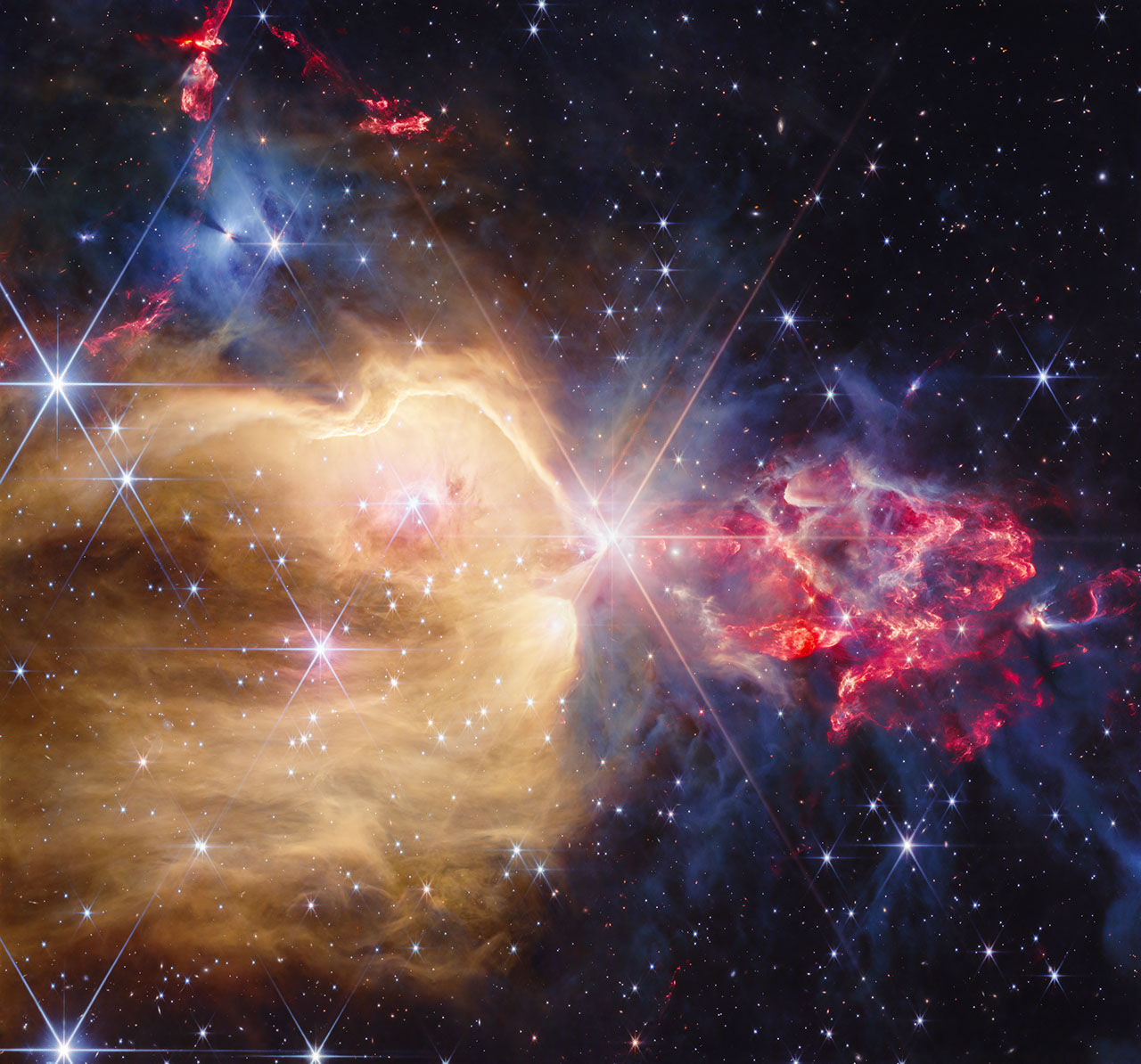
A cauldron of cosmic creation is being revealed in a new image from NASA’s James Webb Space Telescope. Webb has unveiled numerous stars formerly hidden by clouds of dust in a stellar nursery known as NGC 7129, which resides about 3,300 light-years from Earth.
Stars, the engines of elemental creation, have life cycles that begin with their birth in molecular clouds – cold, dense regions of dust and gas. Because of these dusty cocoons, young stars are often impossible to view by many telescopes, particularly those incapable of capturing infrared light. Webb, however, has a high degree of infrared sensitivity, allowing astronomers to peer through that dust and study the beginning of the star life cycle.
Image: NGC 7129 (NIRCam Image)
The stars from this cluster are in different stages of their development, as the more massive stars form and evolve the fastest. The most massive (and the most mature) is the region’s luminous central star, LkH(alpha) 234 (pronounced Lick-H-alpha). This star, which sports the image’s most prominent diffraction pattern, is a pre-main-sequence star weighing around 5 to 8 times the mass of our Sun. Pre-main-sequence stars like these have mostly finished gathering mass and are contracting under the force of gravity, causing their temperatures to rise. In time, this star will fuse its own hydrogen like our Sun.
The cavity to its left, which appears in gold and spans about 3.5 light-years, is the largest demonstration of the central star’s impact. Outflows from an earlier stage of the star’s life cycle carve into the dense molecular cloud of hydrogen. Both the outflows and the star’s light energize the gas, causing it to glow. While much of this hydrogen gas is blown away, a large amount is also compressed, creating the conditions for even more stars to form.
Interactive: The Colorful Clouds of NGC 7129
A few of these stars are visible within the cavity. Several of them are also pre-main-sequence and emit stellar winds. The nearby bow shocks, the curved compressed gas that appears near the stars, are created as those winds push into the energetic gas and create their own, smaller cavities.
Together, the central and embedded stars also create the sharp ridge seen at the top of the golden cavity. Their light generates a hot environment that pushes against the colder and denser molecular gas outside the cavity, and creates a boundary known as a photodissociation region. In this region, the molecules of hydrogen break down into atoms. By influencing the temperature and chemistry of the region, this collection of stars offers insight into how these molecular clouds will gradually erode over millions of years.
The region to the right of the central star narrates a different, but equally chaotic tale. This clumpy matter represented in red hides much younger objects than those on the left: protostars. The protostar stage is earlier than the pre-main-sequence stage and occurs after molecular clouds of gas and dust initially compress and fragment.
As the protostars accumulate matter and increase their mass, they eject outflows of superheated material. These outflows interact with the dense, gray, translucent matter the protostars are wrapped within, creating shocks that cause a textured appearance. The red glow is also the result of the interaction. Multiple outflows from multiple stars overlap from our point of view, leading to the scene’s chaotic look.
Image: NGC 7129 Side-by-Side (Spitzer and Webb Image)
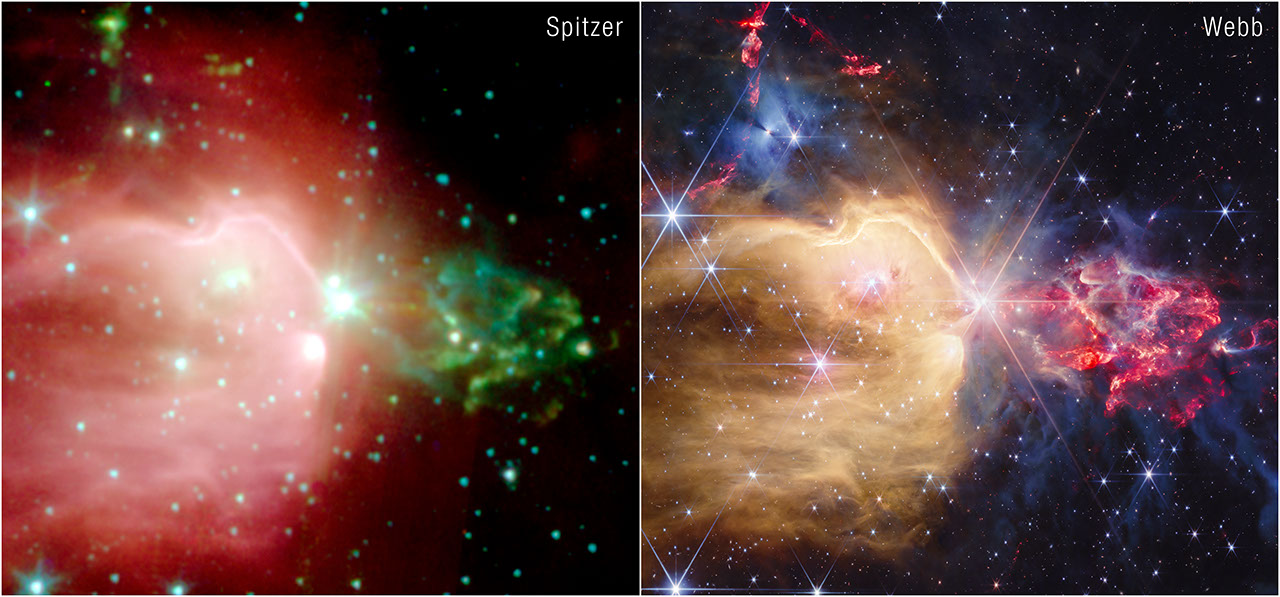
More of these protostellar outflows can be seen at the upper left of the image, near a blue-colored nebula. The center of this blue region hosts a protostar surrounded by a donut-shaped disk of material. This disk casts a shadow against the surrounding nebula, reminiscent of a similar structure known as the “Bat Shadow” that was observed by NASA’s Hubble Space Telescope.
Webb’s high spatial resolution reveals many rich structures in the region’s gas, building on research done previously by NASA’s retired Spitzer Space Telescope. Astronomers will continue to use this Webb data to study how the stars and protostars in this region influence the surrounding gas and dust.
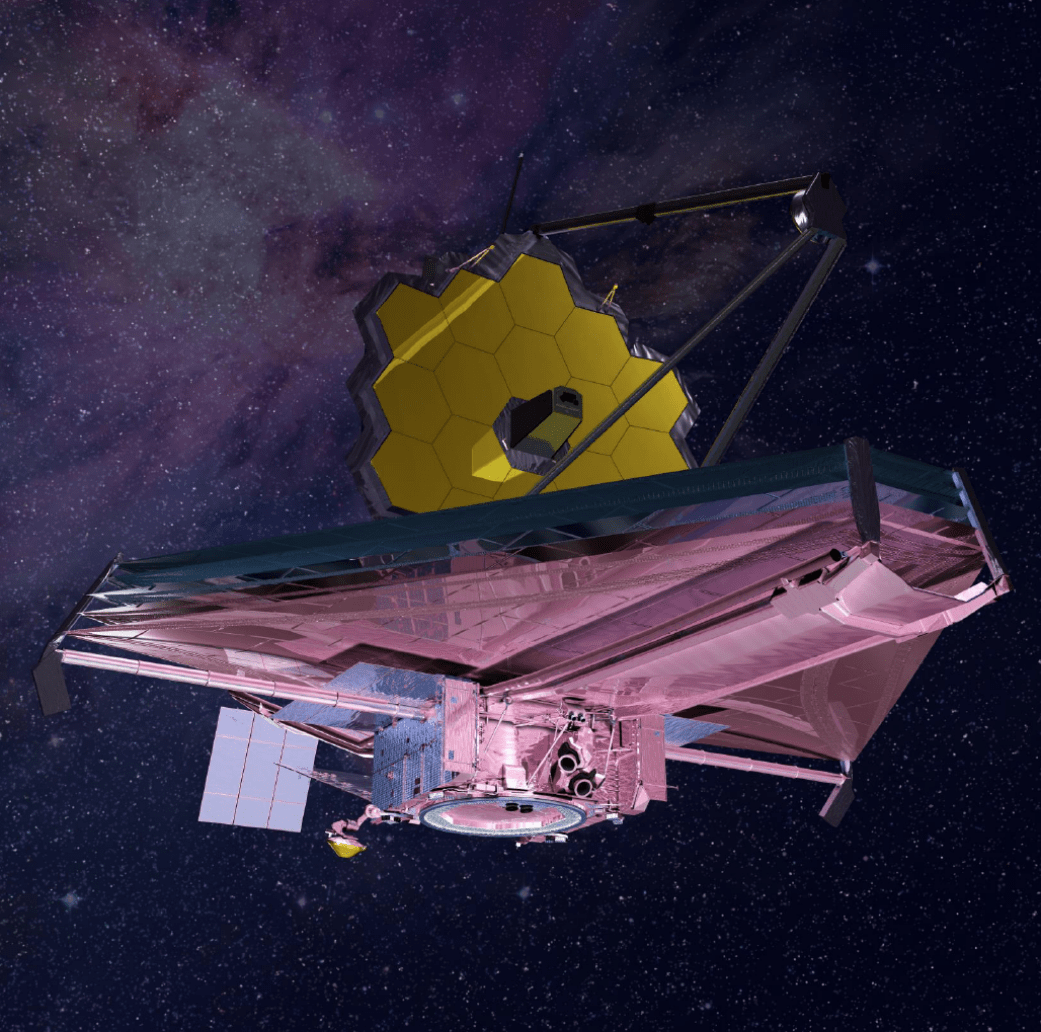
The James Webb Space Telescope is the world’s premier space science observatory. Webb is solving mysteries in our solar system, looking beyond to distant worlds around other stars, and probing the mysterious structures and origins of our universe and our place in it. Webb is an international program led by NASA with its partners, ESA (European Space Agency) and CSA (Canadian Space Agency).
To learn more about Webb, visit:
Downloads & Related Information
The following sections contain links to download this article’s images and videos in all available resolutions followed by related information links, media contacts, and if available, research paper and Spanish translation links.
Related Images & Videos
Related Links
Read more: Webb’s Star Formation Discoveries
Explore more: Image Tour: Herbig-Haro 46/47
Watch: Herbig-Haro 49/50 Stellar Jets Visualization
Explore more: Star formation in the Eagle Nebula
Watch: Celestial Lightsabers: Stellar Jets in HH24
More Webb: News | Images | Science | Home Page
Share
Details
Laura Betz
NASA’s Goddard Space Flight Center
Greenbelt, Maryland
laura.e.betz@nasa.gov
Matthew Brown
Space Telescope Science Institute
Baltimore, Maryland
Hannah Braun
Space Telescope Science Institute
Baltimore, Maryland
Related Terms


APOD: 2026 October 6 – A Complete Auroral Oval from SMILE
2026-10-06 04:05
APOD
Astronomy Picture of the Day
Discover the cosmos! Each day a different image or photograph of our fascinating universe is featured, along with a brief explanation written by a professional astronomer.
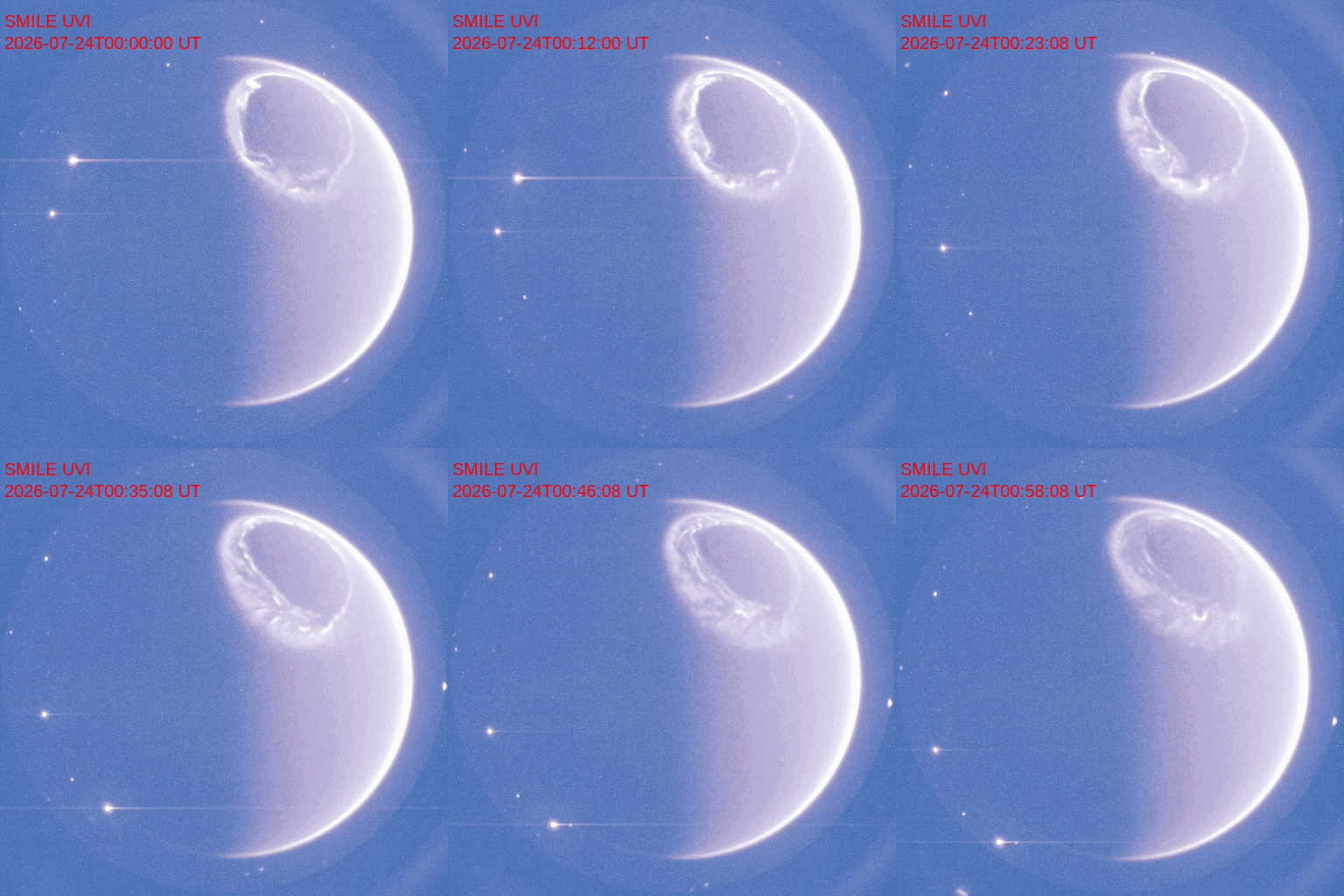
A Complete Auroral Oval from SMILE
Explanation: Have you ever seen a complete auroral oval? You can’t see one from the ground because it makes too large a circle around one of Earth’s magnetic poles. But spacecraft high above the Earth can see them. The featured video from ESA and CAS‘s robotic SMILE spacecraft shows not only a full auroral oval, but using ultraviolet light, one that occurred during the day. The time-lapse covers about an hour in late July and shows visually how variable and turbulent auroras really are. The points of light on the sides are distant stars that appear to move only because SMILE’s camera view shifts as the spacecraft orbits the Earth. A goal of SMILE is to better understand how the Sun’s wind interacts with the Earth’s magnetosphere — and so better understand how to protect astronauts, spacecraft, and ground-based electrical grids from solar storms.
Tomorrow’s picture: a spokey image
| Date: | October 6, 2026 |
|---|---|
| Credit: | ESA, CAS, SMILE, UVI |
| Authors & editors: | Robert Nemiroff, Jerry Bonnell, Cecilia Chirenti, Keighley Rockcliffe |
| A service of: |
ASD at NASA / GSFC, NASA Science Activation & Michigan Tech. U. |
The Beaver Brown Waters of Rupert Bay
2026-10-06 04:01

The Cree word pahtaaunaakun seems particularly apt for describing the distinctive brown hues of the waters that drain into Hannah Bay and Rupert Bay in Canada. Meaning the “color of singed beaver” in Southern East Cree, the word evokes the rich brown of the humic-substance-stained waters that were flowing into the two bays in late September 2026, as well as the role that beavers have long played in the mythology and history of the region.
As the rivers and streams that flow into the two bays—the southernmost extensions of James Bay—wind through the boreal forests and boggy wetlands of northern Quebec and Ontario, they often carry water stained brown by colored dissolved organic matter (CDOM), which absorbs light in the blue and ultraviolet parts of the electromagnetic spectrum and causes water to appear brown. CDOM, including organic substances derived from tannins and lignins, leaches from decaying leaves, roots, bark, and soils into streams and rivers. Similar substances are what stain tea water brown.
When the OLI (Operational Land Imager) on Landsat 9 captured this image on September 27, 2026, the Moose, Nottaway, and Harricanaw rivers were carrying tea-colored water across the broad mudflats of Hannah and Rupert bays and mingling with the darker blue waters of James Bay.
The mudflats, the light brown areas along the shore, are a product of the shallow, sloping bathymetry in the southernmost part of James Bay. Postglacial rebound is slowly lifting the entire landscape, and rivers continually deposit fine mud particles and other sediments that build up the flats. The comings and goings of tides and river currents often stir up the mud, producing the lighter brown plumes of suspended sediment that mix with the incoming river water.
Differences in moisture levels and vegetation patterns likely contribute to the green dendritic, veinlike patterns visible onshore. Denser, more forested growth along stream channels appears dark green, while the poorly drained landscapes in the surrounding peat bogs have less extensive tree cover and appear lighter green.
Beavers have long played a role in the history and mythology of the lake-dotted landscapes in this part of Canada. The Cree people, who have lived in the region for thousands of years, have traditionally hunted beaver for both meat and pelts. European traders arrived in Rupert Bay as early as the 1660s to pursue the animals as well, leading to the establishment of several trading posts along the bay’s shores and the founding of the Hudson’s Bay Company to cultivate the fur trade, especially in beaver pelts.
Beavers also feature prominently in the area’s Cree mythology and environmental history in other ways. For instance, one Cree myth about this area, recorded by the anthropologist Alanson Skinner, tells of a giant pursuing an enormous mythical beaver down the Nottaway River until the beaver escaped into Rupert Bay. According to the myth, the giant then picked up a huge rock and hurled it at the fleeing animal, missing the beaver but creating Stag Rock, the distinctive island found in the river’s mouth today.
In an early example of a managed beaver preserve in Canada, the Hudson’s Bay Company worked with local Cree people in the 1830s and again a century later to set up Charlton Island as a place to raise beavers for later trapping. After predators had been removed and several breeding pairs delivered to the island, its beaver population ballooned, according to historical accounts.
NASA Earth Observatory images by Lauren Dauphin, using Landsat data from the U.S. Geological Survey. Story by Adam Voiland.

References & Resources
- Alanson, S. (1911) Notes on the eastern Cree and northern Saulteaux. Accessed October 5, 2026.
- Canada’s History (2025, August 6) By the early 1900s beaver populations were dwindling… Accessed October 5, 2026.
- Canadian Geographic (2025, July 9) What does the fall of the Hudson’s Bay Company mean to the people of Waskaganish? Accessed October 5, 2026.
- Department of Trade and Commerce (1940) A Fact A Day About Canada. Accessed October 5, 2026.
- Fondriest What is Dissolved Organic Matter? Accessed October 5, 2026.
- Glaser, P., et al. (2004) Tectonic drivers for vegetation patterning and landscape evolution in the Albany River region of the Hudson Bay Lowlands. Journal of Ecology, 92(6), 1054-1070.
- Lewis, M. (2008) Maps, Mapmaking, and Map Use by Native North Americans. Encyclopaedia of the History of Science, Technology, and Medicine in Non-Western Cultures, (Springer, Dordrecht).
- NASA Earth Observatory (2026, March 26) Contours of the James Bay Lowlands. Accessed October 5, 2026.
- NASA Earth Observatory (2018, August 20) Filaments and Color in Rupert Bay. Accessed October 5, 2026.
- NASA Earth Observatory (2016, October 1) Some Tea With Your River? Accessed October 5, 2026.
- Natural Organic Matter Research (2026) What are humic substances? Accessed October 5, 2026.
- Ontario The ecosystems of Ontario – Part 1: ecozones and ecoregions. Accessed October 5, 2026.
You may also be interested in:
Stay up-to-date with the latest content from NASA as we explore the universe and discover more about our home planet.
Tidal and seasonal shifts leave their mark on this crescent-shaped, productive bay in Western Australia’s Kimberley region.
Differences in the underlying bedrock and how rivers distribute sediment make the coastlines west of Portland look unlike those northeast…

Urban development, green spaces, and maritime activity converge in this Northern California city.




TechCrunch - Latest
India’s JioHotstar takes partnership route for Middle East expansion
2026-10-06 17:14
Mirror Particle is building a ‘world model’ of human behavior
2026-10-06 16:35
Furientis lands $25M from Benchmark to mass-produce low-cost missile interceptors
2026-10-06 16:29
Learn all about scaling, fundraising, founder how-tos, and more at TechCrunch Founder Summit, November 4
2026-10-06 16:18
Anthropic is giving startups a free year of Claude Team and $1,000 in credits
2026-10-06 16:00