📰 Trending Topics
Google News - Trending
What's Trending Alaska, Oct. 5, 2026 - Alaska's News Source
2026-10-05 19:17
Trending on KALB.com 10-05-26 - KALB | News Channel 5
2026-10-05 17:21
Google News - Technology
Amazon Launches Early Prime Day Discounts on AirPods, iPad, MacBook Air, and More - MacRumors
2026-10-05 13:01
- Amazon Launches Early Prime Day Discounts on AirPods, iPad, MacBook Air, and More MacRumors
- I’m a devout AirPods user. Here are the best early Prime Day deals on them right now CNN
- The AirPods Pro 3 are a fantastic deal at $179 The Verge
- Major retailers slash prices on popular Apple item during week of sales KCRA
- I Adore My AirPods 4 and You Can Grab a Pair for Just $79 This Prime Day CNET
At 19, founder raises $11M for Ghost, maker of a $3,499 computer for personal AI - TechCrunch
2026-10-05 18:07
- At 19, founder raises $11M for Ghost, maker of a $3,499 computer for personal AI TechCrunch
- Ghost Sells Core Personal AI Computer for $3,499 tokenpost.com
- Ghost raises $11M for a $3,499 computer built for personal AI Dealroom
- At 19, founder raises $11 million for Ghost, maker of a $3,499 computer for personal AI Yahoo Tech
Nvidia’s Shield TV Pro just got a $100 price hike - The Verge
2026-10-05 15:43
- Nvidia’s Shield TV Pro just got a $100 price hike The Verge
- Shield TV Pro vs Google TV vs Fire TV: $240 Gap [2026] tech-insider.org
- The 7-year-old Nvidia Shield TV is now $100 more expensive due to AI Ars Technica
- NVIDIA Axes The Standard Shield TV And Hikes Shield TV Pro By $100 To $299, Blaming Rising DRAM Costs Wccftech
- Old Electronics Prices Surge as AI Demand Tightens Supply 조선일보
Apple releases third iOS 27.2 developer beta for iPhone - 9to5Mac
2026-10-05 18:18
- Apple releases third iOS 27.2 developer beta for iPhone 9to5Mac
- Apple Releases Third iOS 27.2 Beta MacRumors
- macOS 27.2 Golden Gate beta 3 now available, here’s what to expect 9to5Mac
- Apple iOS 27.2 arrives soon: 6 new features on the way Mashable
- Third developer betas for iOS 27.2, macOS 27.2 land for testing AppleInsider
Apple’s new M6 Mac Mini is over $100 off - The Verge
2026-10-05 15:08
- Apple’s new M6 Mac Mini is over $100 off The Verge
- Apple's Newest Macs Just Got Their Biggest Price Cuts Yet on Amazon MacRumors
- The Latest MacBook Air is (Finally) on Sale at Amazon Popular Mechanics
- Amazon's Prime Big Deal Day sales have big savings on MacBooks and Mac Minis — up to $600 in savings on Apple hardware Tom's Hardware
- Heads up! Apple's brand new M6 Mac mini just dropped to the lowest prices ever at up to $150 off 9to5Toys
NASA - Breaking News
NASA Astronaut Christina Koch at Eagles vs. Rams
2026-10-05 17:42

NASA astronaut and mission specialist of the agency’s Artemis II mission, Christina Koch, leads the fans in singing the Eagles Fight Song from the field at an NFL game between the Philadelphia Eagles and the Los Angeles Rams at Lincoln Financial Field on Sunday, Oct. 4, 2026, in Philadelphia.
NASA’s engagement at NFL games is part of the agency’s Inspiration Tour, aimed at strengthening connections between NASA and its partners and showcasing innovation in air and space in the lead up to the MAX POWER aerospace technology expo and airshow at the agency’s Kennedy Space Center in early November.
Image credit: NASA/Thalia Patrinos
NASA Testing Aims at Supercooled Large Droplet Aviation Safety
2026-10-05 15:27
NASA Testing Aims at Supercooled Large Droplet Aviation Safety

NASA is leveraging its expertise and enhancing its test facilities to help address a rare but persistent aviation hazard: icing that occurs when aircraft encounter unusually large, very cold water droplets in clouds.
The problem, known as “supercooled large droplet icing,” occurs when aircraft fly through clouds containing unusually large drops of water that are very cold but remain liquid. When a plane passes through those drops, they can rapidly freeze to surfaces that are not protected from ice buildup.
With a series of tests in the Icing Research Tunnel at Glenn Research Center in Cleveland, NASA researchers are helping U.S. industry better understand the phenomenon.
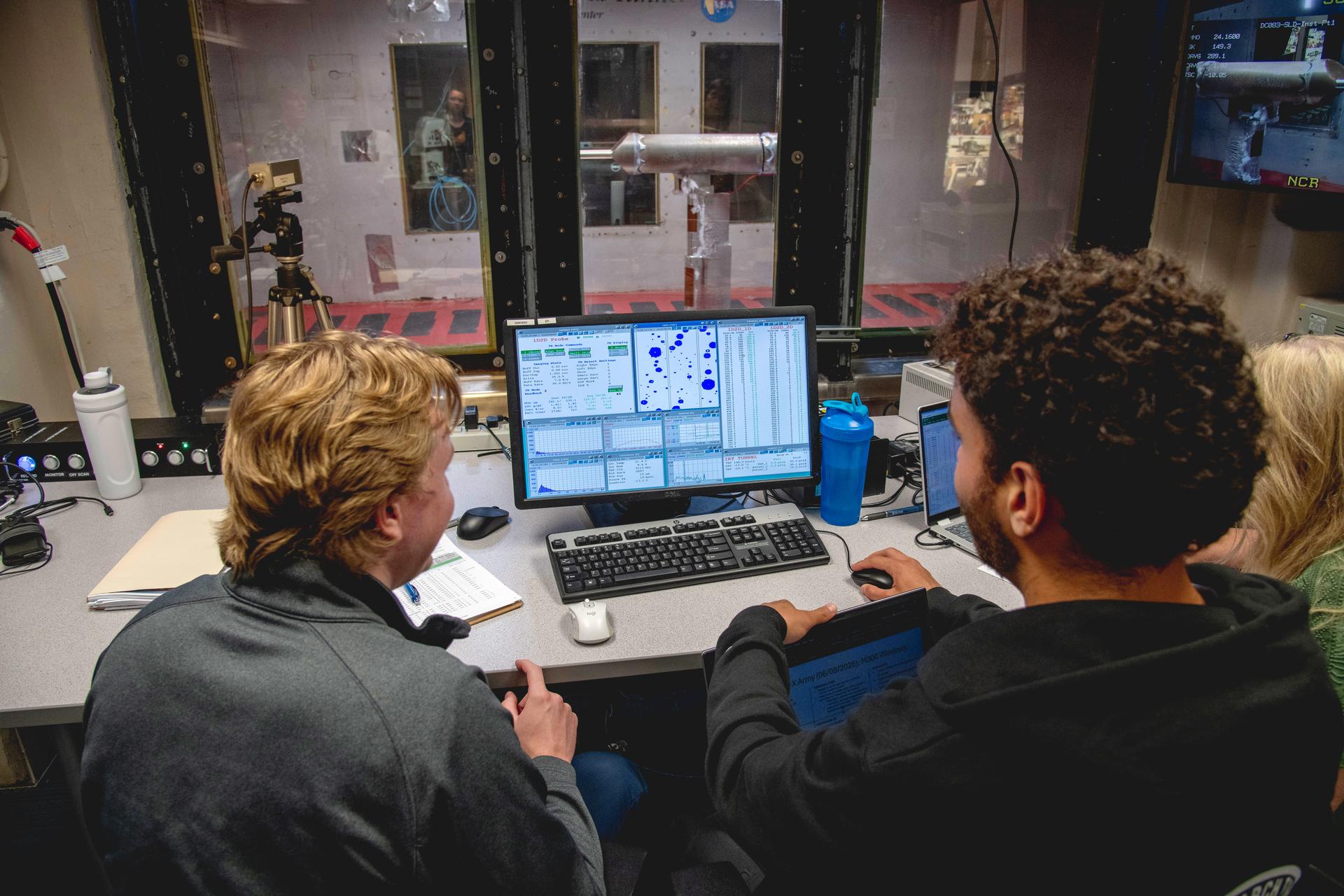
Supercooled water is common in clouds – droplets can go below 32 degrees Farenheit but not freeze unless they encounter dust or other tiny particles around which they can crystalize. Aircraft are designed to encounter typical icing conditions where droplets range from 2 to 100 microns in diameter (for comparison, a human hair is about 70 microns wide). But in rarer cases, clouds can contain supercooled large drops up to 2,000 microns in diameter (if you’ve ever been caught in freezing rain, you’ve encountered these droplets at ground level). These much larger droplets can hit or splash to the aft of an aircraft, including areas behind conventional ice protection systems.
The aviation industry relies on engineering tools to help design their aircraft. Current tools work well for typical clouds, but engineers have questions about how well they account for the physics of supercooled large drops. To help answer those questions, NASA is working to enhance the equipment it uses to generate and measure experimental clouds for testing in the Icing Research Tunnel.
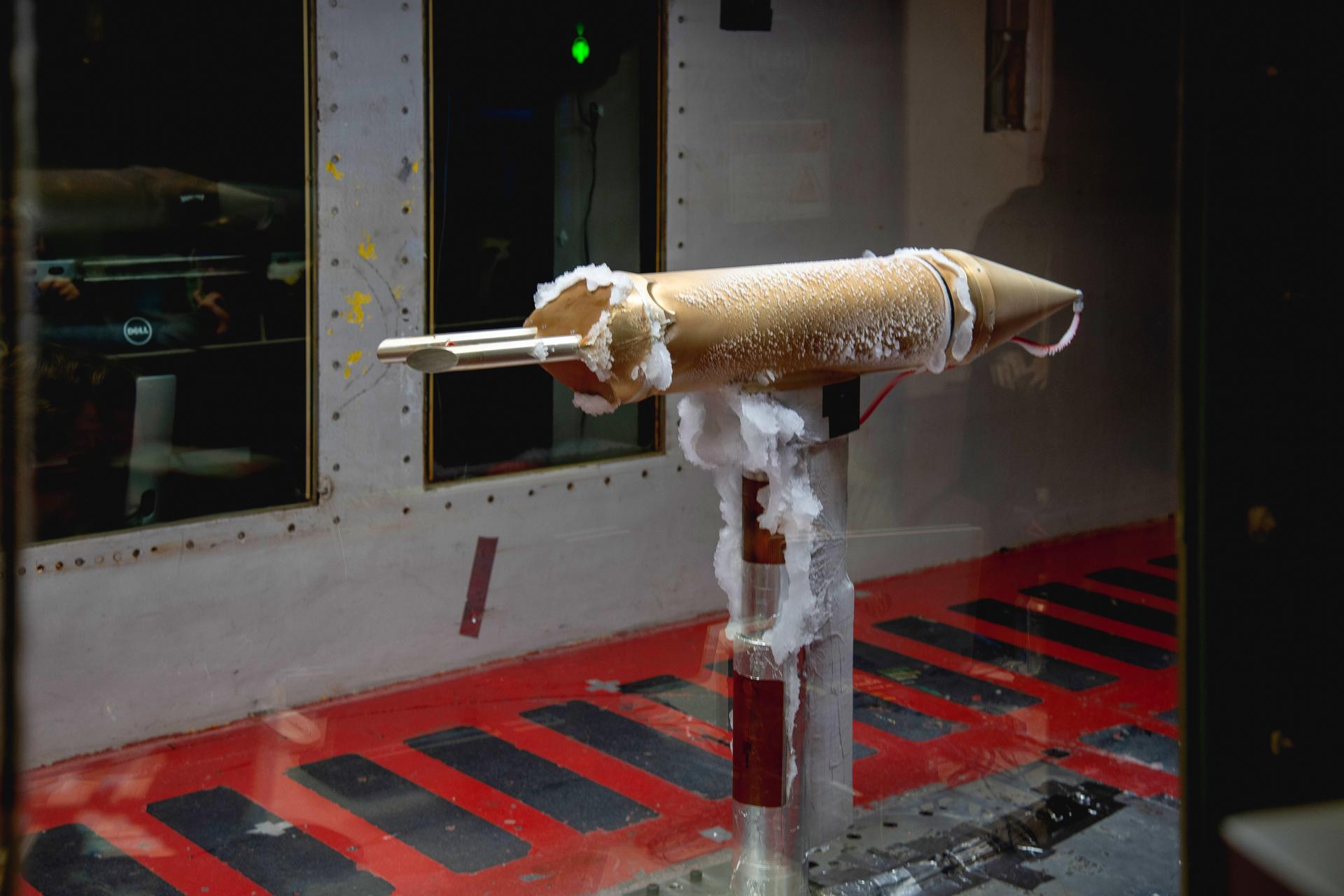
NASA researchers have experimented with brand new probes that help calibrate the sizes of the drops in the clouds the tunnel produces. The probes can “see” drops larger than 45 microns and perform a real-time analysis of their sizes. NASA will compare these results, a laborious technique of post-processing droplet size image data from the tunnel. The results will be mated to results from a different probe that measures droplets smaller than 45 microns. With this, the complete droplet size spectrum is known.
The test campaign marks an important milestone for the Subsonic Flight Demonstrator project, part of NASA’s Research and Technology Mission Directorate. Detailed analysis of the collected data continues, and NASA’s project team will share results with the broader aerospace community once complete.
Share
Related Terms
Explore More






Suspected Second-generation Planet Solves NASA Hubble Cold Case
2026-10-05 15:00
Suspected Second-generation Planet Solves NASA Hubble Cold Case
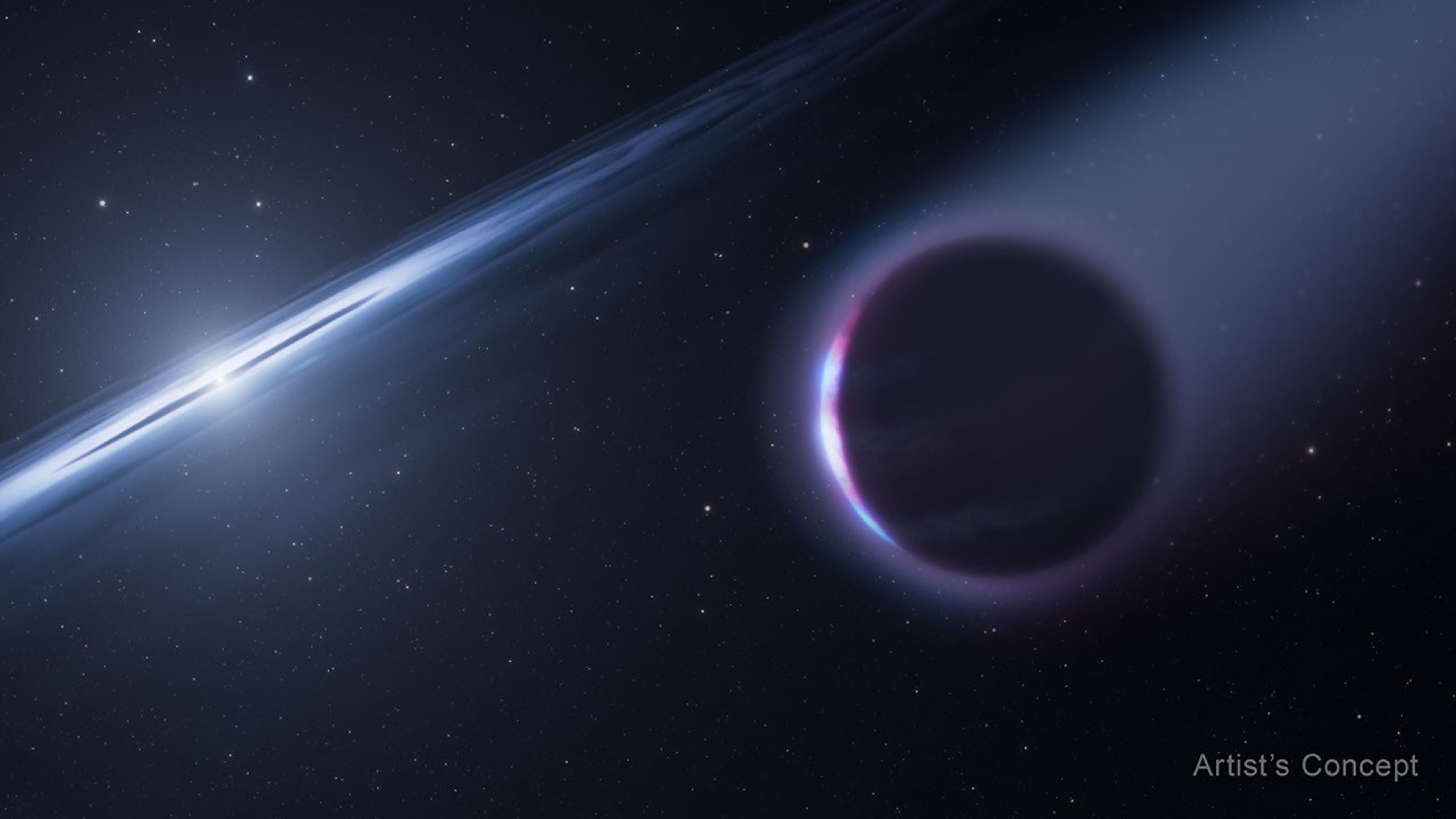
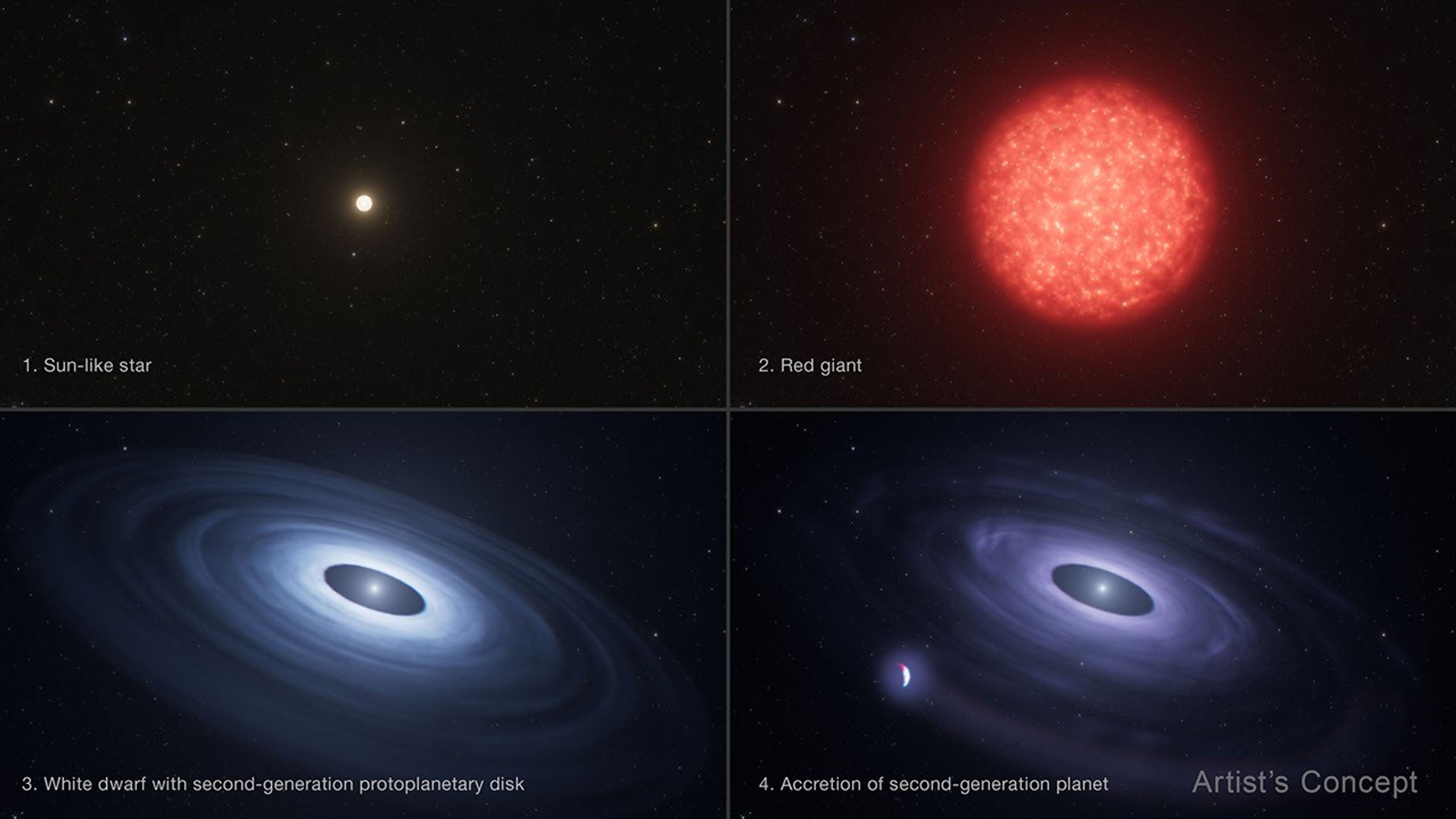
Artwork: NASA, ESA, Leah Hustak (STScI)
Diligent sleuthing by astronomers has broken open a cold case in the data archive of NASA’s Hubble Space Telescope. In a study published Monday in Nature Astronomy, researchers report uncovering a surprising chemical clue that indicates the white dwarf star HS 0209+0832 may host a second-generation planet.
A white dwarf is the remnant core of a low-mass star that has burned through all its nuclear fuel and lost its outer envelope of gas and dust to space. A second-generation planet is a world that forms around the stellar remnant from its cast-off material.
“Rather than the white dwarf stage being a kind of epilogue to the story of a star and its planets, this research points to the systems we are familiar with only being the first chapter of a potentially much longer tale, with some new characters showing up. That’s a really exciting prospect to pursue,” said Jamie Williams, astronomer and lead author, a doctoral candidate at the University of Warwick in the United Kingdom.
Earth and the other planets in our solar system are first-generation planets, which form from material left over from a star’s birth.
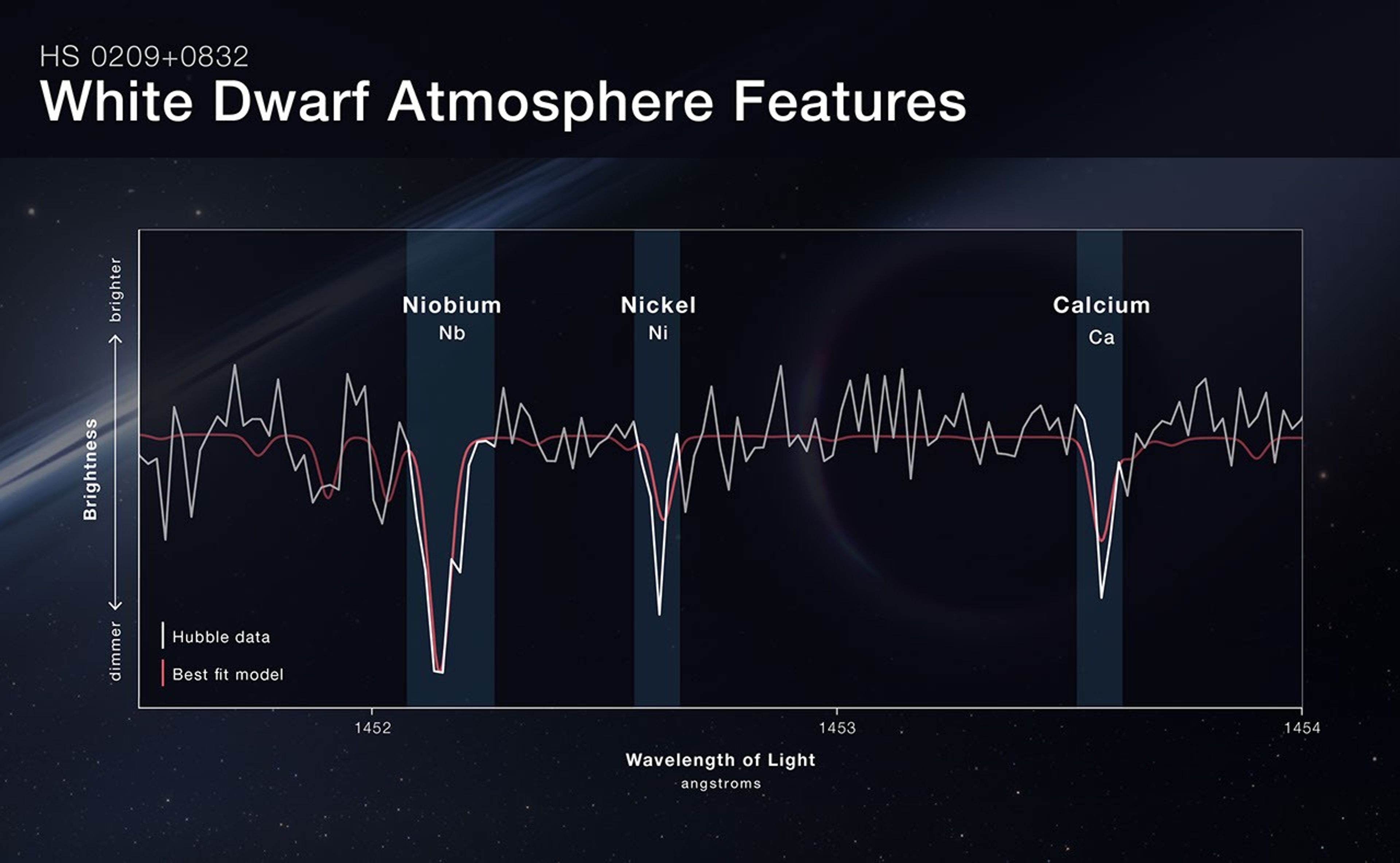
“What Hubble is showing us in this white dwarf system is something we haven’t seen before: a high abundance of the element niobium, the signature of which I was unfamiliar with when I first found it in the archival data,” Williams said.
When Hubble first observed the star in 1999, the data contained roughly 100 chemical features that could not be identified. Williams went back to those records armed with an updated chemical database and found that niobium matched many of the mystery features.
Williams explained that, while niobium is found in our solar system and has multiple uses on Earth, including in jewelry and medical imaging devices, the amount Hubble found in the HS 0209+0832 system points to a planet forming not from a star’s birth, but from the material ejected as it dies.
“Niobium and other elements heavier than iron are astronomically special because, unlike many common elements, they are not formed in the cores of stars by thermonuclear fusion,” said Nicholas Stone, a theoretical astrophysicist at the University of Wisconsin – Madison and member of the research team. “Instead, these heavy elements can only be synthesized in the exotic conditions that briefly emerge inside dying stars. The presence of niobium is a signpost of these ‘death’ throes, and the expulsion of the dying star’s innards into space.”
Once the star ejected this chemically enriched material, the team theorizes that some of it coalesced into a gas giant planet. The remainder of the ejecta dispersed long ago, but the planet remains.
“When Jamie asked me about niobium in relation to this study I was truly gobsmacked, as that element had not been reported in any other white dwarf analyzed to date. Once we realized it was there, everything fell into place,” said astronomer and study co-author Boris Gaensicke, also at the University of Warwick.
The research team confirmed the Hubble observations with data from NASA’s retired FUSE (Far Ultraviolet Spectroscopic Explorer) mission, which also showed strong signatures of niobium in the HS 0209+0832 system.
NASA’s TESS (Transiting Exoplanet Survey Satellite) also observed the white dwarf for four months, allowing it to detect periodic brightness variations that indicate that a planet orbits at a distance of about 3.7 million miles (6 million kilometers), much closer than Mercury orbits the Sun.
The research team estimates the candidate planet is a gas giant about the size of Jupiter that is rapidly losing atmosphere. Because the white dwarf star is relatively new, it is still very hot and likely blasting this planet with energy that is stripping its outer material. This could result in the planet having a comet-like tail of material that would form a disk around the white dwarf star and fall back on to its surface, leading to Hubble detecting the niobium when studying the star. Despite this mass loss, Williams said that the planet is likely not a temporary blip on the cosmic radar.
“If the second-generation planet is there, I think it is likely to survive. Eventually the white dwarf will cool and then maintain a consistent temperature, with the planet in its stable habitable zone for millions of years,” Williams said.
Williams added that there is still a lot of work to do to understand these types of systems — how second-generation planets form, how common or rare they are, and how they evolve in orbit around a “dead” star. He’ll use Hubble to explore these questions for the next several years, hoping to build up substantial data and statistics about these new types of celestial bodies.
“I think this research is an important example of the fact that scientific discovery is not a straight path,” Gaensicke said. “It often needs that magical moment when people discuss big questions on their minds and realize that together they can find unexpected answers.”
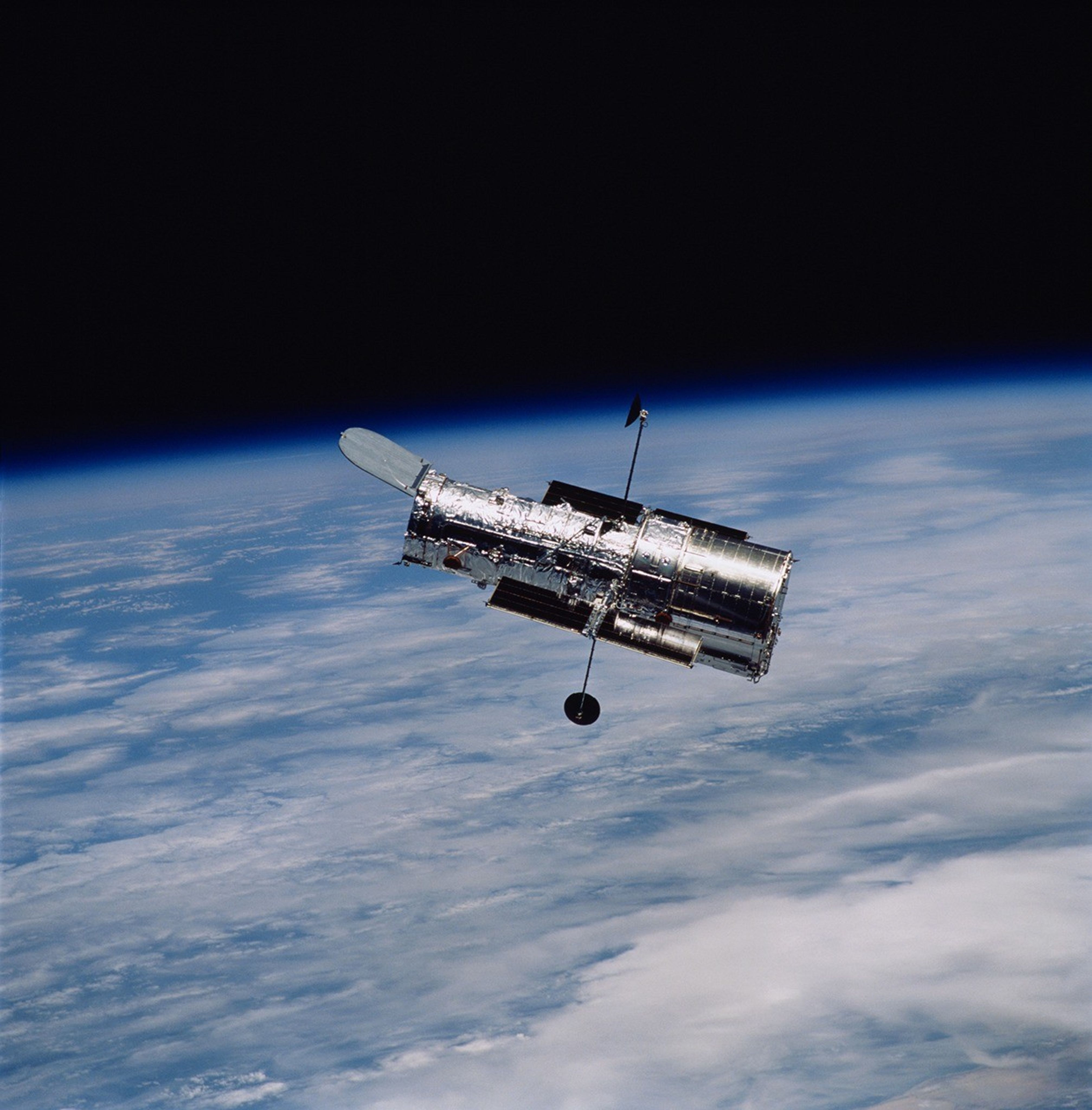
The Hubble Space Telescope has been operating for more than three decades and continues to make ground-breaking discoveries that shape our fundamental understanding of the universe. Hubble is a project of international cooperation between NASA and ESA (European Space Agency). NASA’s Goddard Space Flight Center in Greenbelt, Maryland, manages the telescope and mission operations. Lockheed Martin Space also supports mission operations at Goddard. The Space Telescope Science Institute in Baltimore, which is operated by the Association of Universities for Research in Astronomy, conducts Hubble science operations for NASA.
Related Images & Videos
White Dwarf HS 0209+0832 over Time (Artist’s Concept)
This artist’s concept, not to scale, imagines the evolution of a Sun-like star (1) into an aging red giant (2) and then a small, bright white dwarf surrounded by a disk of its expelled outer layers (3), from which a second-generation planet forms (4).

Share
Details
Claire Andreoli
NASA’s Goddard Space Flight Center
Greenbelt, Maryland
claire.andreoli@nasa.gov
Leah Ramsay, Christine Pulliam
Space Telescope Science Institute
Baltimore, Maryland
Related Terms
Related Links and Documents
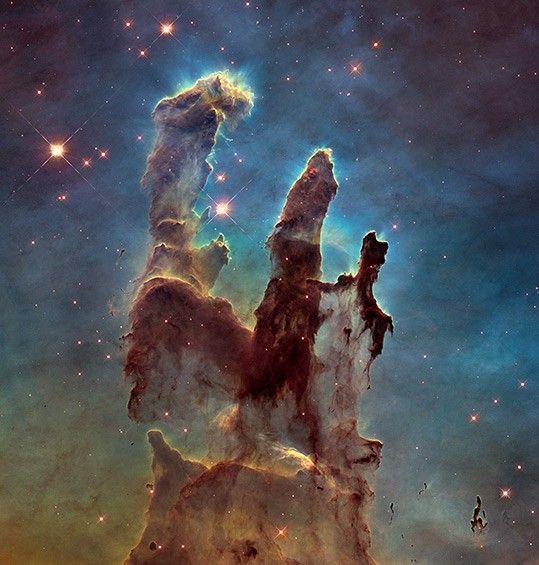
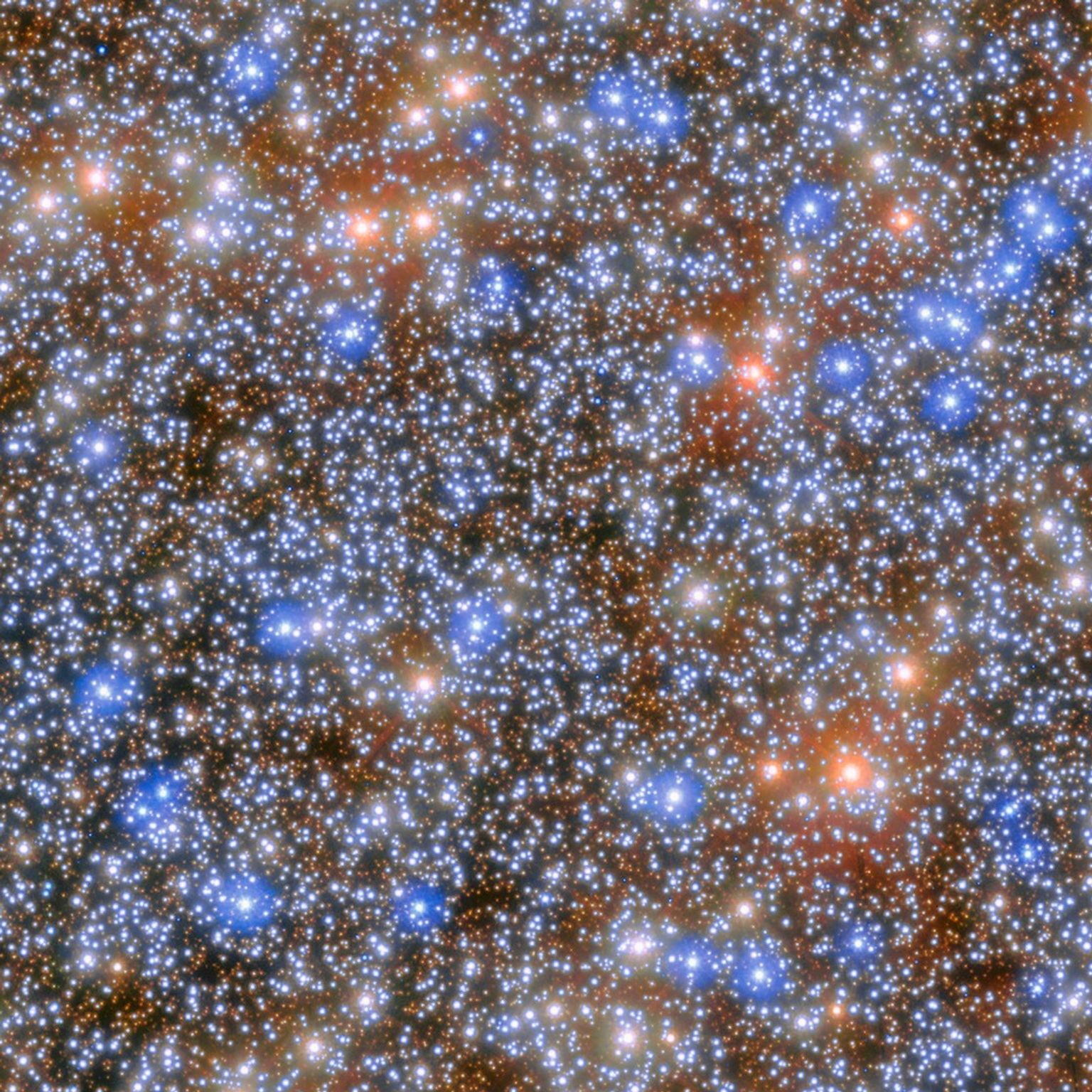
APOD: 2026 October 5 – M104: The Sombrero Galaxy’s Tidal Streams
2026-10-05 04:05
APOD
Astronomy Picture of the Day
Discover the cosmos! Each day a different image or photograph of our fascinating universe is featured, along with a brief explanation written by a professional astronomer.
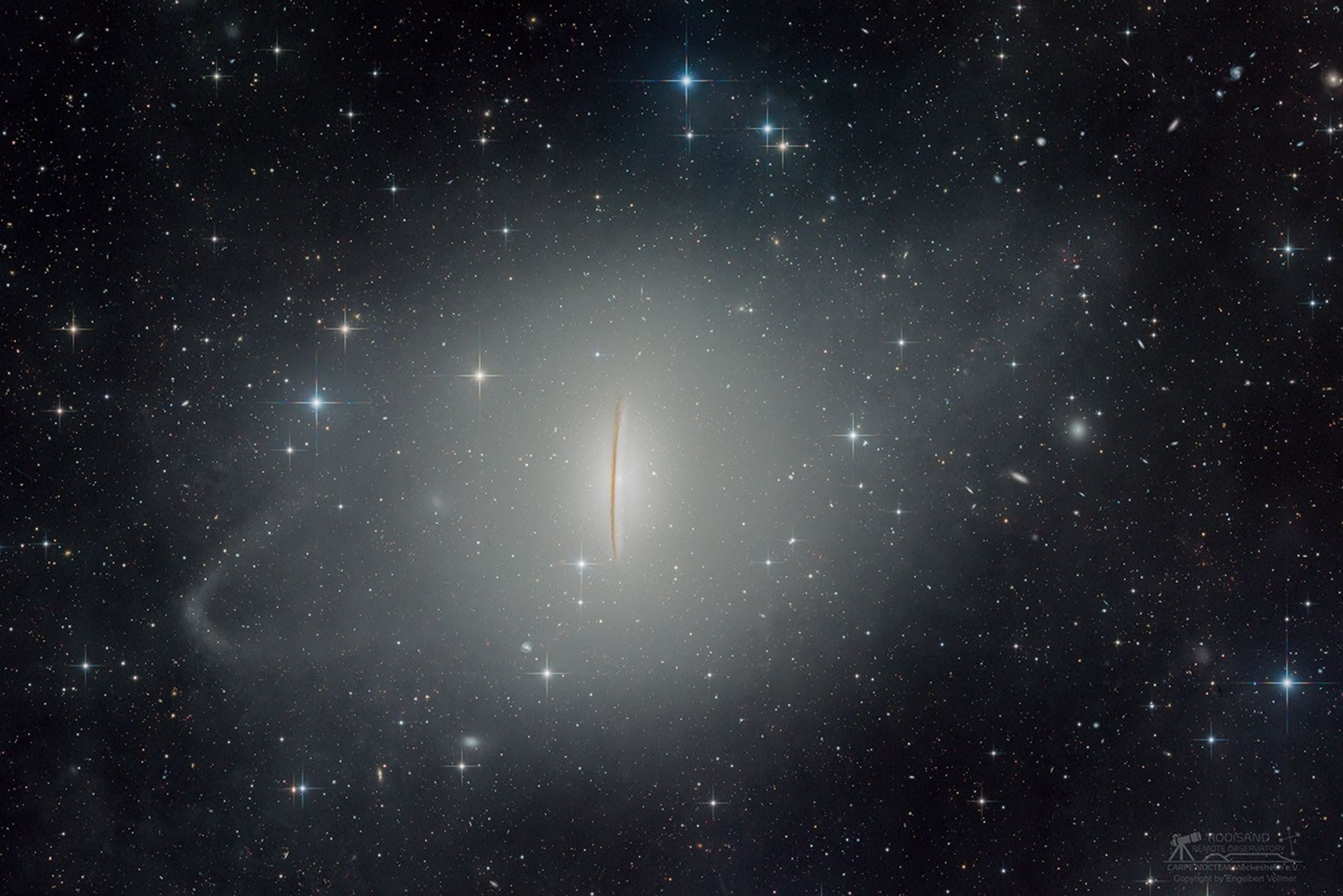
M104: The Sombrero Galaxy’s Tidal Streams
Explanation: A deep image of the Sombrero galaxy reveals surprises. M104 is named the Sombrero galaxy because, on shorter exposures, it looks like a hat. A key defining feature of this huge galaxy is a dark brim of dust that circles the disk galaxy’s center. A much longer exposure, however, brings up a hairy past where a bright, hazy halo is revealed that extends well past the central disk and contains many unresolved stars. Surprisingly, in this stellar haze, structures can be seen that include a diagonal ring. These structures and tidal streams provide fresh evidence that M104 had a violent past and is surely the result of collisions and mergers of smaller galaxies. Light takes about 30 million years to reach us from the Sombrero galaxy, which fully spans about 150 thousand light years across. The featured image was taken over seven days in mid-2026 from Namibia.
Your Sky Surprise: What picture did APOD feature on your birthday? (post 1995)
Tomorrow’s picture: a smile
| Date | October 5, 2026 |
|---|---|
| Credit & Copyright | Engelbert Vollmer |
| Authors & editors: | Robert Nemiroff, Jerry Bonnell, Cecilia Chirenti, Keighley Rockcliffe |
| A service of: |
ASD at NASA / GSFC, NASA Science Activation & Michigan Tech. U. |
Moon-Like Madagascar
2026-10-05 04:01
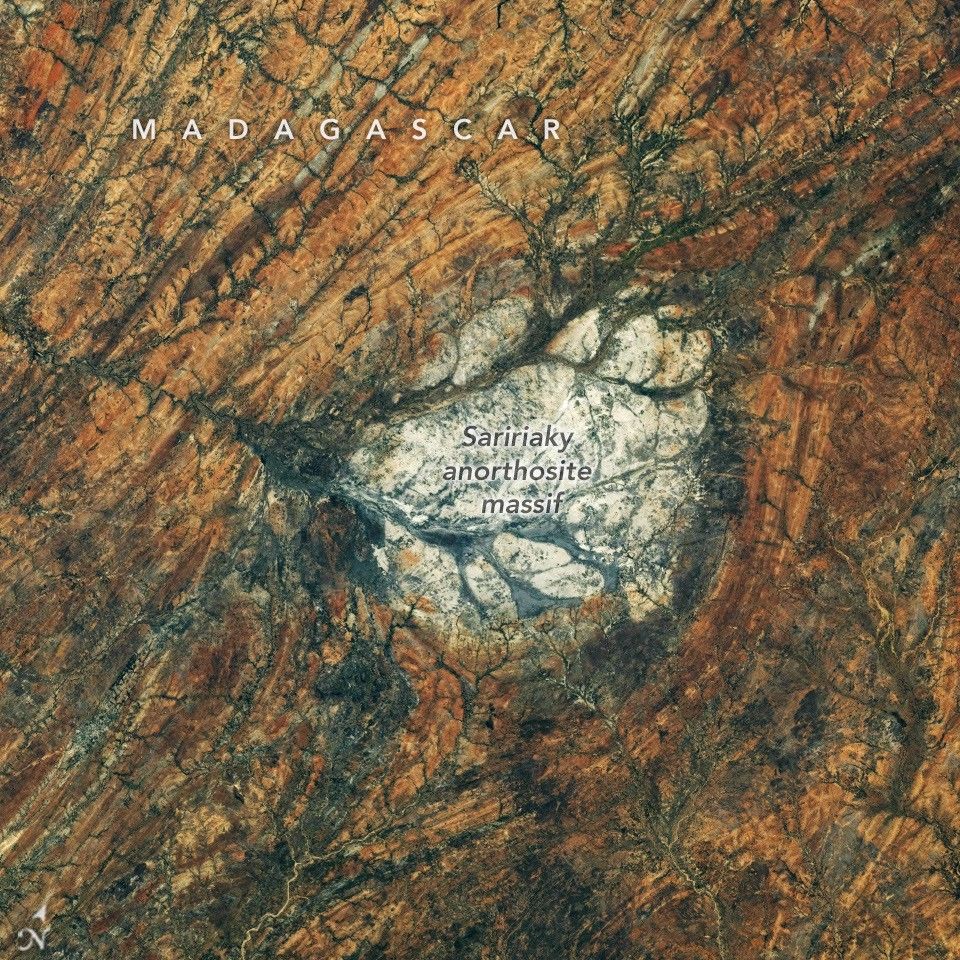
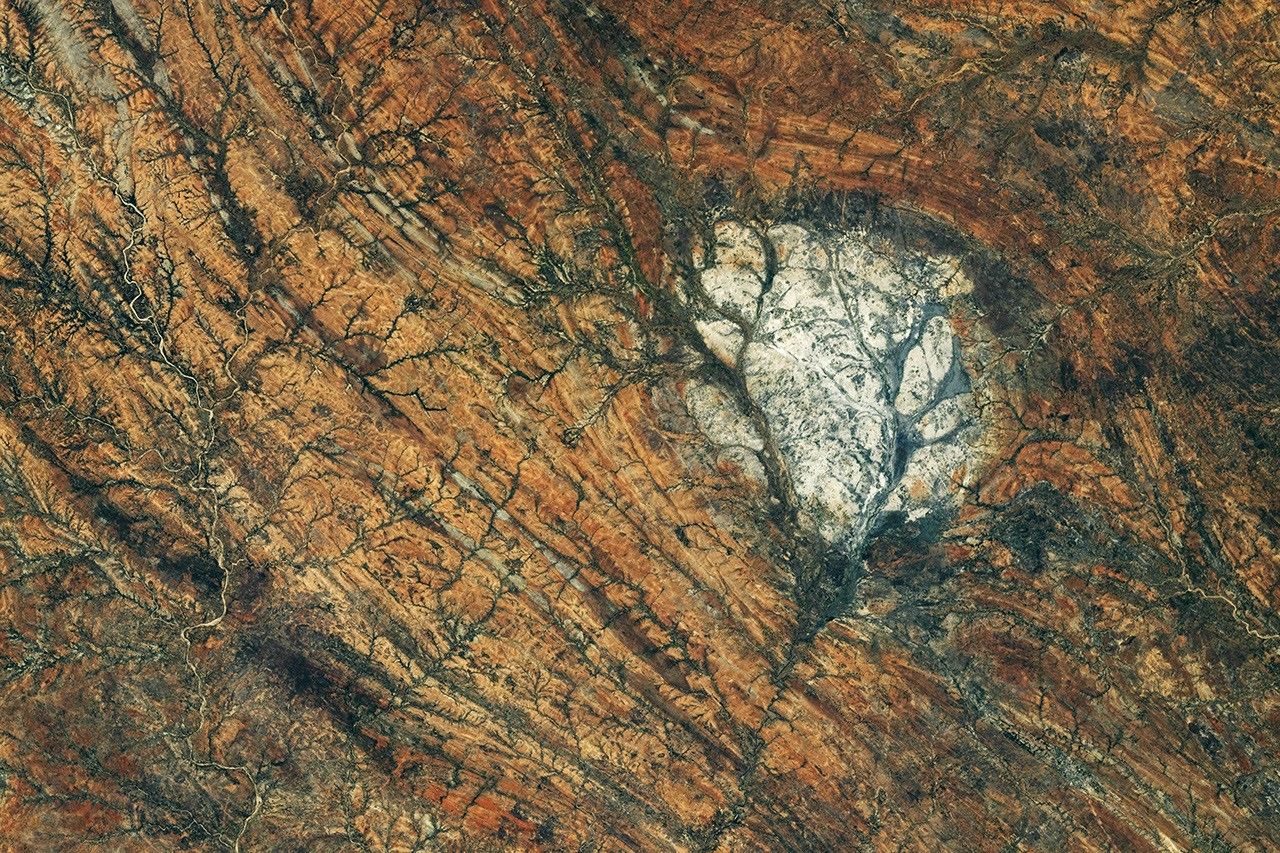
From an astronaut’s perspective looking back at Earth, a patch of bright rock in arid southern Madagascar may appear out of place. But it wouldn’t on the Moon. The igneous rock anorthosite, common on the Moon’s surface, is visible from Earth with the unaided eye as the light-colored, highly reflective areas known as the lunar highlands. Anorthosite also crops up across Earth’s surface, from eastern Canada and Scandinavia to southern India and Madagascar, where it forms a striking round feature.
An astronaut aboard the International Space Station captured this photo of the Saririaky anorthosite massif on August 28, 2026. Anorthosite is an intrusive igneous rock—formed from magma that cools beneath the surface—made up of large mineral crystals. Scientists think the massif seen here formed in the late Precambrian, at least 600 million years ago. Its present-day outcrop covers about 100 square kilometers (40 square miles).
The rocks surrounding the anorthosite reveal a dynamic chapter in the area’s geologic past. Researchers have determined that the Saririaky massif lies within a ductile shear zone, where high pressures and temperatures metamorphosed and reshaped the rock, imparting north-south-trending linear patterns.
Geologists think this deformation occurred when pieces of what are now Africa, India, Madagascar, Australia, and Antarctica were colliding to form the supercontinent Gondwana. Some scientists have posited that another anorthosite massif in the shear zone, located about 60 kilometers (40 miles) to the north, was pulled apart from the Saririaky massif in the process, creating a large-scale boudinage structure.
Anorthosites on Earth have proven useful for scientists studying the Moon’s past. Lunar anorthosites are more than 4 billion years old, having crystallized from the Moon’s magma ocean to form its outer crust. Researchers have analyzed samples brought back to Earth by Apollo astronauts, but because that material is limited, they also look to analogous terrestrial rocks. The anorthosites in the Beartooth Mountains of Montana match the composition of the lunar version particularly well.
Astronaut photograph ISS075-E-85249 was acquired on August 28, 2026, with a Nikon Z9 digital camera using a focal length of 400 millimeters. It is provided by the ISS Crew Earth Observations Facility and the Earth Science and Remote Sensing Unit at NASA Johnson Space Center. The image was taken by a member of the Expedition 75 crew. The image has been cropped and enhanced to improve contrast, and lens artifacts have been removed. The International Space Station Program supports the laboratory as part of the ISS National Lab to help astronauts take pictures of Earth that will be of the greatest value to scientists and the public, and to make those images freely available on the internet. Additional images taken by astronauts and cosmonauts can be viewed at the NASA/JSC Gateway to Astronaut Photography of Earth. Story by Lindsey Doermann.
References & Resources
- Ashwal, L.D., et al. (1998) Geology, petrology and isotope geochemistry of massif-type anorthosites from southwest Madagascar. Contributions to Mineralogy and Petrology, 133, 389-401.
- Earth & Solar System (2017, July 27) Impact Shock State of the Lunar Highlands. Accessed October 2, 2026.
- Martelat, J., et al. (2000) Strain pattern and late Precambrian deformation history in southern Madagascar. Precambrian Research, 102, 1–2.
- NASA Earth Observatory (2020, May 4) Montana’s Moon-Like Rocks. Accessed October 2, 2026.
You may also be interested in:
Stay up-to-date with the latest content from NASA as we explore the universe and discover more about our home planet.

An astronaut’s photo, taken en route to the Moon, reveals our planet and its place in space in a novel…

The tilt in Earth’s axis of rotation makes the apparent position of continents shift with the seasons in imagery from…

Over the years, astronauts aboard the International Space Station have photographed several of the cities hosting the 2026 FIFA World…




TechCrunch - Latest
Lucid Motors’ EV output falls to lowest level in almost two years
2026-10-05 21:54
OpenAI will start watermarking ChatGPT’s text in the EU
2026-10-05 20:36
Etched fields funding offers at $40B+ valuation, sources say
2026-10-05 20:24
After Factory’s public spat with Khosla, Menlo proudly invests
2026-10-05 19:38
Reflection debuts Beam, an open-weight AI model to rival Chinese models at lower compute cost
2026-10-05 19:33











.svg)