dernier Landing Page

dernier News Guide

Get updated News about latest trends, and more Get updated News about latest trends and updates products
dernier Service
>

Dernier Trends Updates

This website uses cookies to ensure you get the best experience on our website. By clicking "Accept", you agree to our use of cookies. Learn more

Trending Topics

📰 Trending Topics

Google News - Trending

Google News - Technology

NASA - Breaking News

NASA Sets Briefings for SpaceX Crew-13 Mission to Space Station

2026-07-20 20:00

The SpaceX Crew-13 members are pictured in their pressure suits seated inside a mockup Dragon spacecraft during a preflight training session at the company's headquarters in Hawthorne, California. From left are, Roscosmos Sergey Teteryatnikov, NASA astronauts Luke Delaney and Jessica Watkins, and CSA (Canadian Space Agency) astronaut Joshua Kutryk.
NASA’s SpaceX Crew-13 members are pictured in their pressure suits seated inside a mockup Dragon spacecraft during a preflight training session at the company’s headquarters in Hawthorne, California. From left are Roscosmos Sergey Teteryatnikov, NASA astronauts Luke Delaney and Jessica Watkins, and CSA (Canadian Space Agency) astronaut Joshua Kutryk.
Credit: SpaceX

NASA and its partners will discuss the upcoming crew rotation mission to the International Space Station during a pair of news conferences on Monday, Aug. 3, from the agency’s Johnson Space Center in Houston.

Mission leadership will provide an overview of NASA’s SpaceX Crew‑13 mission at 12 p.m. EDT. Next, crew members will discuss their training and mission preparations at 2 p.m. This is Crew-13’s final media availability prior to traveling to the agency’s Kennedy Space Center in Florida for launch.

NASA will stream these events live. Learn where to watch online:

https://www.nasa.gov/live

The Crew-13 mission will carry NASA astronauts Jessica Watkins and Luke Delaney, CSA (Canadian Space Agency) astronaut Joshua Kutryk, and Roscosmos cosmonaut Sergey Teteryatnikov to the orbiting laboratory. The crew will launch aboard a SpaceX Dragon spacecraft on the company’s Falcon 9 rocket from Space Launch Complex 40 at Cape Canaveral Space Force Station in Florida no earlier than mid-September.

International media attending in person must email the NASA Johnson newsroom at jsccommu@mail.nasa.gov by 5 p.m., Tuesday, July 21. United States-based media attending in person must respond by 5 p.m., Thursday, July 30. Media joining virtually must respond by 10 a.m. the day of the event. NASA’s media accreditation policy is available online.

Briefing participants are as follows (all times Eastern and subject to change based on real-time operations):

12 p.m.: Mission Overview News Conference

  • Joel Montalbano, deputy associate administrator, Human Spaceflight Mission Directorate, NASA Headquarters
  • Dana Weigel, manager, Low Earth Orbit Program, NASA Johnson
  • Mathieu Caron, director, Astronauts, Life Sciences, and Space Medicine, CSA
  • Julianna Scheiman, director, NASA Science and Dragon Programs, SpaceX

2 p.m.: Crew-13 News Conference

  • Jessica Watkins, commander, NASA
  • Luke Delaney, pilot, NASA
  • Joshua Kutryk, mission specialist, CSA
  • Sergey Teteryatnikov, mission specialist, Roscosmos

Following the news conference, crew members will be available for limited media interviews. All interview requests must be submitted by 5 p.m. on July 30, to the NASA Johnson newsroom at: jsccommu@mail.nasa.gov.

This will be the second flight to the space station for Watkins, who was selected as a NASA astronaut in 2017. Watkins grew up in Lafayette, Colorado, and earned an undergraduate degree in geological and environmental sciences from Stanford University, as well as a doctorate in geology from the University of California, Los Angeles. As a geologist, she studied the Martian surface and was a member of the Curiosity rover science team at NASA’s Jet Propulsion Laboratory in Southern California. Watkins first launched to the space station as a crew member aboard NASA’s SpaceX Crew-4 mission, spending a total of 170 days in space across space station Expeditions 67/68 in 2022. She will be the first NASA astronaut to launch aboard a SpaceX Dragon spacecraft twice.

Selected as a NASA astronaut in 2021, Delaney earned a bachelor’s degree in mechanical engineering at the University of North Florida and a master’s degree in aerospace engineering at the Naval Postgraduate School. The Florida native is a distinguished naval aviator who participated in exercises throughout the Asia Pacific region and conducted missions in support of Operation Enduring Freedom. As a test pilot, Delaney evaluated developmental aircraft systems and served as a test pilot instructor. He also worked as a research pilot at NASA’s Langley Research Center in Hampton, Virginia, where he supported airborne science missions. This is the first spaceflight for Delaney.

The Crew-13 mission also is the first spaceflight for Kutryk. Prior to his selection as a CSA astronaut in 2017, he served as a CF-18 fighter pilot, flying missions in support of Canada’s NATO, U.N., and North American Aerospace Defense Command commitments. A native of Fort Saskatchewan, Alberta, Kutryk also worked as an experimental and operational test pilot at the Aerospace Engineering Test Establishment in Cold Lake, Alberta. Kutryk received a bachelor’s degree in mechanical engineering from the Royal Military College of Canada in Kingston, Ontario, and he is a distinguished graduate of the United States Air Force Test Pilot school in Edwards, California. He has master’s degrees in space studies, flight test engineering, and defense studies.

This mission will be Teteryatnikov’s first trip to the orbiting laboratory. He graduated from the Naval Academy, St. Petersburg, Russia, in 2011 as an engineer specializing in ship power plant operations. Before his selection as a test cosmonaut, Teteryatnikov served in various naval engineering roles, including undersea vessels and specialized engine room operations. He was selected for the Gagarin Research and Test Cosmonaut Training Center Cosmonaut Corps in 2021 and has served as a test cosmonaut since 2023.

For more information about the mission, visit:

https://www.nasa.gov/mission/nasas-spacex-crew-13

-end-

Joshua Finch / Jimi Russell
Headquarters, Washington
202-358-1100
joshua.a.finch@nasa.gov / james.j.russell@nasa.gov

Leah Cheshier / Anna Schneider
Johnson Space Center, Houston
281-483-5111
leah.d.cheshier@nasa.gov / anna.c.schneider@nasa.gov

Share

Details

Last Updated
Jul 20, 2026
Editor
Jessica Taveau
NASA, GE Aerospace Work Enables Hybrid-Electric Flight Demonstration

2026-07-20 18:54

4 min read

Preparations for Next Moonwalk Simulations Underway (and Underwater)
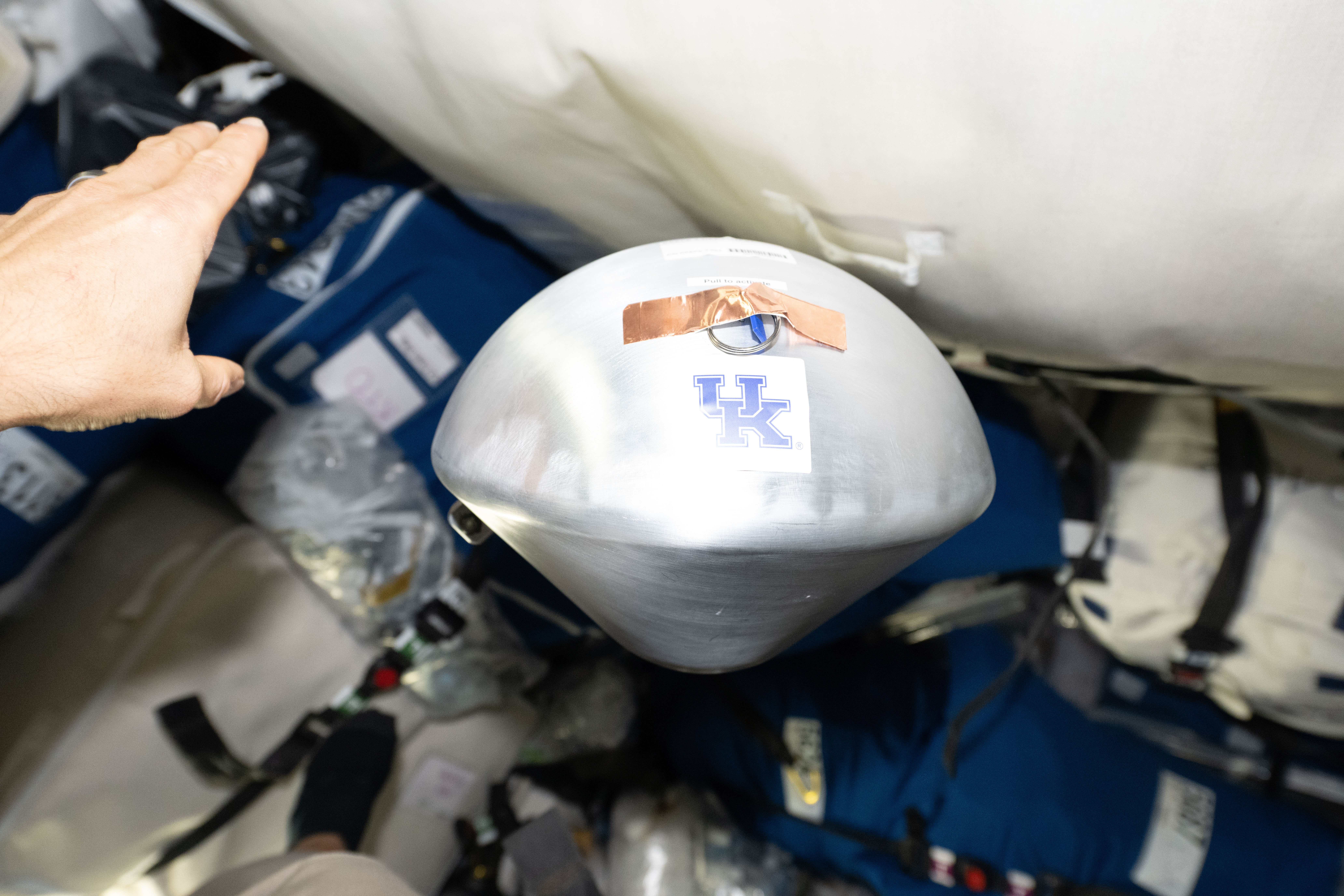
Modified Saab 340, a hybrid-electric aircraft in flight.
A modified Saab 340B aircraft in flight powered in part by a hybrid electric system built by GE Aerospace, along with NASA, BETA Technologies, and Boeing.
GE Aerospace

An aircraft powered by a megawatt-class hybrid-electric engine developed in collaboration with NASA and built by GE Aerospace, demonstrated flight of an innovation that can inform new generations of fuel-saving aircraft power systems.

Mounted to a Saab 340B aircraft, the engine flew at Farnborough International Air Show in the United Kingdom. It was the public debut of a system that has in recent months made historic test flights, becoming the first hybrid electric-powered aircraft to fly above 30,000 feet.

“This achievement reflects what NASA does best in aeronautics: we explore bold possibilities, validate them through rigorous research and testing, and work with industry to turn breakthrough ideas into technologies that bring real value for the American people,” said Laurie Grindle, director of the Aeronautics Division within the agency’s Research and Technology Mission Directorate at NASA Headquarters in Washington.

The testing leveraged work done through NASA’s former Electrified Powertrain Flight Demonstration project and the agency’s ongoing Subsonic Vehicle Technologies and Tools project – years of collaborative research that included key testing at NASA test facilities. 

The engine integrates electric motors, a gas turbine, and energy storage capabilities. It was designed to demonstrate the capacity to power an aircraft around the size of a regional-class jet, reducing fuel burn and costs without sacrificing performance. The unit’s technology and designs are expected to be used to help develop future hybrid systems that could lower airline operating costs. 

The demonstration flight came after years of rapid development for the technology. For NASA, it also validates work that stretches back to a time when hybrid aviation propulsion seemed almost beyond the horizon of possibility.

This achievement reflects what NASA does best in aeronautics: we explore bold possibilities, validate them through rigorous research and testing, and work with industry to turn breakthrough ideas into technologies that bring real value for the American people.

LAURIE A. GRINDLE

LAURIE A. GRINDLE

Director of the Aeronautics Division within the agency's Research and Technology Mission Directorate

“This is the culmination of more than 15 years of work, and we did that because it’s going to have an impact for aircraft that will help reduce energy use and help U.S. companies and the public,” said Ralph Jansen, aerospace engineer at NASA’s Glenn Research Center in Cleveland. “It’s about having a vision that no one believes can happen and then doing the work to define and execute the research and development needed to make it happen.”  

This accomplishment was possible because of the collaborative effort of hundreds of people working on Electrified Powertrain Flight Demonstration and Subsonic Vehicle Technologies and Tools projects across NASA centers, in conjunction with GE Aerospace and its partner companies.

Hybird-Electric Evolves

In recent years, aviation has seen a boom in small aircraft and drones powered by electrical systems drawing from batteries. But large passenger and cargo planes require complex engines capable of supplying massive amounts of power. So more than a decade ago when NASA began contemplating hybrid systems, just the possibility of using electric motors to supplement some energy was a daunting engineering challenge. 

NASA spent about seven years performing preliminary research, working with small businesses and other partners to consider technological obstacles and the potential commercial viability of hybrid systems. During that time, the agency addressed several barriers to implementation including the power, thermal, and battery technology, and the integration of the power system, engine, and aircraft.

Through the agency’s Electrified Powertrain Flight Demonstration award, GE Aerospace and NASA worked with researchers to develop lighter and more efficient power systems and shrink key components – sometimes dramatically. 

NASA and GE Aerospace also leveraged agency facilities and resources to further their research. In 2022, GE Aerospace tested an integrated version of its propulsion system at NASA’s Electric Aircraft Testbed at the agency’s Neil A. Armstrong Test Facility in Sandusky, Ohio. Testing allowed the system to operate in conditions simulating 45,000 feet in altitude, the range in which commercial single-aisle aircraft fly. 

The team added components, including electric motors, power converters, propellers, and a GE Aerospace commercial engine, followed by more ground tests and eventual flight tests. For the researchers who’d spent years on the concept, seeing the engine powering an aircraft in flight was a major step in a long journey.

“I’ve got to say, I was pretty touched seeing it fly. It was just awesome,” Jansen said.  “It’s just like a regular plane, which is probably the best thing of all.”

NASA’s current support for this research is through the Aeronautics Division of its Research and Technology Mission Directorate.

New NASA Earth Missions Gear Up to Start Science Flights  

2026-07-20 18:25

6 Min Read

New NASA Earth Missions Gear Up to Start Science Flights  

Satellite imagery captured wildfires burning hot enough to generate pyrocumulonimbus clouds north of Lake Superior in July 2026. NASA aircraft will help scientists study the powerful storms as they develop.

Credits:
CSU/CIRA & NOAA

Landslides in Alaska. Air quality in Atlanta. Fire clouds out West. From the Arctic fringes to farm country, NASA’s newest class of suborbital Earth Venture missions is gearing up to deliver science that will benefit communities in the United States and beyond. 

The six projects will mobilize hundreds of scientists and pilots from NASA, the U.S. Navy, universities, and other institutions over the next several years. While the investigations range across topics, a defining feature of suborbital missions is the use of sensors mounted on aircraft. 

Airborne remote sensing serves as a bridge between ground-based instruments and satellites. Data collected via planes, helicopters, drones, and balloons can fill in gaps in computer models used by weather forecasters, city planners, and others.  

When wildfires create their own weather 

The first project to take wing this summer is Injected Smoke and PYRocumulonimbus Experiment (INSPYRE), led by the Naval Research Laboratory. From mission headquarters in Colorado, the team will chase one of the least understood forms of severe weather on Earth: towering “fire clouds” generated when extreme wildfires burn hot enough to brew their own thunderstorms.  

Pyrocumulonimbus clouds crackle with lighting in imagery captured over Utah and Colorado by the GOES-18 satellite in early July 2026.
CSU/CIRA & NOAA

Smoky and crackling with lightning, these unique storms can create blind spots for aviators above and spark new blazes below. Measuring and mapping the dangerous storms as they develop in real-time will help scientists forecast them in the future. Several aircraft, including NASA’s high-altitude ER-2, flying out of Montana, will carry a large suite of instruments over wildfire-generated storm systems. Among them will be two state-of-the-art infrared wildfire trackers, which were developed at NASA’s Jet Propulsion Laboratory (JPL) in Southern California and will be flying as part of the agency’s FireSense program.  

Testing the air over farmland, megacities 

Agricultural emissions represent an important and understudied part of Earth’s land and atmosphere systems. The FarmFlux mission, which kicks off this year, will deploy more than a dozen sensors to measure ozone, methane, ammonia, particulates, and other pollutants rising from agricultural lands and animal farms stretching from the Midwest to California’s Central Valley. These emissions affect human health, global climate, and stratospheric ozone. The mission is led by NASA’s Goddard Space Flight Center in Greenbelt, Maryland, along with Colorado State University, and Boston University. 

A Boeing 777 wide-body twin-engine aircraft looms on a taxiway, viewed directly from the front.
NASA’s 777 aircraft is gearing up to start science flights. Structural modifications – like enlarged cabin windows and instrument portals – have transformed the former passenger plane into a flying laboratory. It’s seen here at Langley Research Center in Hampton, Virginia, in April 2026.
NASA/Ryan Hill

Two North American cities with air quality concerns are Atlanta and Mexico City. But the causes differ, with weather and terrain playing a role. To explore these differences, the Hemispheric Airborne Measurements of Air Quality (HAMAQ) mission will investigate areas of poor air in the two capitals and test how satellite information can help forecasting and mitigation efforts. The team will deploy two aircraft at different altitudes: NASA’s P-3B will fly close to the surface, directly measuring fine particle and gaseous pollutants, while the recently acquired 777 science jet will soar high above, mapping pollution with remote sensors.  NASA’s Langley Research Center in Hampton, Virginia, is leading the mission. 

Fast-changing north 

As the Arctic warms at least twice as fast as the rest of Earth, data collected today can help guide communities on the front lines of change.  

Amid a rugged landscape, a snow-white glacier spills into dark blue water.
Alaska’s glaciers are losing ice and contributing to sea level rise. NASA is tracking the changes from land, air, and space.
NASA

The Snow4Flow campaign, led by the University of Arizona, seeks to measure and model how far and fast glaciers are retreating in the far north. Traversing remote icescapes across Alaska, the Yukon, Arctic Canada, Greenland, and Svalbard, Norway, they’ll sound both the near-surface and frozen depths of hundreds of glaciers while flying over in a modernized WWII-era aircraft outfitted with a scanning laser altimeter and two custom radars. Their observations, combined with satellite data and advanced models of snowfall and glacier flow, will advance our understanding of how glaciers behave in different regions of the Arctic. The mission seeks to uncover not just what these glaciers look like beneath the surface today, but the processes that will drive changes in the future. 

As permafrost thaws, rivers on the doorstep of the Arctic become conveyor belts of carbon and sediment. NASA Goddard, and the City College of New York lead a multidisciplinary team studying how rivers, lagoons, and estuaries across Alaska’s North Slope interact with the Arctic Ocean. The project, called Frontlines of Rapidly Transforming Ecosystems (FORTE) will combine optical and radar measurements from satellites, planes, high-tech research vessels, drones, and underwater autonomous systems to track microscopic marine life, water flow, and chemistry. The team will collaborate with local and tribal communities to sustain observations over time and apply NASA assets to address emerging local needs and decision-making priorities.  

Landslide triggers 

When a slow-moving landslide in California suddenly collapsed and buried a section of coastal highway in 2017, scientists at NASA JPL wanted to know how precipitation swings played a role. JPL studies how water infiltrates and destabilizes hillslopes all over the world. The Landslide Change Characterization Experiment (LACCE) project will combine airborne synthetic aperture radar with land-based sensors to track how slopes in California are responding to a world of intensifying droughts and downpours. The project also takes aim at emerging landslide hazards in Alaska, where rapidly retreating glaciers are accelerating slope movements that have the potential to create mega-tsunamis.  

This series of images shows the collapse of the Mud Creek landslide in May 2017 along the Big Sur coast in Central California, and the subsequent repairs to Highway 1, which was damaged during the event.
Andy Ritchie/USGS Pacific Coastal and Marine Science Center

NASA’s Earth Venture Suborbital program, designed to be nimble and high impact, was established following a recommendation by the National Research Council in 2007. In the decades since, teams have studied phenomena, including blizzards, coral reefs, and ocean whirlpools.  

About the Author

Sally Younger

Share

Details

Last Updated

Jul 20, 2026

From Hampton to Mars: How NASA Langley Helped Land on the Red Planet

2026-07-20 15:47

3 min read

Preparations for Next Moonwalk Simulations Underway (and Underwater)

This historic image — the first from the surface of Mars
This historic image — the first from the surface of Mars — confirmed that NASA’s Viking 1 lander had become the first spacecraft to touch down on the Red Planet on July 20, 1976.
NASA/JPL-Caltech

Fifty years ago, NASA’s Viking 1 and 2 landers made the first successful landings on Mars, opening a new era in planetary exploration. Behind that achievement was a team at NASA’s Langley Research Center in Hampton, Virginia, whose steady leadership and technical expertise helped turn an ambitious idea into a mission that reshaped how we explore other worlds.

Building the Blueprint for Mars

NASA selected Langley in 1968 to lead the massive Viking project, the first U.S. mission designed to land safely on Mars and search for signs of life. Project Manager James S. Martin Jr. set the tone from the start. He wanted clear priorities, tough engineering reviews, and the discipline to test every system until the team was confident it would perform on Mars.

A full-scale Viking model is suspended in the air at NASA Langley's Landing and Impact Research Facility.
A full-scale Viking model is suspended in the air at NASA Langley’s Landing and Impact Research Facility.
NASA

Entry, Descent, and Landing

Langley engineers faced a challenge unlike anything attempted before: slowing a spacecraft plunging into the Martian atmosphere at more than 10,000 miles per hour. So they leaned into their expertise in atmospheric entry aerodynamics, heat shielding, and parachute technology. Their work produced the protective aeroshell and heat shield, as well as the supersonic parachute. These systems didn’t come from theory alone — they were shaped by years of wind‑tunnel tests, analysis, and problem‑solving. Langley still excels at entry, descent, and landing systems today.

Science and Safety, Hand in Hand

Langley also helped create a new approach to finding safe landing sites. Teams combined images from Viking’s orbiters with radar data from Earth‑based observatories to identify regions that balanced scientific value with engineering safety — a method now standard for Mars missions.

Viking also changed how mission teams operated. Engineers and scientists adopted the sol — a Martian day slightly longer than 24 hours — to keep daily work aligned with local time on Mars, a practice still used for surface missions.

From left to right, Dr. Thomas Mutch, Brown University, James Martin, Viking Project manager; and Dr. Gerald Soffen, Viking Project scientist talk at a Viking Science Review.
NASA

A Mission Reborn: From Voyager to Viking

Viking grew out of a pivotal program shift. The earlier Voyager Mars lander concept was canceled because it was too costly and risky, relying on two large landers stacked on a single Saturn V rocket. Langley helped chart a more realistic path forward, pairing each lander with its own orbiter and using Titan IIIE‑Centaur rockets instead. The new design preserved scientific ambition while making the mission achievable.

A Legacy That Endures

Viking provided an early model for how NASA could explore the solar system: scout with orbiters, certify landing sites with real data, and land only with systems tested well beyond their limits. That “planetary playbook,” shaped heavily by Langley, provided a guide for future Mars missions like Curiosity and Perseverance.

The two landers returned thousands of images and groundbreaking data, revealing Mars as a world with weather, geologic history, and complexity that scientists are still studying today. And while no human has ever set foot on the Martian surface, Viking proved that reaching another planet — and working on it ­­— was within reach.

As the 50th anniversary of those landings arrives, Langley’s influence is unmistakable. The center continues to advance new entry, descent, and landing technologies, and explore concepts that will support future human explorers. The same spirit that guided Viking still drives the work happening in Hampton today — steady, curious, and always looking toward the next horizon.

Famous scientist Dr. Carl Sagan, center, speaks with two other men at a Viking Science Symposium Biology Conference at NASA Langley.
NASA

Share

Details

Last Updated
Jul 20, 2026

Our First View of the Surface of Mars

2026-07-20 15:38

Angular rocks cast long shadows over the finely granulated dust, that dominates that surroundings of one of the Viking 1 lander’s landing pads, seen in the lower right corner.
On the morning of July 20, 1976, roughly 40 minutes after mission controllers received word that the Viking 1 lander had successfully touched down on the surface of Mars, this photo gave us our first view from the surface of another planet.
NASA/JPL

“Touchdown, we have touchdown!” At 5:12 a.m. PDT, July 20, 1976, mission controllers at NASA’s Jet Propulsion Laboratory erupted in cheers as they learned that the Viking 1 lander had survived its descent through the thin Martian atmosphere. Forty minutes later, the lander’s first image began to appear on their monitors, slowly forming line by line from left to right. For the first time, humans were able to see Mars’s rocky terrain from its surface.

Dr. Thomas Mutch, leader of the Viking lander imaging team, described the moment: “I studied the black screen, waiting for that narrow strip that will signal the first few lines of the first picture. And it appeared. A sliver of electronic magic. Areas of brightness and darkness. The picture begins to fill the screen. Rocks and sand are visible and — finally at the far right — one of the spacecraft foot pads, a symbolic artifact that stamps our accomplishment with the sign of reality. Time and time again I repeat, ‘It’s incredible.’”

Fifty years ago today, the Viking 1 lander became NASA’s first robot to explore Mars’s surface and begin the search for signs of life in our solar system. Viking 1 was joined six weeks later by its twin lander, Viking 2, which explored a different region of Mars, while two mission orbiters that delivered the landers to the Red Planet continued to collect data from space and helped relay communications to Earth.

Learn more about what Viking found and NASA’s legacy of discovery on Mars at Viking: 50 Years on Mars.

Image credit: NASA/JPL

TechCrunch - Latest

Google is working on a new AI chip designed to make Gemini more efficient

2026-07-20 21:21

Alphabet, Google's parent company, is reportedly working on a new chip designed to make its Gemini models run much more efficiently.
AI’s most important protocol is getting a little bit easier to use

2026-07-20 20:50

The Model Context Protocol (MCP) is one of the basic building blocks of AI interoperability, giving AI models a secure way to access external data sources and services. It’s the plumbing that lets a chatbot reach into your calendar, your database, or your internal tools, instead of engineers building custom pipes for every connection. Next […]
X relaunches a rebuilt Android app after year-long effort

2026-07-20 19:37

X says the rebuilt version of its Android app is now available globally.
OpenAI is scared of open-weight models. Should the US be?

2026-07-20 19:33

Talk of banning Chinese-made open-weight LLMs reveals the challenge of turning AI into a business.
Natural raises $30M to reinvent payments for AI agents — and take on Stripe

2026-07-20 19:11

The one-year-old startup aims to reinvent financial architecture for autonomous AI transactions.
×
Useful links
Home
Definitions Terminologies
Socials
Facebook Instagram Twitter Telegram
Help & Support
Contact About Us Write for Us


8 months ago Category :
Latest Trends and Updates in Testing and Inspection Standards

Latest Trends and Updates in Testing and Inspection Standards

Read More →
8 months ago Category :
In recent years, keeping up with the last trends and updates in tax benefits has become increasingly important for individuals and businesses alike. Understanding and taking advantage of tax benefits can lead to significant savings and financial advantages. Here are some of the latest trends and updates in tax benefits that you should be aware of:

In recent years, keeping up with the last trends and updates in tax benefits has become increasingly important for individuals and businesses alike. Understanding and taking advantage of tax benefits can lead to significant savings and financial advantages. Here are some of the latest trends and updates in tax benefits that you should be aware of:

Read More →
8 months ago Category :
Sydney is a vibrant city with a plethora of shopping destinations to cater to every shopper's needs. From high-end luxury boutiques to trendy street markets, there is something for everyone in this bustling metropolis. In this blog post, we'll explore some of the latest trends and updates in Sydney's shopping scene.

Sydney is a vibrant city with a plethora of shopping destinations to cater to every shopper's needs. From high-end luxury boutiques to trendy street markets, there is something for everyone in this bustling metropolis. In this blog post, we'll explore some of the latest trends and updates in Sydney's shopping scene.

Read More →
8 months ago Category :
The Sydney real estate market has been a hot topic of discussion recently, with several key trends and updates shaping the current landscape. Let's take a closer look at some of the most significant developments impacting the market.

The Sydney real estate market has been a hot topic of discussion recently, with several key trends and updates shaping the current landscape. Let's take a closer look at some of the most significant developments impacting the market.

Read More →
8 months ago Category :
Sydney Hotels: Latest Trends and Updates

Sydney Hotels: Latest Trends and Updates

Read More →
8 months ago Category :
Sydney Business Trends and Updates in 2021

Sydney Business Trends and Updates in 2021

Read More →
8 months ago Category :
Sudanese Music: Latest Trends and Updates

Sudanese Music: Latest Trends and Updates

Read More →
8 months ago Category :
Sudanese culture is rich and diverse, drawing from centuries of history and a blend of various ethnicities, languages, and traditions. In recent years, there have been some fascinating trends and updates within Sudanese culture that are worth exploring.

Sudanese culture is rich and diverse, drawing from centuries of history and a blend of various ethnicities, languages, and traditions. In recent years, there have been some fascinating trends and updates within Sudanese culture that are worth exploring.

Read More →
8 months ago Category :
Sudanese cuisine is a vibrant and diverse culinary tradition that reflects the country's rich history and cultural influences. In recent years, Sudanese cuisine has been gaining popularity worldwide, with a growing number of restaurants and food bloggers showcasing the delicious flavors and unique dishes of this African nation.

Sudanese cuisine is a vibrant and diverse culinary tradition that reflects the country's rich history and cultural influences. In recent years, Sudanese cuisine has been gaining popularity worldwide, with a growing number of restaurants and food bloggers showcasing the delicious flavors and unique dishes of this African nation.

Read More →
8 months ago Category :
Sudanese Business Trends and Updates: A Look into the Latest Developments

Sudanese Business Trends and Updates: A Look into the Latest Developments

Read More →