📰 Trending Topics
Google News - Trending
Google News - Technology
Goodbye, Fire Tablet: Amazon’s New Alexa Tablet Is a Flashy Portable Entertainment Hub - CNET
2026-10-08 15:12
- Goodbye, Fire Tablet: Amazon’s New Alexa Tablet Is a Flashy Portable Entertainment Hub CNET
- Amazon overhauls aging devices lineup with higher-priced Alexa tablet, dumping the budget Fire CNBC
- Amazon Launches New Tablets. Alexa+ Is the Bigger Deal. Barron's
- Amazon’s new Alexa Tablets drop the Fire branding but are more Android than ever Ars Technica
- Amazon Overhauls Tablet Line By Going After Apple’s High-End iPads Bloomberg.com
Apple Product Launch Announced for October 13: 'Welcome Home' - MacRumors
2026-10-08 16:04
- Apple Product Launch Announced for October 13: 'Welcome Home' MacRumors
- Apple to Launch Doorbell, Lock, Thermostat Developed With LG Bloomberg.com
- Apple Reportedly Partners With LG Electronics To Enter Smart Home Device Market Yahoo Finance
- 4 big announcements coming at Apple’s Welcome Home event Macworld
- What to expect from Apple's October 13 'Welcome home' releases AppleInsider
Microsoft releases new Nvidia-chip AI PCs with revamped Windows 11 - TechCrunch
2026-10-07 20:22
- Microsoft releases new Nvidia-chip AI PCs with revamped Windows 11 TechCrunch
- Microsoft to sell $2,599 Surface Laptop Ultra containing Nvidia AI chip CNBC
- The tech industry wants you to run AI models at home, but it’s not for everyone Yahoo Finance
- NVIDIA, Microsoft Kick Off a New Beginning for Windows PCs With RTX Spark and AI Agents NVIDIA Blog
- Building Windows for hybrid intelligence Windows Blog
Google is launching a one-stop Gemini agent for your work tasks - The Verge
2026-10-08 14:28
- Google is launching a one-stop Gemini agent for your work tasks The Verge
- Google Launches ‘Universal’ Gemini AI Agent for Workplace Bloomberg.com
- Google Cloud introduces the Gemini agent. blog.google
- Google Cloud unveils persistent Gemini Agents for long-running tasks, and they get their own Gmail, Calendar, and Drive storage VentureBeat
- I tested Google's new Gemini Windows app; it turns out Mac users got all the best features Android Police
AirPods 5 vs. AirPods Pro 3: I’ve Listened to Both Earbuds, and This Pair Wins - CNET
2026-10-08 12:00
- AirPods 5 vs. AirPods Pro 3: I’ve Listened to Both Earbuds, and This Pair Wins CNET
- Ode to the AirPods 5 Spyglass
- AirPods Pro 3 vs AirPods Pro 2: Three reasons to upgrade 9to5Mac
- Apple AirPods 5 offers the best noise cancellation yet on open earbuds, and better sound to match Telegraph India
- The AirPods 5 are Apple's most repairable earbuds ever with a score of 2/10. Great success! PhoneArena
NASA - Breaking News
NASA’s SpaceX Crew‑12 Splashes Down, Sets Briefing to Discuss Mission
2026-10-08 17:02

After more than seven months aboard the International Space Station, NASA’s SpaceX Crew-12 mission safely splashed down Thursday in the Pacific Ocean off the coast of Los Angeles. The crew members will discuss their science mission during a news conference at 3:30 p.m. EDT, Thursday, Oct. 15, at the agency’s Johnson Space Center in Houston.
“Jessica, Jack, Sophie, and Andrey spent 237 days living and working in orbit, traveled more than 100 million miles, advanced important science, and returned safely home because of the extraordinary expertise and competence of thousands across NASA, SpaceX, and our international partners,” said NASA Administrator Jared Isaacman. “Building the capability, experience, and confidence to do this repeatedly is exactly what will allow us to go farther, and I am grateful to Crew-12 and their families for their service to humanity’s greatest adventure.”
NASA astronauts Jessica Meir and Jack Hathaway, ESA (European Space Agency) astronaut Sophie Adenot, and Roscosmos cosmonaut Andrey Fedyaev returned to Earth at 8:34 a.m. PDT. Teams aboard SpaceX recovery vessels retrieved the spacecraft and its crew shortly after. Following standard postflight medical screenings, the crew will fly to shore before returning to NASA’s Johnson Space Center in Houston.
“NASA’s activities supporting the International Space Station — transporting crew, conducting impactful research, and maintaining critical national assets — enable the science, engineering, and risk‑reduction needed for future missions across the solar system,” said Dana Weigel, manager of NASA’s Low Earth Orbit Program at the agency’s Johnson Space Center. “We’re grateful for the dedication across the human spaceflight team that makes this possible, and we’re thrilled to welcome Jessica, Jack, Sophie, and Andrey home.”
During their 237-day mission, the four crew members traveled more than 100 million miles and completed more than 3,792 orbits around Earth. The mission was the second for Meir and Fedyaev and the first for Hathaway and Adenot. Crew-12 lifted off at 5:15 a.m. EST on Feb. 13 and docked to the orbiting laboratory a day later.
Crew‑12 logged hundreds of hours of scientific research to support human exploration beyond low Earth orbit and advance benefits for people on Earth. The crew members’ work included testing stem cell production for cell‑based therapies, demonstrating on‑demand IV fluid generation for future missions, and studying how the bacteria that causes pneumonia can lead to long‑term heart damage. The crew also conducted nutrition-focused research and examined how physical characteristics may affect blood flow during spaceflight to help keep astronauts safe and healthy on future missions. Research conducted aboard the space station advances knowledge and demonstrates new technologies that enable us to prepare for human exploration of the Moon and Mars.
Meir completed four spacewalks, bringing her career total to seven. That places her third all-time in total spacewalks among women at NASA, behind former agency astronauts Peggy Whitson and Suni Williams. Adenot completed three spacewalks, becoming the first French woman to venture outside the orbital outpost.
United States-based media interested in attending the crew news conference in person with Meir, Hathaway, and Fedyaev, must contact the NASA Johnson newsroom no later than 5 p.m. EDT, Tuesday, Oct. 13, at jsc-newsroom@mail.nasa.gov. Media joining by phone must request dial-in details by 9:30 a.m., Oct. 15. To ask a question, media must join no later than 15 minutes before the start of the news conference. The agency’s media credentialing policy is available online. Adenot will return to Europe and not be available during the news conference.
NASA’s Low Earth Orbit Program provides reliable access to space, maximizing the use of the International Space Station for research and development by partnering with private U.S. companies, including SpaceX, to transport astronauts to and from the space station.
Learn more about NASA’s SpaceX Crew-12 at:
https://www.nasa.gov/commercialcrew
-end-
Joshua Finch / Jimi Russell
Headquarters, Washington
202-358-1100
joshua.a.finch@nasa.gov / james.j.russell@nasa.gov
Sandra Jones / Joseph Zakrzewski
Johnson Space Center, Houston
281-483-5111
sandra.p.jones@nasa.gov / joseph.a.zakrzewski@nasa.gov
Steven Siceloff
Kennedy Space Center, Florida
321-867-2468
steven.p.siceloff@nasa.gov
NASA, Energy Department Advance New Era of Nuclear-Powered Exploration
2026-10-08 15:46
As the Golden Age of deep-space exploration begins, NASA and the U.S. Department of Energy are advancing the development of safe, reliable, next-generation nuclear technologies for space.
Together, the agencies will supercharge civil space exploration, unlock bold scientific discovery, and solidify American leadership in space nuclear power and propulsion.
“We are entering the ‘Nuclear NASA-era,’ which represents a major transformation for space exploration,” said NASA Administrator Jared Isaacman. “Nuclear power will allow us to go farther, operate longer, and field more capable spacecraft and instruments than ever before. The work we’re doing today is laying the foundation for the fission-powered spacecraft of tomorrow and opening an entirely new frontier for exploration and discovery.”
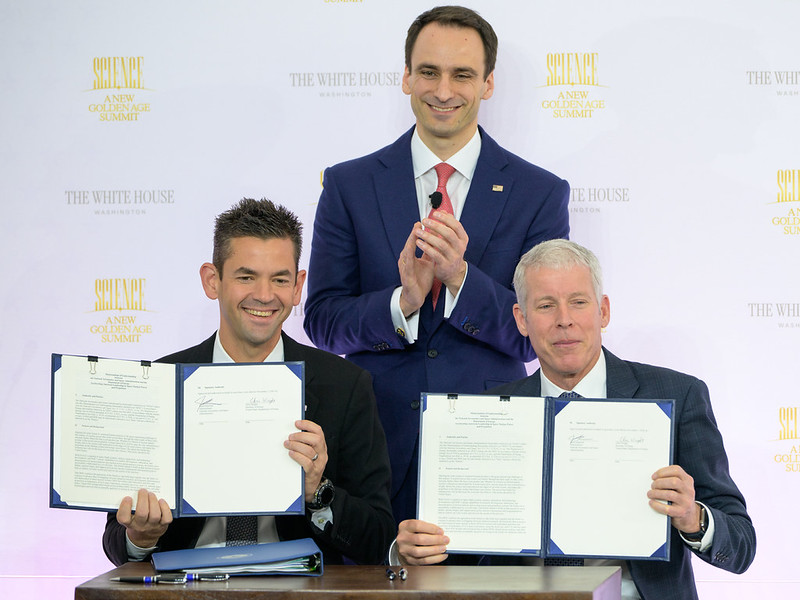
The new Memorandum of Understanding, “Accelerating American Leadership in Space Nuclear Power and Propulsion,” was signed Thursday between NASA and DOE, and establishes a framework for end-to-end collaboration. The agreement unites both agencies across the full spectrum of space nuclear development, spanning advanced research and fuel production to rigorous testing, launch integration, and operations. Across all these efforts, an uncompromising commitment to safety remains the central pillar.
The signing took place between Isaacman and U.S. Secretary of Energy Chris Wright during the Golden Age Summit, hosted by the Office of Science and Technology Policy at the Donald J. Trump Institute of Peace in Washington, and is effective Sunday, Nov. 1.
“Thanks to President Trump, America’s nuclear renaissance is reaching a new frontier,” said Wright. “The Energy Department is proud to partner with NASA as we help American space missions reach uncharted territory.”
President Trump’s December 2025 Executive Order on Ensuring American Space Superiority directs NASA to develop a launch-ready lunar surface reactor by 2030, a goal toward which NASA, partnering with DOE, is making steady progress. This pivotal agreement fortifies existing collaborations on fission and radioisotope power systems, propelling NASA’s vision for a sustained human presence on the Moon and accelerating the breakthrough technologies to enable our mission.
When NASA’s Space Reactor‑1 Freedom launches in 2028, nuclear propulsion will advance from laboratory research to operational deep‑space application. This milestone paves the way for Lunar Reactor‑1, the fission surface power system that will sustain the future Moon Base through darkness and shadow. Nuclear power will energize habitats, communications, instruments, rovers, resource usage, and critical lunar infrastructure, and it will be essential for the demanding energy needs of future Mars missions.
Together, SR‑1 and LR‑1 form the foundation of a robust domestic nuclear‑space industrial base. These programs are poised to power permanent lunar outposts, enable exploration of distant worlds, and cement American leadership in space for generations. These endeavors will expand humanity’s reach toward Mars, reinforce American preeminence in deep space, and pioneer innovative technologies that yield benefits here on Earth.
In addition to fission power, NASA continues to expand its use of radioisotope power systems. The Dragonfly mission to Saturn’s moon Titan, scheduled for launch in 2028, will rely on a Multi‑Mission Radioisotope Thermoelectric Generator and 24 Light Weight Radioisotope Heater Units to power and warm the car‑sized rotorcraft. Dragonfly will fly to various locations on Saturn’s moon Titan and investigate the moon’s habitability.
NASA and DOE additionally plan to support ESA’s (European Space Agency) Rosalind Franklin Mars rover studying the potential for past and current life on the Red Planet, by providing 24 similar heater units to maintain instrument temperatures in the extreme cold of the Martian environment.
To learn about Nuclear NASA, visit:
-end-
Camille Gallo / Elizabeth Shaw
Headquarters, Washington
202-358-1600
camille.m.gallo@nasa.gov / elizabeth.a.shaw@nasa.gov
NASA Advances LISA Mission Contributions With New Test Telescope
2026-10-08 15:31
3 min read
NASA Advances LISA Mission Contributions With New Test Telescope
NASA has taken the next step in the process of developing a new all-glass telescope for the LISA (Laser Interferometer Space Antenna) mission, a space observatory designed to detect ripples in space-time called gravitational waves.
L3Harris Technologies will design, assemble, and integrate the new telescope for NASA. Called the Engineering Test Unit, this contribution represents a final step toward the future production of flight hardware.
Led by ESA (European Space Agency), the LISA mission is slated for launch in the mid-2030s. As a collaborative partner, NASA is contributing the telescopes, other critical hardware, and engineering and scientific support as part of its mission to better understand how the universe works.
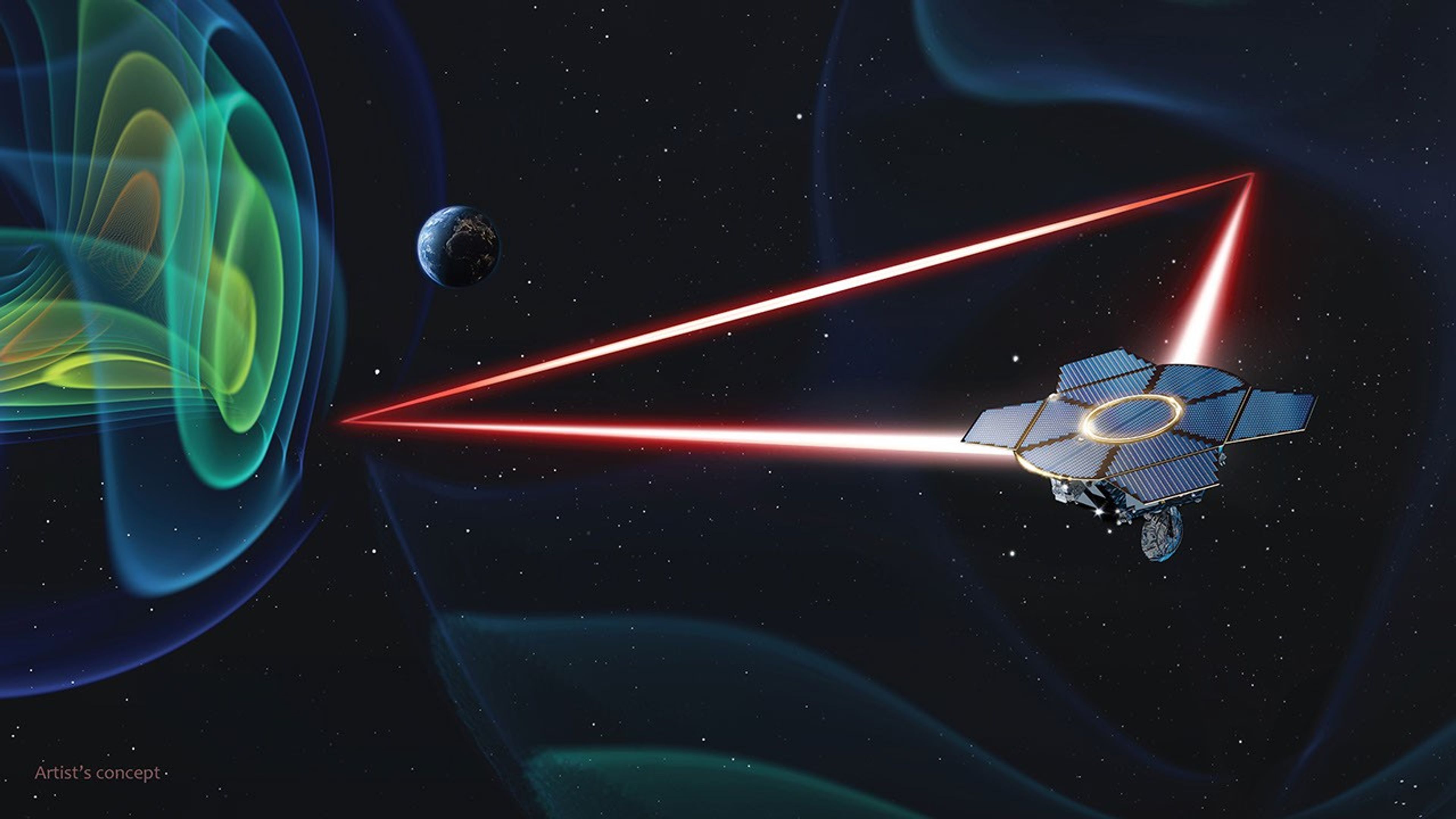
The LISA mission will deploy a trio of satellites into an Earth-following orbit, creating a vast triangular array stretching 1.6 million miles (2.5 million kilometers) on each side. Each satellite will include two telescopes that will use infrared laser beams to simultaneously transmit and receive signals between adjacent spacecraft. Through these telescopes, the spacecraft will measure miniscule changes in their relative distances, the signals of passing gravitational waves.
“These changes are tiny, smaller than the width of a helium atom, but through them LISA will reveal a sea of low-frequency gravitational waves that we cannot currently detect through facilities on Earth,” said Ira Thorpe, the NASA project scientist for the mission at the agency’s Goddard Space Flight Center in Greenbelt, Maryland. “The LISA mission will be able to detect mergers of monster black holes billions of light-years away, map compact pairs of white dwarfs, neutron stars, and stellar-mass black holes in our own cosmic backyard, and perhaps provide new insights into gravity itself.”
Each telescope will be entirely made of an amber-colored ceramic-glass composite called Zerodur, which is widely used in high-precision applications because it resists changes in shape across a wide range of temperatures. In 2024, L3Harris delivered a prototype telescope to NASA that served as an engineering development unit for this next step.

“We’ve put the prototype through rigorous testing, and we’re bringing everything we’ve learned into this new telescope,” said Ritva Keski-Kuha, lead for the LISA Telescope program at NASA Goddard. “This will be our last pre-flight unit and our first optical telescope delivery to ESA.” Earlier this year, in June, the team delivered a structural model of the telescope made from metal instead of glass.
Gravitational waves were predicted by Albert Einstein’s 1916 general theory of relativity and first detected by ground-based observatories in 2015. The waves form whenever massive objects accelerate, such as two stars in orbit around each other. They flow across space-time, moving at the speed of light, and are unaffected by objects they encounter along the way. These properties make them a valuable tool for probing the cosmos.
Each of the three LISA spacecraft contains a free-floating gold-platinum cube called a proof mass. The spacecraft will fly around the cube and manage its environment so the cube falls through space only under the influence of gravity. In 2016, ESA’s LISA Pathfinder mission showed that it was possible to reduce non-gravitational forces on the proof masses to the level needed for gravitational wave detection.
Additional NASA contributions include the laser system, devices to manage the buildup of electric charge on the proof masses, data analysis for identifying and characterizing individual gravitational wave sources, and additional scientific and engineering expertise.
To learn more about the LISA mission, visit:
Share
Details
Related Terms
Explore More

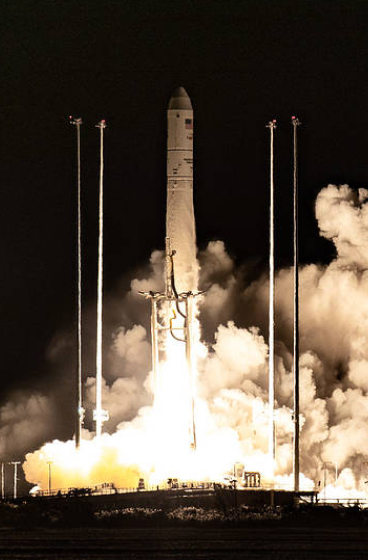
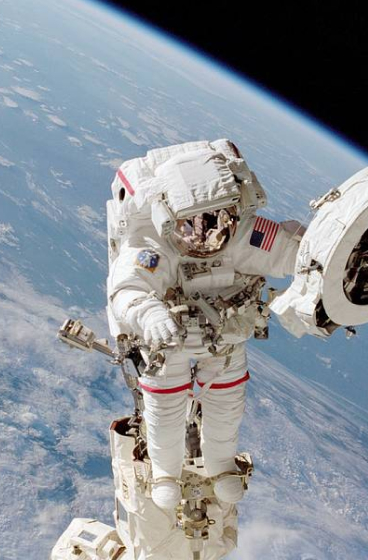

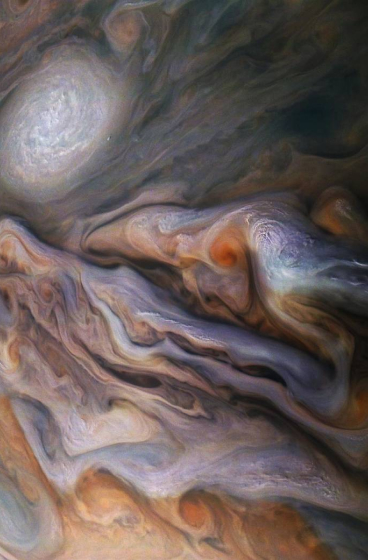
APOD: 2026 October 8 – The Saturn System Smörgåsbord
2026-10-08 04:05
APOD
Astronomy Picture of the Day
Discover the cosmos! Each day a different image or photograph of our fascinating universe is featured, along with a brief explanation written by a professional astronomer.
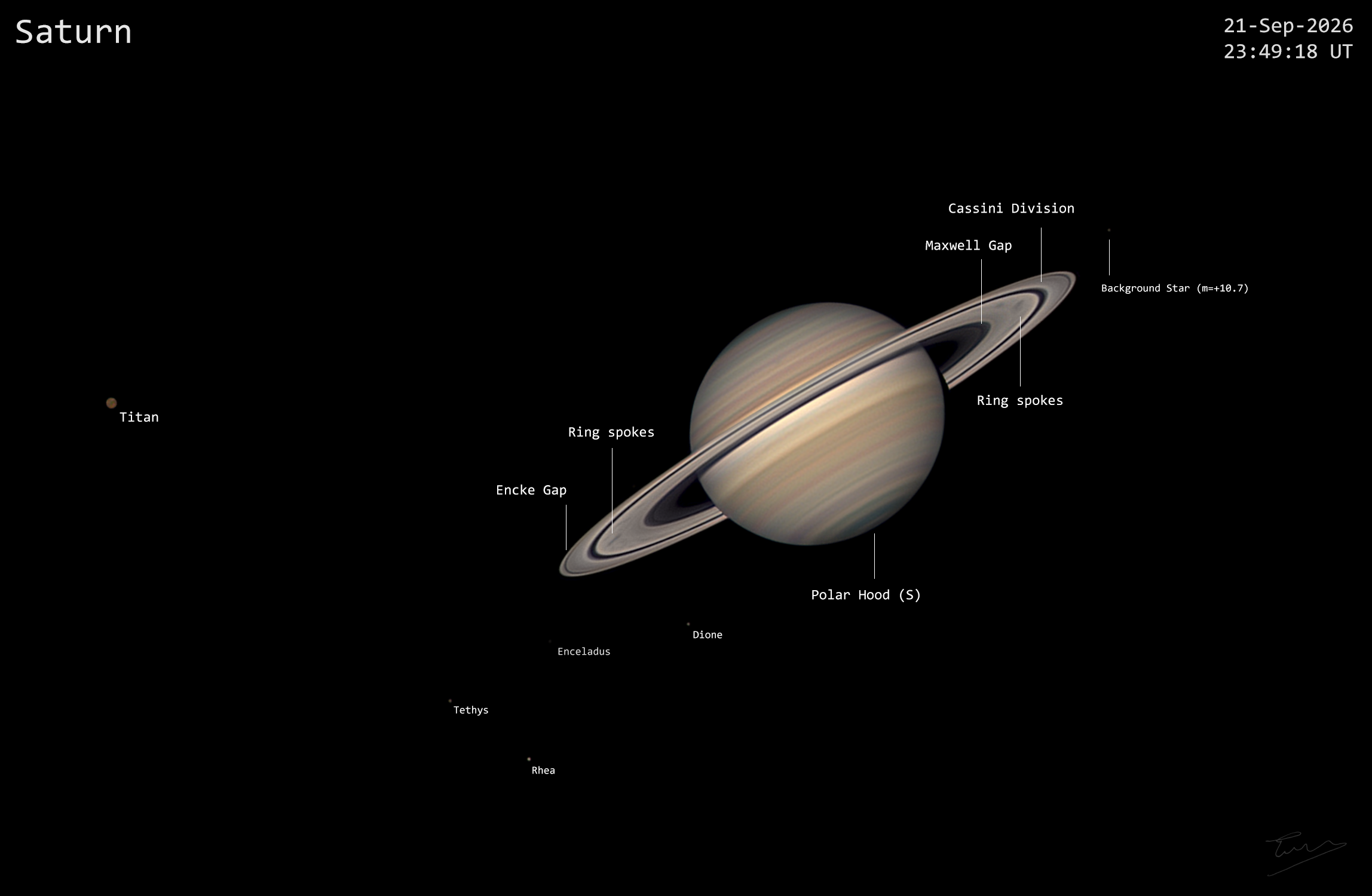
The Saturn System Smörgåsbord
Explanation: How was the Saturn system imaged so clearly? Astrophotographer Tom Williams captured such exquisite details due to one night of exceptional atmospheric conditions above the United Kingdom. This means more than a cloudless sky. Pockets of air at different temperatures and densities move around and bend light as it travels through Earth’s atmosphere, distorting astronomy images. This is called “seeing.” Less atmospheric turbulence means clearer images. The astrophotographer reduced the impact of seeing with the lucky imaging technique: thousands of short-exposure images are taken very quickly with a high-speed camera and the clearest images are added up. Which object in this smörgåsbord interests you? Perhaps Titan or the icy stripes of Enceladus? Maybe the gaps and spokes in Saturn’s rings? Saturn’s opposition, when Earth passes in between the planet and the Sun, occurred on October 4th. Due to the planet’s proximity and full illumination from the Sun, now is a great time of year to observe it!
Tomorrow’s picture: bumpy
| Date: | October 8, 2026 |
|---|---|
| Credit: | Tom Williams |
| Authors & editors: | Keighley Rockcliffe, Robert Nemiroff, Jerry Bonnell, Cecilia Chirenti |
| A service of: |
ASD at NASA / GSFC, NASA Science Activation & Michigan Tech. U. |
Fighting Drought in Texas Cotton Country
2026-10-08 04:01
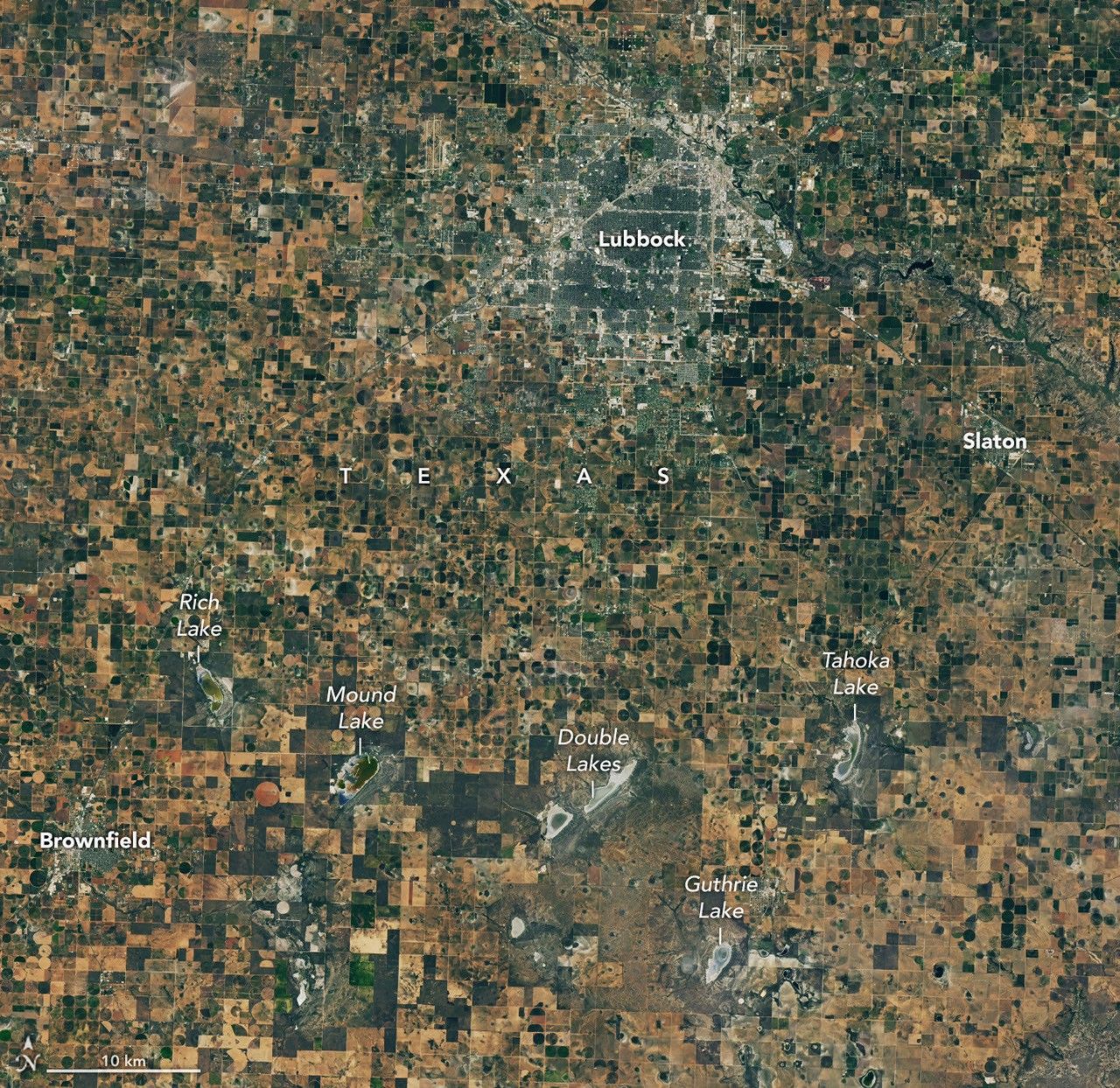

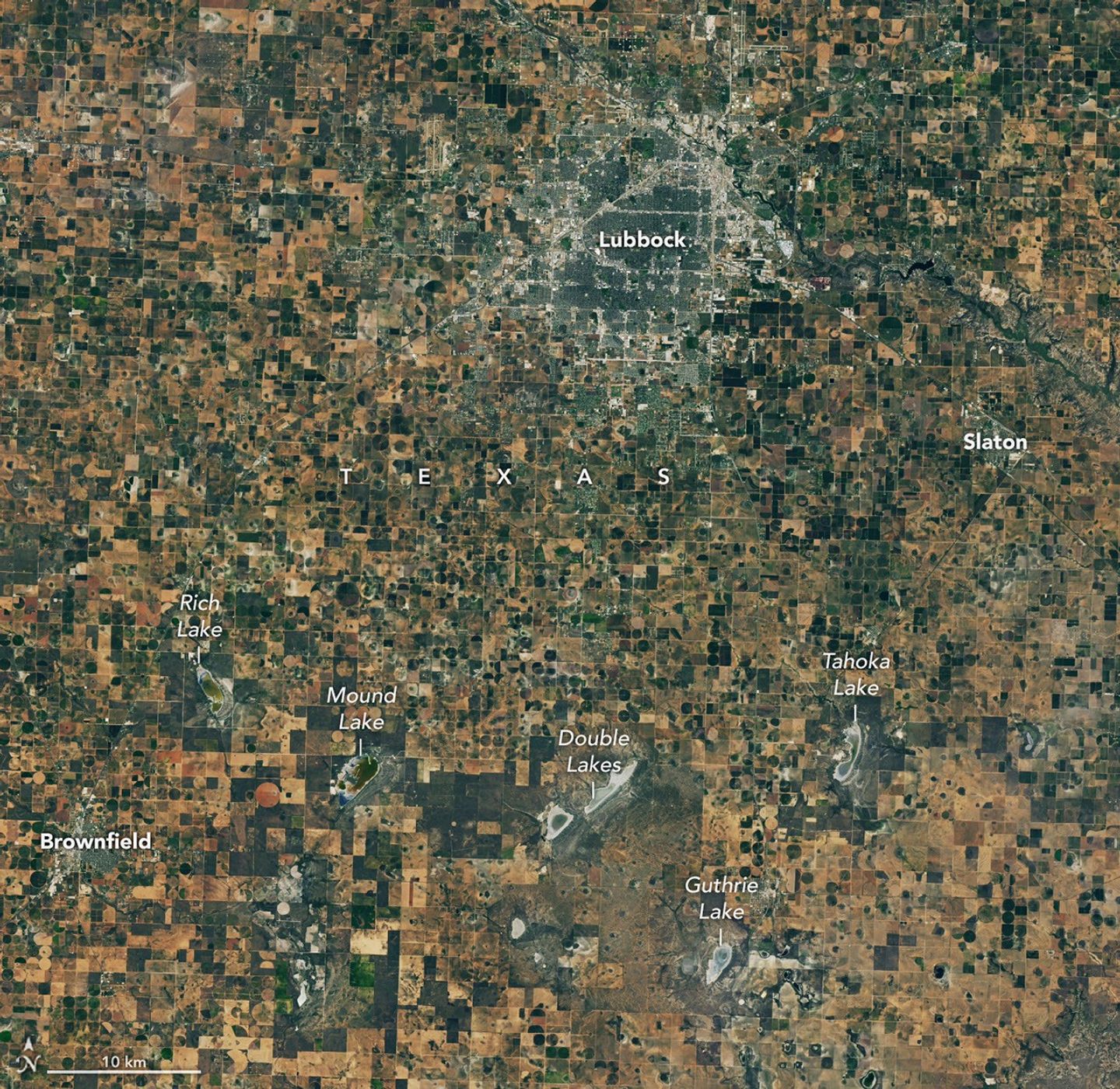

September 22, 2025
September 9, 2026
For many longtime cotton farmers in the Texas High Plains, the 2026 drought sparked flashbacks to catastrophic harvests of the past. Miserably dry seasons forced farmers in America’s largest cotton-producing region to abandon massive portions of their dryland crop, including 72 percent in 2022 and 66 percent in 2011.
But in some ways, farmers felt the drought in 2026 entered new territory. “This is the first year that we’ve had cotton completely die,” said Lacy Cotter-Vardeman, a farmer based in Lubbock County whose family has worked the land there for several generations. “I was just talking to our insurance people, and they said they’d never seen this before,” she said, adding that roughly 90 percent of her dryland cotton was dead.
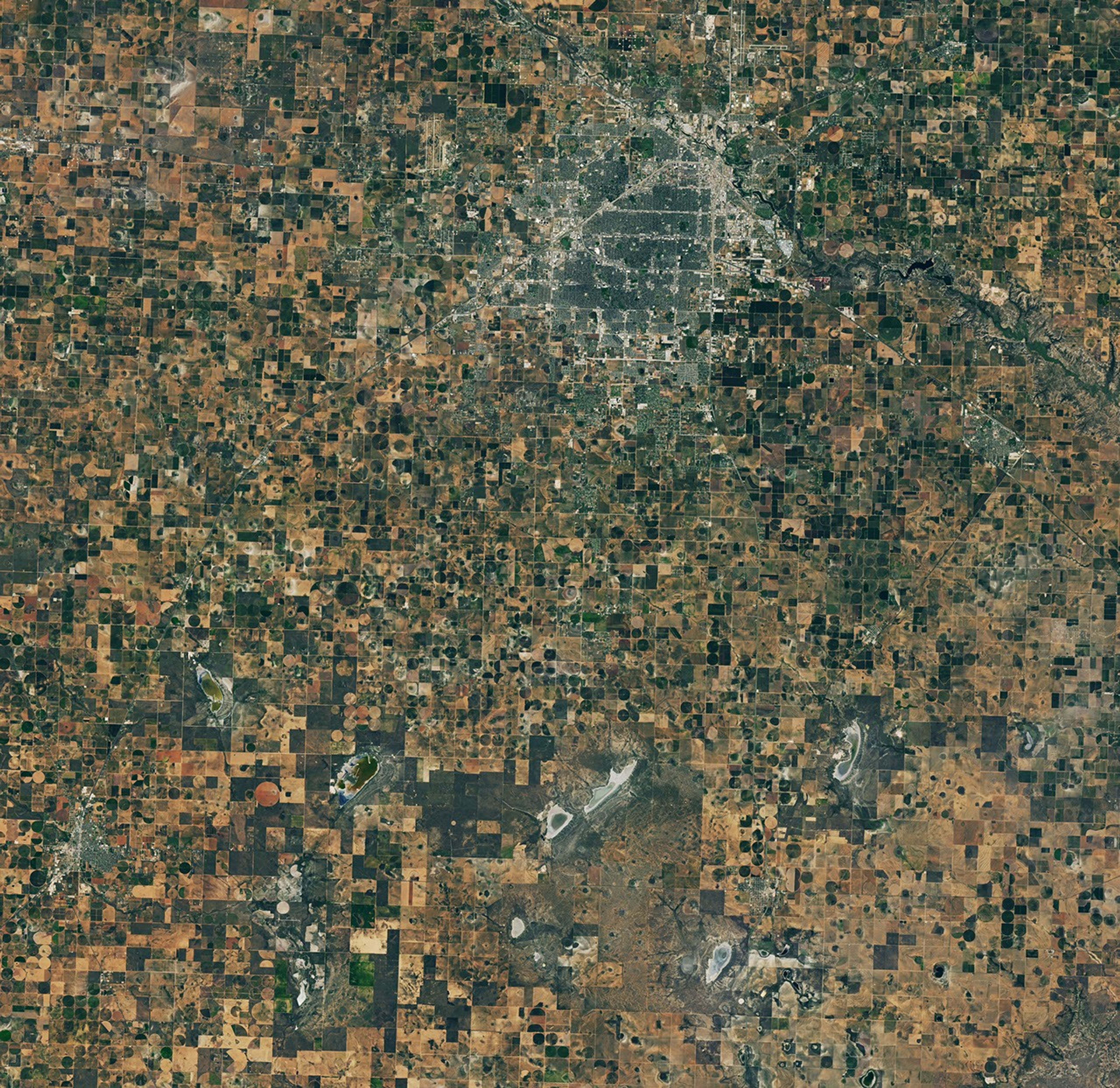
Satellite images highlight the scale of the problem in Lubbock and adjacent counties. Brown, parched crops and vacant plots dominated the landscape on September 9, 2026, when the OLI (Operational Land Imager) on Landsat 8 captured the image above (right). In contrast, much greener landscapes prevailed on September 22, 2025 (left), when the sensor captured an image of the same area during a more typical year with a relatively healthy harvest.
Subtler signs of the drought are also visible. With groundwater growing scarce in the High Plains aquifer, many farmers in the region have started irrigating just one-half or one-third of their center-pivot fields, explained Tillery Timmons-Sims, an agricultural conservationist who owns land in Brownfield, Texas, and used to grow cotton. In the imagery, these appear as green semicircles and quarter circles.
Note also the many shallow water features known as playa lakes—sometimes called mud holes, buffalo wallows, and lagoons—scattered throughout the image. Some, like Double Lakes and Mound Lake, are fairly large, but most of the more than 19,300 playa lakes in the Texas High Plains are quite small, less than 30 acres.
Many of these ephemeral lakes were dry in September 2026, unlike the previous year. Playa lakes are critical in this water-stressed region because the clay-lined features, if active, collect rainfall and provide pathways for water to seep underground and recharge the aquifer below, the region’s primary source of irrigation water. However, about 80 percent are modified by tilling or buried with sediment, and many no longer function that way.
Farmers in this region operate along the eastern margin of the aquifer, which has declined sharply in recent decades. According to U.S. Geological Survey data, the water table across much of Lubbock County has dropped by between 25 and 100 feet since 1950, around when people began drawing large volumes of water from the aquifer to irrigate. Losses have been even more extreme (150 feet or more) in counties to the north, including Parmer, Castro, Swisher, and Briscoe.
The aquifer’s long-term decline, combined with the 2026 drought, left many wells “pumping air” this summer for some of the farmers Timmons-Sims knows. “We simply don’t have groundwater to fall back on anymore,” she said. Many farmers she knows thought that water might run out during the next generation; instead, it’s “happening now,” she said. For Cotter-Vardeman, the problem couldn’t be more tangible. Many of her irrigation wells stopped working in August.
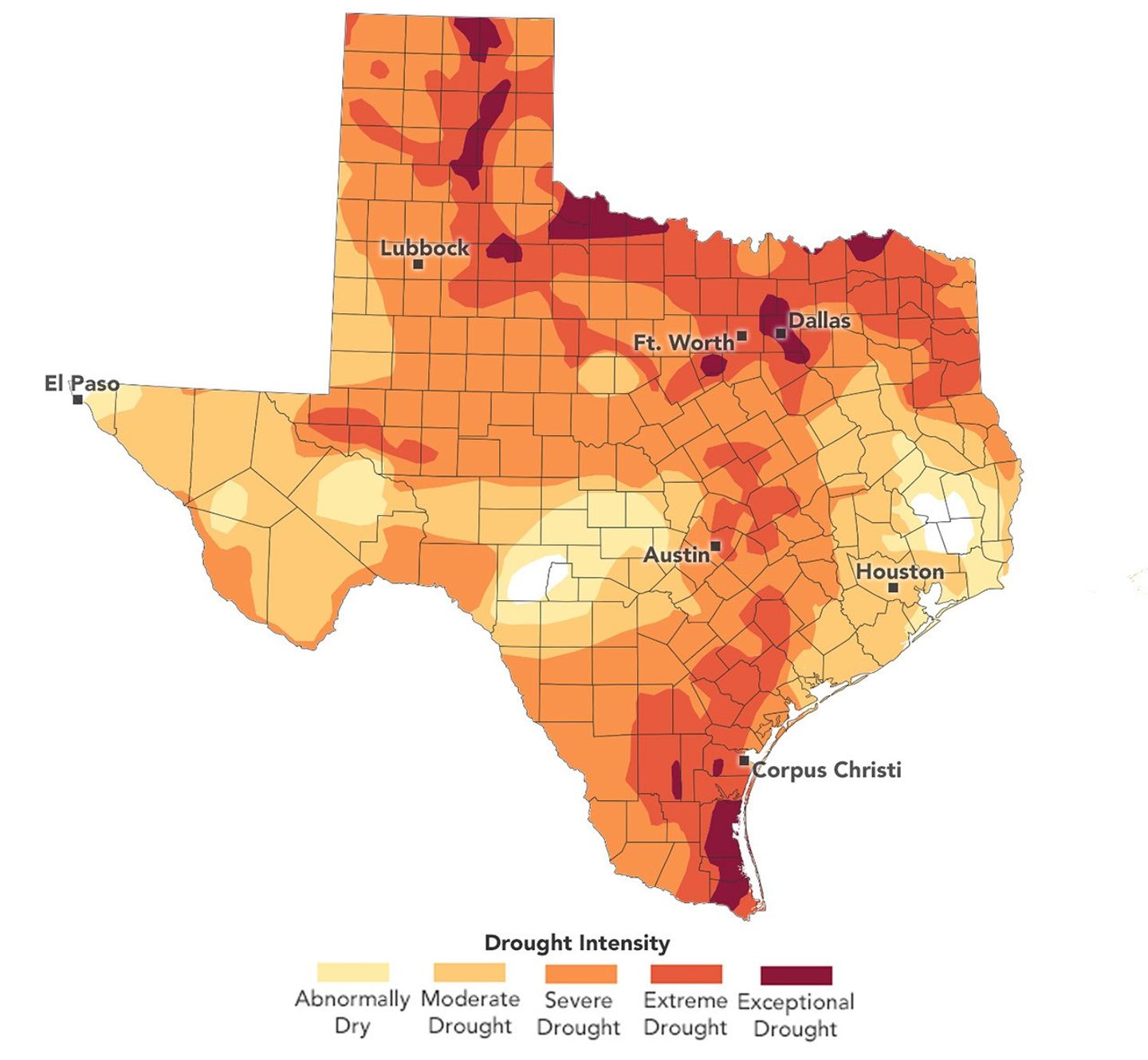
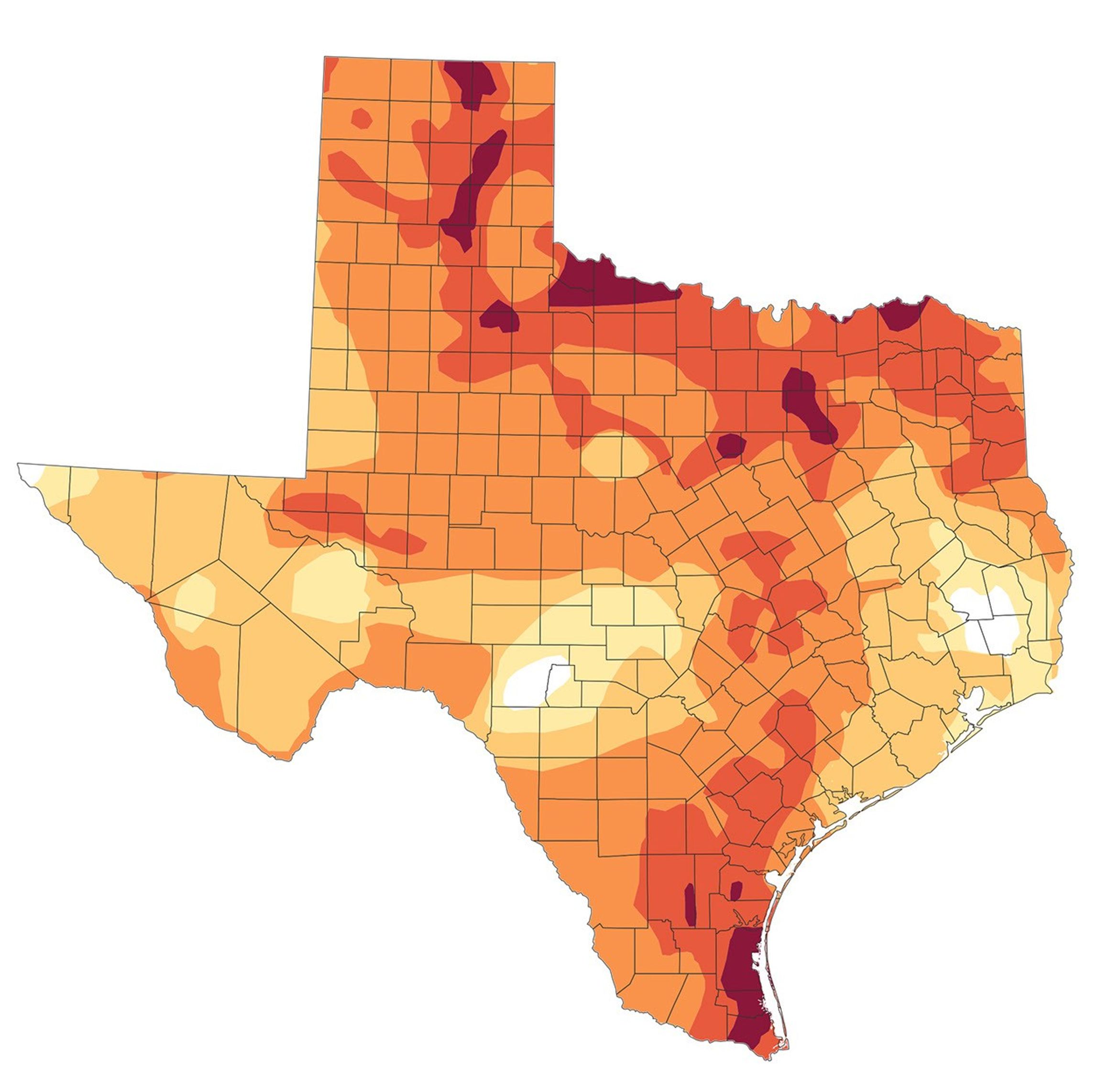
Rains in September and October, aided by a strong El Niño in the Pacific, are bringing needed moisture to the region, but they haven’t been enough, according to analysis from the U.S. Drought Monitor. “It will take about 7 inches of rain over a three-month period to ‘end’ the current drought,” said Jonathan Case, a meteorologist at NASA’s Marshall Space Flight Center and one of the Drought Monitor’s authors.
The deteriorating aquifer is one of the reasons Timmons-Sims stopped farming in 2007. She now spends most of her time searching for ways to keep farms in business, such as converting irrigated croplands to grasslands to earn water credits, developing alternative energy projects, adopting water-efficient techniques, and working with conservation organizations to plan for the long term.
Through that work, the Sandhills Area Research Association, a conservation organization she helps run, partnered with NASA Acres, a research consortium that connects farmers with NASA science to address agricultural challenges.
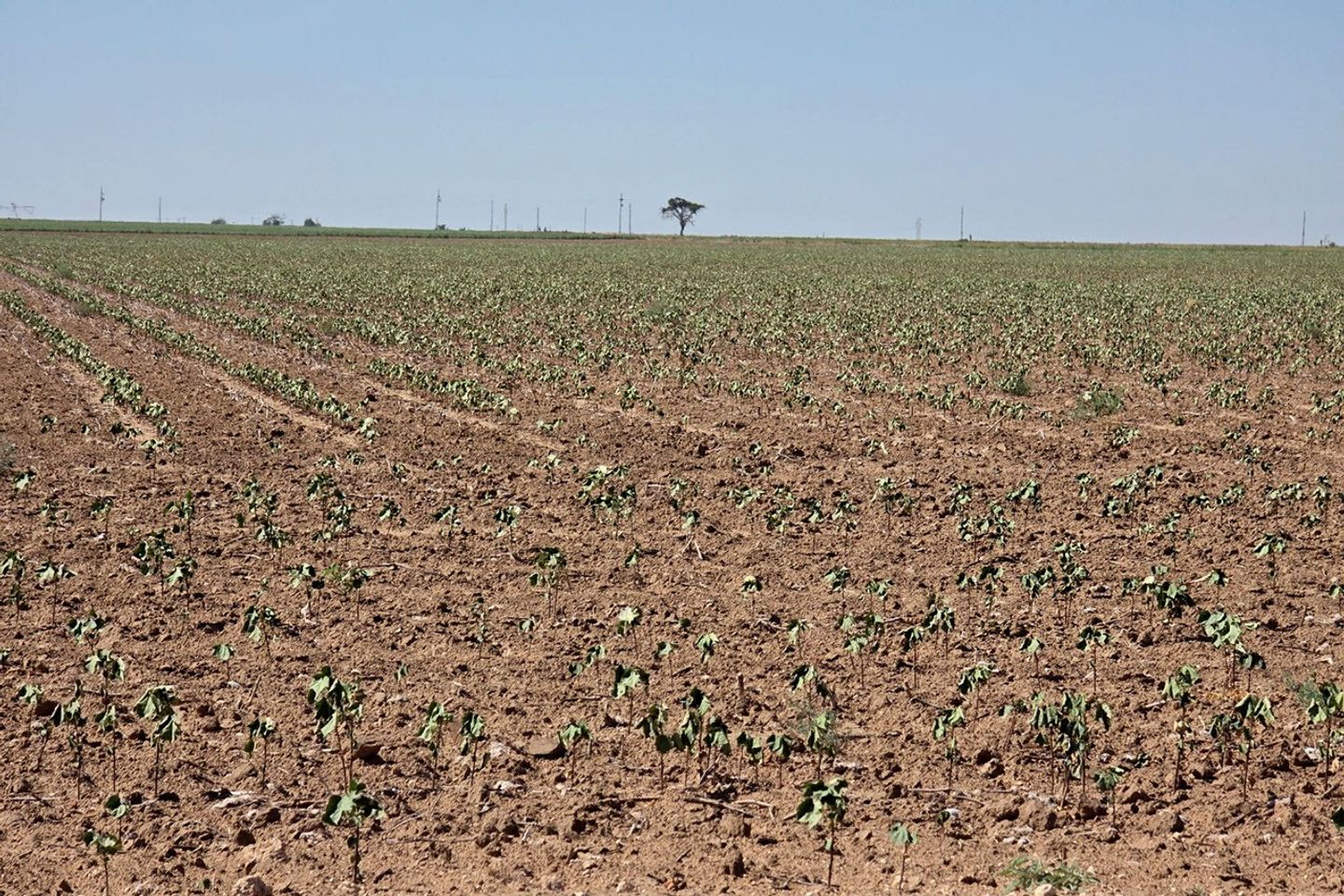
In August, a NASA Acres Space for Agriculture listening tour brought NASA officials to Cotter-Vardeman’s farm in Slaton, a vineyard in Meadow, and parched cotton fields in Kress (below). At each stop, the conversation returned to water: how to preserve the ailing aquifer, and how farmers could manage their land in ways that would help restore playa lakes and return billions of gallons of water to the aquifer.

The playa lakes around Lubbock were among the first scientific topics researchers studied after Landsat 1 launched in 1972. One early analysis by a Texas Tech geoscientist highlighted the Double Lakes playa (shown above), estimating that monitoring lakes from space would cost just a fraction of what ground surveys would.
More recently, a team of Texas Tech University researchers used a deep learning framework to identify and track changes affecting thousands of playa lakes over three decades. Their results, published in September 2026, showed that since 1995, playa lakes declined significantly in 15 of the 45 counties analyzed, highlighting the water challenges facing farmers like Cotter-Vardeman, a member of the NASA Acres Farm Innovation Ambassador Team (FIAT).
In Texas, Timmons-Sims and FIAT are working to connect farmers and NASA scientists, making it easier for farmers to use NASA data to decide what and when to plant, how to use cover crops and irrigation, and how to manage sediment and playa lakes. “We’re simply running out of time and water,” Timmons-Sims said. “Farmers need information, innovation, optimization, and solutions—and they need it now.”
NASA Earth Observatory images by Lauren Dauphin, using Landsat data from the U.S. Geological Survey and the U.S. Drought Monitor at the University of Nebraska-Lincoln. Photos by Lacy Cotter-Vardeman and Adam Zwerner. Story by Adam Voiland.

References & Resources
- Better Cotton Initiative, Lacy Cotter-Vardeman and her girls. Accessed October 7, 2026.
- Dryside Dispatch (2026, September 10) Space4Ag with Tillery Sims. Accessed October 7, 2026.
- Economic Research Service (2025, January 8) Cotton and Wool – Cotton Sector at a Glance. Accessed October 7, 2026.
- National Integrated Drought Information System, Texas. Accessed October 7, 2026.
- NASA Acres (2026) On the Road with the NASA Space4Ag Tour: Listening to Agriculture Across Texas, Oklahoma, and Kansas. Accessed October 7, 2026.
- NASA, Earth Action. Accessed October 7, 2026.
- NASA, Drought. Accessed October 7, 2026.
- NASA DEVELOP (2025) Southern High Plains Texas Agriculture. Accessed October 7, 2026.
- NASA Technical Reports Server (1973) Dynamics of playa lakes in the Texas High Plains. Accessed October 7, 2026.
- NOAA, Current Drought Reduction. Accessed October 7, 2026.
- Playa Lakes Joint Venture Playas. Accessed October 7, 2026.
- Sandhills Area Research Association (2026, September 19) From Satellites to Soil: Bringing NASA Remote Sensing to West Texas Farms. Accessed October 7, 2026.
- Texas Counties Deliver, Texas Counties Interactive Map. Accessed October 7, 2026.
- Texas Water Development Board, Region O Planning Group. Accessed October 7, 2026.
- Texas Parks & Wildlife, Panhandle Playa Lakes. Accessed October 7, 2026.
- U.S. Drought Monitor (2026, September 29) National Drought Summary. Accessed October 7, 2026.
You may also be interested in:
Stay up-to-date with the latest content from NASA as we explore the universe and discover more about our home planet.

Drought in the Rio Grande basin contributed to New Mexico’s largest reservoir dwindling to its lowest level in decades.
Rainfall deficits and high temperatures have created unusually dry conditions and have spurred water shortages on much of the tropical…
Relentless rains are threatening a lake in Kenya’s Great Rift Valley that has become a key hub in the global…




TechCrunch - Latest
A startup founder who served time in prison is looking to court an untapped market: ex-cons
2026-10-08 16:45
Natura’s $99 smart ring puts AI agents on your finger
2026-10-08 16:00
Goodfire says its new ‘inside-out’ monitors catch rogue AI agents at a fraction of the cost
2026-10-08 16:00
US bars Microsoft, Adobe, and major IT firms from green card program for skilled foreign workers
2026-10-08 15:42
Elon Musk questions Ambani’s influence as Starlink India launch stalls
2026-10-08 15:12


