dernier Landing Page

dernier News Guide

Get updated News about latest trends, and more Get updated News about latest trends and updates products
dernier Service
>

Dernier Trends Updates

This website uses cookies to ensure you get the best experience on our website. By clicking "Accept", you agree to our use of cookies. Learn more

Trending Topics

📰 Trending Topics

Google News - Trending

Google News - Technology

NASA - Breaking News

NASA Celebrates Decade of University Innovation in Aeronautics 

2026-04-24 13:04

8 min read

Preparations for Next Moonwalk Simulations Underway (and Underwater)
Artist illustration of a digital laptop and graduation cap and ULI, 10 Years graphic.

For 10 years, a NASA initiative has helped the agency produce breakthrough aeronautical innovations while fostering the aviation workforce of tomorrow – and the University Leadership Initiative (ULI) is still flying high, making awards with the potential to change 21st century air travel. 

Through ULI, NASA has supported more than 1,100 students at 100 schools, allowing them to pursue advancements in top priority areas for U.S. aviation, including high-speed flight, advanced air mobility, future airspace management and safety, and electrified propulsion.  

Many of those students have used their ULI experience as a springboard to careers in aviation. And many of their ideas — such as designing more efficient wings or building supersonic aircraft that can change shape in flight — are either being investigated further by industry or the technologies adopted outright.  

As it celebrates a decade of success, NASA’s ULI team is looking forward to leveraging student innovations with new awards in 2026 and beyond. 

“Through ULI we’re building the workforce of the future and fostering the skill sets we so desperately need to compete globally,” said John Cavolowsky, director of NASA’s Transformative Aeronautics Concepts Program at NASA Headquarters in Washington. 

Through ULI we're building the workforce of the future and fostering the skill set we so desperately need to compete globally.

john cavolowsky

john cavolowsky

Director, Transformative Aeronautics Concepts Program

What makes ULI unique from other NASA research projects, and especially appealing to universities, is that it provides the opportunity for university students and faculty to propose what research to conduct.  

Usually, NASA determines the research it needs and then does the work itself or through partnerships and contracts. But with ULI, the agency shares its goals and universities consider how they can best help realize them.  

“There are no better ways in my mind to help develop that talent within the students than to engage them in identifying big problems and then give them the resources they need to use their creativity to solve them,” Cavolowsky said.  

ULI history 

NASA’s relationship with academia and reliance on its research proficiency is written into NASA’s DNA going back to the days of the National Advisory Committee for Aeronautics, from which NASA was formed in 1958. 

“For more than a century we have leaned on the brilliance and the capabilities of universities to help us think,” Cavolowsky said. “With ULI we can ensure they continue to bring their fresh ideas and young energy to the work we do at NASA Aeronautics.”  

ULI evolved from an earlier project called Leading Edge Aeronautics Research for NASA (LEARN). NASA selected five LEARN teams in 2015 to pursue truly outside of the box ideas that showed promise but needed additional study.  

One of those teams, for example, sought to take a cue from migrating flocks of birds by asking if airliners could save fuel by cruising in a giant ‘V’ formation. The numbers were intriguing and simple flight tests proved the concept, although the idea never made it to practice. 

Slightly retooled but keeping the innovative spirit of LEARN, ULI was officially announced in 2016 and a year later NASA selected five teams of university professors and students to contribute solutions to the biggest aeronautical challenges of the 21st century. 

A decade later, NASA has made a total of $220 million in awards to 33 teams over eight rounds of solicitations 

Smooth flying 

One of the earliest selected ULI teams was led by James Coder, who at the time was an aerospace engineering professor at the University of Tennessee in Knoxville. His team worked on technology that would smooth the airflow around a wing to make it more efficient. 

Technically known as slotted natural laminar flow (SNLF) wings, Coder has called the idea a potential game changer for commercial airliners. The more efficient wing would mean less drag on an airplane, which in turn could help airlines save money on fuel. 

Coder credits ULI for not only helping to prove the technology’s effectiveness – with the aid of wind tunnel testing at NASA’s Ames Research Center in California – but for providing students with an experience they couldn’t get elsewhere. 

Four men wearing masks stand around a section of an airplane wing mounted vertically inside a NASA wind tunnel as part of a University Leadership Initiative project.
Three University of Tennessee/Knoxville students and co-investigator Dan Somers (in red jacket) prepare a slotted laminar flow wing section for testing in a wind tunnel at NASA’s Ames Research Center in California.
University of Tennessee/Knoxville

“After 10 years industry remains interested in the SNLF technology and I am optimistic for good reason about its future,” Coder said. “And project alumni have gone on to do many wonderful things and leverage what they did and learned through the ULI.” 

With ULI experience prominent on their resumes, several of the students on Coder’s team wound up with jobs in industry – such as Boeing and Lockheed Martin – and government labs. One is currently a NASA Pathways intern working on his PhD. 

Now at Pennsylvania State University, Coder remains a strong advocate for ULI. 

“It goes above and beyond simple workforce development,” he said. “We recognized early on the value-add of ULI is the students themselves. While we could have just trained students en masse, we wanted to put them in the front seat of technical leadership on the project. I think this was a very successful strategy that benefited the project and the students as they embarked on their careers.” 

Mighty morphing 

Forrest Carpenter is another example of a student whose ULI support led to work after graduation – in this case at NASA.  

“Working on the ULI project was an incredible experience, one I will always be thankful for and will remember fondly,” Carpenter said. “I think the project challenged me to be something more than ‘just an engineer;’ really helping my professional development and giving me a clearer focus on my passion.”  

As a student at Texas A&M, he was part of a team selected by NASA in 2017 to research a novel idea in which a supersonic aircraft could alter its shape to fly more efficiently based on the atmospheric conditions in real time. Dimitris Lagoudas, now the university’s interim department head for aerospace engineering, led the team.  

A group of university students and faculty gather around a laboratory workbench.
Members of a University Leadership Initiative round one team led by Texas A&M University participate in a status update meeting with NASA prior to their final review in 2022.
Texas A&M University / Jonathan Weaver-Rosen

A laser shooting out ahead of the aircraft would take measurements of the oncoming air and then the aircraft’s computer would command patches of shape memory alloys and other mechanisms to morph the aircraft’s outer shape. 

One possible application of the technology could be in contributing to the reduction of the loudness of a sonic boom, expanding on the science behind NASA’s X-59 quiet supersonic technology demonstrator that seeks to reduce the sonic boom to a sonic thump.  

“My main research role on the team was performing Computational Fluid Dynamics simulations of the various geometries we were looking at, including a pre-production version of X-59,” Carpenter said.  

His work on the idea continues. A follow-on NASA project, GoSWIFT, will flight test the core technologies Carpenter and his ULI team worked on at Texas A&M. Only this time, Carpenter is the co-lead for the tests, which are targeted to take place at NASA’s Armstrong Flight Research Center in California in the near future.  

Carpenter’s enthusiasm for his work and gratitude for how ULI led to his career with NASA resonates with many other ULI alumni.  

“The number of students impacted, and how they were impacted, by a long-term project like ULI is huge,” Carpenter said. “NASA’s involvement in this kind of activity can only strengthen the research done in this country and to help inspire and develop the next generation of our workforce.”  

ULI is supported by the Transformative Aeronautics Concepts Program within NASA’s Aeronautics Research Mission Directorate, which publishes ULI solicitations and other opportunities to collaborate with the agency’s aeronautical innovators. 

About the Author

Jim Banke

Jim Banke

Managing Editor/Senior Writer

Jim Banke is a veteran aviation and aerospace communicator with more than 40 years of experience as a writer, producer, consultant, and project manager based at Cape Canaveral, Florida. He is part of NASA Aeronautics' Strategic Communications Team and is Managing Editor for the Aeronautics topic on nasa.gov. In 2007 he was recognized with a Distinguished Public Service Medal, NASA's highest honor for a non-government employee.

Keep Exploring

Discover More Topics From NASA

An Agricultural Mosaic in Taiwan

2026-04-24 04:01

An array of green rectangular parcels of farmland in a range of hues is interspersed with several small towns.
Farms raising an array of crops form an agricultural mosaic across Yunlin County in this image captured by the OLI (Operational Land Imager) on Landsat 9 on March 18, 2026.
NASA Earth Observatory/Michala Garrison

About 23 million people live in Taiwan, a Pacific island about the size of Maryland. Despite its size, the island produces a tremendous amount of agricultural goods per year—about $18 billion, according to Taiwan’s Ministry of Agriculture.

The average size of a farm in Taiwan (less than 1 hectare) is much smaller than in the United Kingdom (87 hectares) or the United States (187 hectares). Since much of the island is mountainous, only about one-quarter of Taiwan’s land is arable, and it is mostly located on the southwestern side of the island in the Chianan Plain. That amounts to 0.03 hectares of farmland per Taiwanese citizen—about half as much arable farmland as there is per person in the United Kingdom and one-tenth as much as in the United States.

The small plot size is apparent in this satellite image of farmland in Yunlin County in southwestern Taiwan, one of the island’s most productive agricultural areas. The small size of farms is partly a result of past policies that limited the size of farms and partly a byproduct of cultural traditions that often lead to the division of farms into smaller parcels as property is passed from one generation to the next.

Located along the floodplains of the Zhoushui and Beigang rivers, Yunlin County is mostly flat, has fertile soils, and enjoys easy access to irrigation water. The county, one of Taiwan’s main agricultural hubs, is known for producing a wide range of crops, including rice, sweet potatoes, peanuts, corn, sugarcane, garlic, scallions, coffee, fruit trees, and leafy greens. Farms in the county also raise millions of pigs, the most of any county in Taiwan.

A patch of farmland with much larger fields stands out north of Baozhong.
Areas with large fields were generally once part of sugar plantations.
NASA Earth Observatory/Michala Garrison

Most crops in Yunlin County are grown in small rectangular plots defined by roadways and networks of irrigation canals. The exception is sugarcane, which was grown widely in the county in the early 1900s when Japan controlled Taiwan and established an expansive network of sugarcane plantations in the southwestern part of the country. These plantations were consolidated into Taiwan Sugar Corporation after the conclusion of World War II, and the large plot sizes in the farmland north of Baozhong in the image above persist as a legacy of this period.

While the amount of sugarcane cultivated in Taiwan has declined in recent decades and many of the fields have transitioned to other crops, Taiwan Sugar Corporation still raises sugarcane around Baozhong. The company operates a railway that transports harvested cane to nearby Huwei, site of one of just a few remaining sugar refineries on the island. While Taiwan also once had a large network of sugar railways that serviced thousands of kilometers of track and dozens of sugar refineries, the line that serves Huwei is the only one on the island that remains active.

Farm fields around Xiluo appear a darker shade of green than other parts of the image because of shade nets.
Farmers around Xiluo often use shade nets to protect crops from the elements.
NASA Earth Observatory/Michala Garrison

Another area that stands out in the mosaicked agricultural landscape of Yunlin is located around Xiluo (above). Here the fields take on an unusual greenish-blue hue, largely because of the ubiquity of shade nets. Farmers use the nets to protect crops from heat, sun, heavy rains, and pests. They’re generally deployed for specialty crops such as vegetables, fruit, and flowers. This area contrasts with the darker green region in the lower right of the first image, where rice is the dominant crop.

NASA Earth Observatory images by Michala Garrison, using Landsat data from the U.S. Geological Survey. Story by Adam Voiland.

References & Resources

You may also be interested in:

Stay up-to-date with the latest content from NASA as we explore the universe and discover more about our home planet.

Satellite Spots a Spawn

3 min read

The activity of herring around Vancouver Island in British Columbia brightened coastal waters enough to be detectable from space.

Article

Showy Swirls Around Jeju Island

2 min read

Winds blowing past the volcanic landmass near the Korean Peninsula created a trail of spiraling clouds, while murky water churned…

Article

Home Reef Adds On

3 min read

The Tongan volcano expanded its mid-Pacific real estate during its latest eruptive phase.

Article

Johnson Leaders Honored by National Space Club & Foundation 

2026-04-23 23:24

The 2026 award recipients at the 69th Annual Robert H. Goddard Memorial Dinner at the Washington Hilton on March 13, 2026.
National Space Club & Foundation

The National Space Club & Foundation announced its annual award recipients March 13, 2026, in Washington, D.C.  

Two dedicated leaders from NASA’s Johnson Space Center were recognized for their contributions to human spaceflight. 

Orion Program Manager Howard Hu receives the Norman L. Baker Astronautics Engineer Award.
National Space Club & Foundation

Orion Program Manager Howard Hu received the Norman L. Baker Astronautics Engineer Award for sustained technical contributions to multiple human spaceflight efforts.  

Hu leads the design, development, production, and operations of Orion, NASA’s spacecraft for Artemis missions to the Moon. He has held several leadership roles within the Orion program, including deputy program manager, a manager of the Avionics, Power, and Software Office, and deputy manager of the Vehicle Integration Office. Hu has supported Orion since its inception, beginning as the Vehicle System Performance and Analysis lead. 

On April 1, 2026, Artemis II launched on a 10-day voyage around the Moon, marking the first crewed flight of the Orion spacecraft. NASA astronauts Reid Wiseman, Victor Glover, and Christina Koch, and CSA (Canadian Space Agency) astronaut Jeremy Hansen splashed down safely inside Orion April 10 in the Pacific Ocean off the coast of San Diego. At their farthest point, the crew and spacecraft traveled 252,756 miles from Earth, setting a new record for the greatest distance traveled by humans in space. 

The mission successfully proved the capability of Orion’s critical systems such as life support with humans aboard. Data from Artemis II will help refine mission operations and further evaluate Orion’s performance in deep space, supporting future Artemis missions.  

NASA and its partners are now shifting their focus to Artemis III, which will test integrated operations between Orion and the human landing system in lunar orbit and advance plans to return astronauts to the Moon. 

Before joining Orion, Hu served in multiple technical and leadership roles at Johnson, including chief engineer for exploration in the Aeroscience and Flight Mechanics Division, project manager and co-developer of shuttle abort flight management software for the Space Shuttle Cockpit Avionics Upgrades Program, and deputy guidance, navigation, and control system manager for the International Space Station program. 

International Space Station Program Manager Dana Weigel receives the Eagle Manned Mission Award.
National Space Club & Foundation

International Space Station Program Manager Dana Weigel received the Eagle Manned Mission Award. She leads development, integration, and operations for the International Space Station. The space station celebrated a historic milestone on Nov. 2, 2025, marking 25 years of continuous human habitation. The orbiting laboratory remains a critical testbed for future commercial destinations in low Earth orbit and for deep space exploration, supporting Artemis missions and future human missions to Mars. 

Weigel has held several leadership roles within the program, including deputy chief of the Flight Director Office, where she led the Extravehicular Activity Recovery Team following a major in-flight spacewalk anomaly. She also served as a NASA flight director for STS-123 and led the agency’s geosynchronous Earth orbit satellite servicing habitat study. 

NASA’s Johnson Space Center Director Vanessa Wyche attends the 69th Annual Robert H. Goddard Memorial Dinner with her husband George Wyche Jr.
National Space Club & Foundation

Selected by panels of experts across industry, government, and academia, the awards reflect achievements that advance aerospace and national interests. Honorees were recognized at the 69th Annual Robert H. Goddard Memorial Dinner at the Washington Hilton.  

“Dana Weigel and Howard Hu’s contributions to human space exploration, through their leadership and roles within the agency, are paramount,” said Johnson Director Vanessa Wyche. “It was a privilege to be there in person to celebrate and champion them as they were recognized for the lasting impact of their work. Congratulations to Dana, Howard, and all the award recipients on this well-deserved recognition.” 

Hu and Weigel’s service exemplifies the leadership and technical excellence that continue to advance U.S. human space exploration. 

NASA Shares SpaceX Crew-13 Assignments for Space Station Mission

2026-04-23 21:15

Compilation of four astronaut portraits that make up NASA's SpaceX Crew-13
From left to right, NASA astronauts Jessica Watkins and Luke Delaney, CSA (Canadian Space Agency) astronaut Joshua Kutryk, and Roscosmos cosmonaut Sergey Teteryatnikov.
Credit: NASA

As part of NASA’s SpaceX Crew-13 mission, four crew members from three space agencies will launch no earlier than mid-September to the International Space Station for a long-duration science expedition.

NASA astronauts Jessica Watkins and Luke Delaney will serve as spacecraft commander and pilot, respectively. They will be joined by CSA (Canadian Space Agency) astronaut Joshua Kutryk and Roscosmos cosmonaut Sergey Teteryatnikov, who will serve as mission specialists. After arriving at the orbiting laboratory, Crew-13 will become members of the space station’s Expedition 75.

This flight is the 13th crew rotation with SpaceX to the space station as part of NASA’s Commercial Crew Program. NASA is advancing the launch date of Crew-13 from November to help increase the frequency of U.S. crew rotation missions to the space station. The crew will conduct scientific investigations and technology demonstrations to help prepare humans for future exploration missions to the Moon and Mars, and benefit people on Earth.

This will be the second flight to the space station for Watkins, who was selected as a NASA astronaut in 2017. Watkins grew up in Lafayette, Colorado, and earned an undergraduate degree in geological and environmental sciences from Stanford University, as well as a doctorate in geology from the University of California, Los Angeles. As a geologist, she studied the Martian surface and was a member of the Curiosity rover science team at NASA’s Jet Propulsion Laboratory in Southern California. Watkins first launched to the space station as a crew member aboard NASA’s SpaceX Crew-4 mission, spending a total of 170 days in space across Expeditions 67/68 in 2022. She will be the first NASA astronaut to launch aboard a SpaceX Dragon spacecraft twice.

Selected as a NASA astronaut in 2021, Delaney earned a bachelor’s degree in mechanical engineering at the University of North Florida and a master’s degree in aerospace engineering at the Naval Postgraduate School. The Florida native is a distinguished naval aviator who participated in exercises throughout the Asia Pacific region and conducted missions in support of Operation Enduring Freedom. As a test pilot, Delaney evaluated developmental aircraft systems and served as a test pilot instructor. He also worked as a research pilot at NASA’s Langley Research Center in Hampton, Virginia, where he supported airborne science missions. This is the first spaceflight for Delaney.

The Crew-13 mission also is the first spaceflight for Kutryk. Prior to his selection as a CSA astronaut in 2017, he served as a CF-18 fighter pilot, flying missions in support of Canada’s NATO, U.N., and North American Aerospace Defense Command commitments. A native of Fort Saskatchewan, Alberta, Kutryk also worked as an experimental and operational test pilot at the Aerospace Engineering Test Establishment in Cold Lake, Alberta. Kutryk received a bachelor’s degree in mechanical engineering from the Royal Military College of Canada in Kingston, Ontario, and he is a distinguished graduate of the United States Air Force Test Pilot school in Edwards, California. He has master’s degrees in space studies, flight test engineering, and defense studies.

Crew-13 will be Teteryatnikov’s first trip to the orbiting laboratory. He graduated from the Naval Academy, St. Petersburg, Russia, in 2011 as an engineer specializing in ship power plant operations. Before his selection as a test cosmonaut, Teteryatnikov served in various naval engineering roles, including undersea vessels and specialized engine room operations. He was selected for the Gagarin Research and Test Cosmonaut Training Center Cosmonaut Corps in 2021 and has served as a test cosmonaut since 2023.

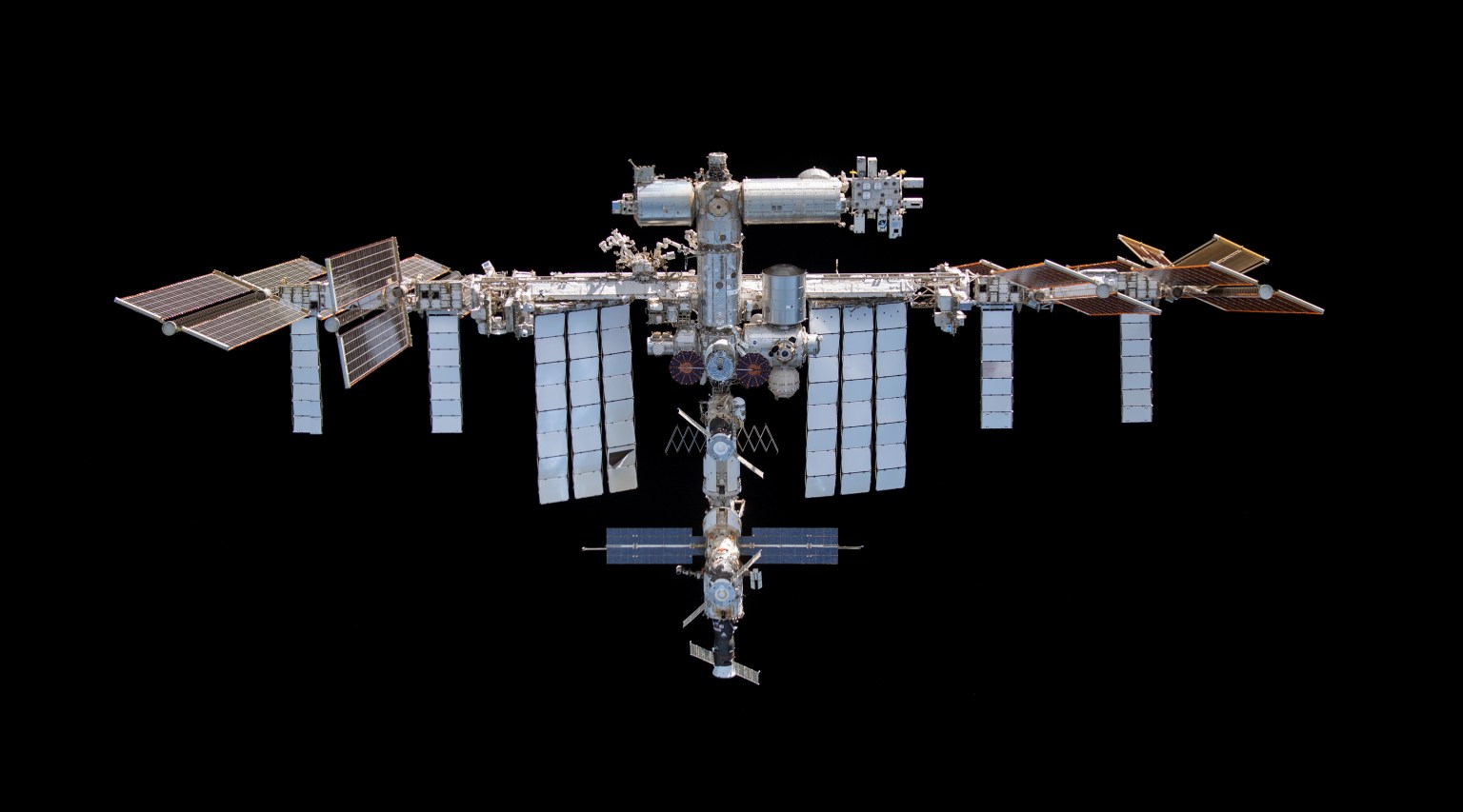
For more than 25 years, people have lived and worked continuously aboard the International Space Station, advancing scientific knowledge and making research breakthroughs that aren’t possible on Earth. The space station helps NASA understand and overcome the challenges of human spaceflight, expand commercial opportunities in low Earth orbit, and build on the foundation for long-duration missions to the Moon, as part of the Artemis program, and to Mars.

Learn more about International Space Station research and operations at:

https://www.nasa.gov/station

-end-

Joshua Finch / Jimi Russell
Headquarters, Washington
202-358-1100
joshua.a.finch@nasa.gov / james.j.russell@nasa.gov

Anna Schneider / Mary Pfister
Johnson Space Center, Houston
281-483-5111
anna.c.schneider@nasa.gov / mary.m.pfister@nasa.gov

NASA Kennedy Prepares Facility for Roman Space Telescope Arrival

2026-04-23 20:14

Image shows sunny, blue skies with a few wispy clouds outside the NASA Kennedy’s Payload Hazardous Servicing Facility (PHSF). The building is a grayish color with a nearby driveway and a small door for people to enter and huge doors for spacecrafts and instruments to enter. Photo credit: NASA/Kim Shiflett
A photograph shows the exterior of NASA’s Payload Hazardous Servicing Facility (PHSF) on Tuesday, April 21, 2026, at NASA’s Kennedy Space Center in Florida.
NASA/Kim Shiflett

Preparations are underway for launch of NASA’s Nancy Grace Roman Space Telescope as soon as early September on a SpaceX Falcon Heavy rocket from Launch Complex 39A at NASA’s Kennedy Space Center in Florida. The Roman space telescope will provide deep, panoramic views of the cosmos, generating never-before-seen pictures that will revolutionize our understanding of the universe. Before Roman arrives at the launch pad, however, the telescope will complete final inspections, checkouts, and fueling at NASA Kennedy’s Payload Hazardous Servicing Facility (PHSF).

The 40-year-old facility is a dedicated dual-use complex for clean room and hazardous material operations, where numerous spacecraft have undergone final prelaunch processing including receiving, integration, testing, and encapsulation ahead of liftoff. NASA’s Launch Services Program, based at NASA Kennedy, manages the launch service for the Roman mission.

To prepare for Roman’s arrival, the program oversaw several upgrades to the PHSF. This included replacing its air-shower system, a small entry chamber that blasts high-velocity HEPA-filtered air onto people and equipment before they enter a clean room.

“Roman is a very sensitive spacecraft. NASA is always pushing the boundaries of how precise our instruments can be, and the result of that is they need to be very well cared for while they’re being processed at the PHSF,” said Ryan Boehmer, launch site integration manager with the Launch Services Program at NASA Kennedy. “One of the biggest sources of contamination for a spacecraft is people.”

The PHSF is a clean work area, so the facility must be free of any contamination that could negatively impact the Roman spacecraft. Technicians must dress in a protective suit before using the air shower, which sprays air to reduce any particles carried on clothing or equipment and keeps the spacecraft’s environment in the facility as clean and contamination-free as possible.

Dust, debris, or even a piece of hair can interfere with a spacecraft and its instruments as it gathers crucial science data in orbit. The facility is certified to the International Organization for Standardization (ISO) ISO class 8 clean room standards but can exceed that with augmentation. The team is planning to use a HEPA filtration wall to achieve ISO class 7 standards required for Roman.

This image shows the recently upgraded air showers which blast high-velocity HEPA-filtered air onto people before they enter a clean room at NASA’s Payload Hazardous Servicing Facility at the agency’s Kennedy Space Center in Florida on Friday, Feb. 27, 2026.
NASA/Kim Shiflett

Another PHSF upgrade is its HVAC system, which is far more advanced than a typical residential system. The goal of this upgrade is to replace the facility’s chiller coils to ensure the airlock and clean room remain climate-controlled with backups available if one fails. Additional updates include the compressed-air system’s pressure tank, air dryer, and regulator panel to supply clean, reliable compressed air to slide hardware around the floor – like an air hockey table but on a much larger scale. Massive volumes of filtered air circulate through the facility to prevent outside contaminants from entering the building.

“Another consideration we have is keeping both the spacecraft and people working on it at comfortable temperatures during processing, especially given Florida’s hot and humid environment,” said Genevieve Futch, Launch Services Program mission manager for Roman at NASA Kennedy. “Throughout processing, teams are powering on spacecraft for testing, which can generate heat. All the technicians in the clean room wear significant amounts of protective garments that trap heat, so we rely on the PHSF’s HVAC to reliably maintain the facility’s environment. We don’t want to overheat either the hardware or our team.”

Inside, the temperature is kept around 70° F with a maximum relative humidity of 60% and minimum humidity requirement of 30%. Too much humidity can lead to corrosion, while too little can create static electricity. The team constantly monitors the conditions to ensure the spacecraft’s safety.

Workers also repainted the facility’s 15-ton bridge crane, which is used to lift spacecraft hardware, but not for aesthetic reasons. The new paint helps prevent any paint chips from becoming foreign object debris, commonly referred to as FOD. All the teams working on Roman aim to mitigate even microscopic particles from contaminating the spacecraft. Paint chips are larger and heavier than some of the smallest contaminants, but they could still become airborne debris that can settle on hardware, causing mechanical interference and degrading performance. Removing all potential sources of contamination is part of the launch site planning and reflects the attention to detail required to launch a spacecraft.

Roman will undergo several prelaunch operations, including thermal protection closeout, cleaning, solar array work, and loading hydrazine propellant. The PHSF is one of the very few facilities where spacecraft undergo both hazardous fueling operations and delicate contamination control procedures.

Continuing legacy

The PHSF began operations in 1986 during the Space Shuttle Program, where it supported processing for several major shuttle payloads, including missions supporting NASA’s Hubble Space Telescope. Since 1998, the Launch Services Program has managed 16 launches processed at the PHSF, beginning with the program’s first mission, NASA’s Deep Space 1. Other missions include Mars 2020 Perseverance Rover, NASA’s Europa Clipper spacecraft, and soon to be Roman.

“We have the responsibility for ensuring the highest practical probability of launch success for these incredibly sophisticated and delicate spacecrafts,” said Boehmer. “We’re a common thread combining the capabilities of commercial rockets with NASA’s scientific spacecraft, and we have experience supporting the processing of everything from space telescopes to Mars rovers to deep space probes in this building.”

Roman will work in collaboration with NASA’s James Webb Space Telescope and Hubble. It is a survey mission with a field of view 100 times larger than Webb and up to 200 times larger than Hubble. Roman’s wide view will help answer essential questions about dark energy, exoplanets, and astrophysics, while Webb can follow up on rare objects Roman discovers, looking at them in greater detail.

“I think it’s human nature to wonder about what is out there in space,” said Boehmer. “I believe when we start getting images from Roman and see more of the universe than ever before, people will connect to that feeling of wonder.”

TechCrunch - Latest

Another spyware maker caught distributing fake Android snooping apps

2026-04-24 14:17

Researchers have found a new case where government authorities used a fake Android app to plant spyware on a target’s phone. The company that allegedly developed the spyware was not previously known to sell this type of software.
Uber CTO Praveen Neppalli Naga joins stacked StrictlyVC SF lineup for April 30 event

2026-04-24 14:00

Surprise! StrictlyVC San Francisco, which will kick off this year’s events lineup for TechCrunch on April 30 at the Sentro Filipino Cultural Center, is getting a new addition to its increasingly stacked lineup of speakers. Uber CTO Praveen Neppalli Naga will join the rest of the lineup to discuss operating at scale in the age of AI.
Nothing introduces an AI-powered dictation tool

2026-04-24 13:41

Nothing's new on-device dictation tool supports over 100 languages.
DeepSeek previews new AI model that ‘closes the gap’ with frontier models

2026-04-24 13:30

DeepSeek says both models are more efficient and performant than DeepSeek V3.2 due to architectural improvements, and have almost "closed the gap" with current leading models, both open and closed, on reasoning benchmarks.
In another wild turn for AI chips, Meta signs deal for millions of Amazon AI CPUs

2026-04-24 12:00

Meta has commandeered a big chunk of Amazon's homegrown CPUs (not GPUs) for AI agentic workloads, signaling that a new kind of chip race has begun.
×
Useful links
Home
Definitions Terminologies
Socials
Facebook Instagram Twitter Telegram
Help & Support
Contact About Us Write for Us


1 year ago Category :
Are you looking to upgrade your audio setup in Zurich, Switzerland? Stay ahead of the curve with the latest audio equipment on the market! Whether you're a music enthusiast, audiophile, or simply looking to enhance your home entertainment system, investing in top-of-the-line audio gear can truly transform your listening experience.

Are you looking to upgrade your audio setup in Zurich, Switzerland? Stay ahead of the curve with the latest audio equipment on the market! Whether you're a music enthusiast, audiophile, or simply looking to enhance your home entertainment system, investing in top-of-the-line audio gear can truly transform your listening experience.

Read More →
1 year ago Category :
YouTube Content Creation and Translation + Latest Streaming Services

YouTube Content Creation and Translation + Latest Streaming Services

Read More →
1 year ago Category :
The Impact of YouTube Content Creation and Translation on the Latest Hollywood Movies

The Impact of YouTube Content Creation and Translation on the Latest Hollywood Movies

Read More →
1 year ago Category :
Are you tired of watching the same old Bollywood movies and craving some fresh content? Look no further than YouTube! With content creators all around the world sharing the latest Bollywood movies and translating them for global audiences, you can enjoy a diverse range of films right at your fingertips.

Are you tired of watching the same old Bollywood movies and craving some fresh content? Look no further than YouTube! With content creators all around the world sharing the latest Bollywood movies and translating them for global audiences, you can enjoy a diverse range of films right at your fingertips.

Read More →
1 year ago Category :
Enhancing Your YouTube Content Creation with the Latest Audio Equipment

Enhancing Your YouTube Content Creation with the Latest Audio Equipment

Read More →
1 year ago Category :
In recent years, streaming services have become the go-to option for entertainment for many people around the world. From popular platforms like Netflix and Hulu to niche services focusing on specific genres or interests, the streaming landscape has continued to evolve and expand. One area where streaming services have been making a significant impact is on YouTube channels.

In recent years, streaming services have become the go-to option for entertainment for many people around the world. From popular platforms like Netflix and Hulu to niche services focusing on specific genres or interests, the streaming landscape has continued to evolve and expand. One area where streaming services have been making a significant impact is on YouTube channels.

Read More →
1 year ago Category :
Are you a fan of Hollywood movies and looking for a convenient way to stay updated on the latest releases? If so, subscribing to a YouTube channel that specializes in featuring clips, trailers, reviews, and updates on the newest Hollywood movies might be the perfect solution for you.

Are you a fan of Hollywood movies and looking for a convenient way to stay updated on the latest releases? If so, subscribing to a YouTube channel that specializes in featuring clips, trailers, reviews, and updates on the newest Hollywood movies might be the perfect solution for you.

Read More →
1 year ago Category :
Are you a Bollywood movie buff looking for a YouTube channel to stay updated on the latest releases? Well, look no further! In the vast sea of YouTube channels dedicated to Bollywood content, there are a few standout channels that consistently upload the latest Bollywood movies for your viewing pleasure.

Are you a Bollywood movie buff looking for a YouTube channel to stay updated on the latest releases? Well, look no further! In the vast sea of YouTube channels dedicated to Bollywood content, there are a few standout channels that consistently upload the latest Bollywood movies for your viewing pleasure.

Read More →
1 year ago Category :
If you are a content creator, musician, or audiophile looking to stay ahead of the curve in the world of audio equipment, keeping an eye on the latest releases from YouTube channel dedicated to audio equipment can be a game-changer. These channels provide in-depth reviews, comparisons, and demonstrations of the newest gear on the market, helping you make informed decisions about your next purchase.

If you are a content creator, musician, or audiophile looking to stay ahead of the curve in the world of audio equipment, keeping an eye on the latest releases from YouTube channel dedicated to audio equipment can be a game-changer. These channels provide in-depth reviews, comparisons, and demonstrations of the newest gear on the market, helping you make informed decisions about your next purchase.

Read More →
1 year ago Category :
The FIFA World Cup is one of the most anticipated sporting events in the world, drawing millions of fans to their screens to watch the action unfold. With advancements in technology, the way people watch the World Cup has evolved over the years. Today, there are a variety of streaming services that allow fans to catch all the excitement of the tournament from the comfort of their own homes.

The FIFA World Cup is one of the most anticipated sporting events in the world, drawing millions of fans to their screens to watch the action unfold. With advancements in technology, the way people watch the World Cup has evolved over the years. Today, there are a variety of streaming services that allow fans to catch all the excitement of the tournament from the comfort of their own homes.

Read More →