📰 Trending Topics
Google News - Trending
Google News - Technology
Apple CEO Ternus Says iPhone Duo Shortages Have No End Date in Sight - MacRumors
2026-11-02 22:03
- Apple CEO Ternus Says iPhone Duo Shortages Have No End Date in Sight MacRumors
- I tested Apple's $2,000 iPhone Duo. It's a fascinating experiment, but the price is hard to justify. Axios
- John Ternus addresses iPhone Duo supply constraints, display issue 9to5Mac
- You’ll Never Guess How Scalpers Are Reportedly Snagging Rare iPhone Duos Gizmodo
- Will the iPhone Duo Fit in Your Pocket? Here’s How It Compares to Other iPhone Sizes CNET
Dell XPS Googlebook Review: Beautiful Hardware For A Useless Platform - Engadget
2026-11-02 12:30
- Dell XPS Googlebook Review: Beautiful Hardware For A Useless Platform Engadget
- I compared Googlebook and Samsung DeX; Galaxy users have little reason to switch Android Police
- Lenovo's Googlebook 15 is a fantastic laptop held back by an OS that isn't ready for prime time XDA
- Big Googlebook Problem Frustrates Early Adopters BGR
- Dell XPS Googlebook [2026]: $999, But the OS Hurts shattered.io
One of Google’s Android partners turned 1.3 million set-top boxes into a botnet - The Verge
2026-11-02 20:37
- One of Google’s Android partners turned 1.3 million set-top boxes into a botnet The Verge
- Shutting the Door on the XCPE Botnet Google Cloud
- Google shuts down a sneaky malware backdoor on millions of Android TV and Google TV boxes 9to5Google
- Cops bust botnet of 1.3M infected Android TV boxes The Register
- Google Disrupts 1.3 Million-Device Android Botnet, Says TV Box Maker Sold Criminal Access The Hacker News
Raspberry Pi 5 16GB Price Rises To $385 USD - Phoronix
2026-11-02 10:27
- Raspberry Pi 5 16GB Price Rises To $385 USD Phoronix
- Price rises for some 16GB Raspberry Pi products Raspberry Pi
- The 16GB Raspberry Pi 5 got another ‘unavoidable’ RAM price hike The Verge
- 16GB Raspberry Pi 5 hiked to $385, more than triple its launch price — makers are already shifting to Pico/ESP32 for small projects, mini PCs for more ambitious tasks Tom's Hardware
- Raspberry Pi 5 16 GB Hits $385 Following Latest Price Hikes TechPowerUp
NASA - Breaking News
Happy 65 Years: NASA’s Johnson Space Center Then and Now
2026-11-02 21:35
Happy 65 Years: NASA’s Johnson Space Center Then and Now
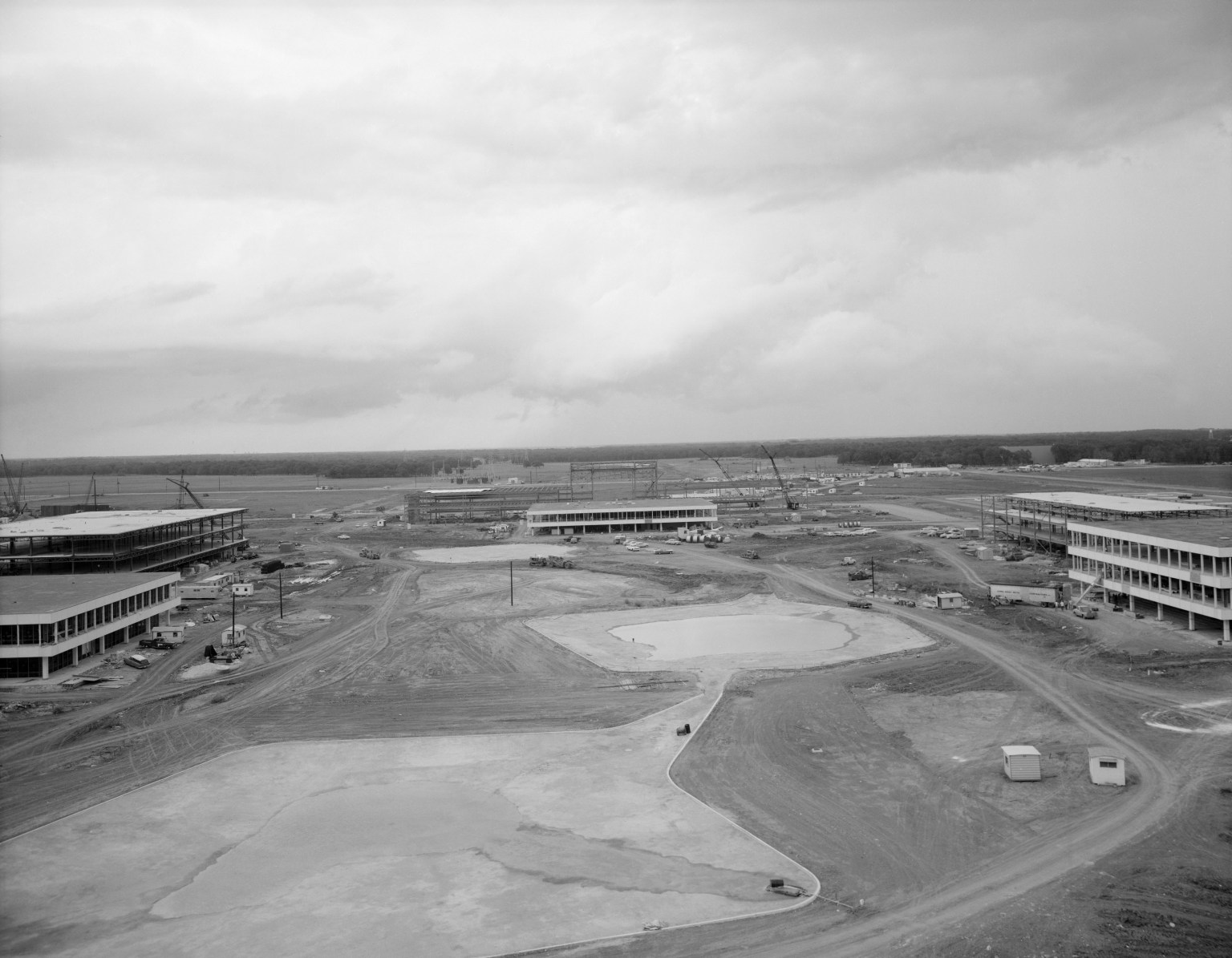
Sixty-five years ago, a bold vision took root in Houston: a NASA center dedicated to human spaceflight. Since its founding, NASA’s Johnson Space Center has helped lead the nation’s human spaceflight program, supporting missions from Project Mercury through Artemis.
Today, Johnson serves as NASA’s Center of Excellence for Human Spaceflight, and its workforce is helping to usher in a Golden Age of innovation and discovery. Johnson is home to America’s astronaut corps, the Mission Control Center, and the teams behind some of humanity’s greatest achievements in space. As NASA’s human spaceflight programs evolve, Johnson remains at the forefront of these efforts.
Houston is home to NASA’s Low Earth Orbit Program, comprising International Space Station operations and commercial partnerships and destinations in low Earth orbit. For missions beyond low Earth orbit, Johnson houses the Moon Base Program and Orion Program, while NASA’s Human Health and Performance Directorate and Human Research Program work to protect crew health and performance as missions extend farther from Earth.
On May 25, 1961, the center’s story began when President John F. Kennedy gave a speech before a joint session of Congress, committing the nation to achieve the goal of landing a man on the Moon and returning him safely to Earth before the end of the decade.
NASA’s Space Task Group, in charge of America’s human spaceflight program, was already working on Project Mercury to put astronauts into Earth orbit, but with the additional task of a human lunar landing, it soon outgrew its facilities at NASA’s Langley Research Center in Hampton, Virginia. The agency decided it needed a dedicated field center for human spaceflight and on Sept. 19, 1961, after evaluating multiple sites around the country, NASA announced that the new Manned Spacecraft Center would be built near Houston, Texas. The agency established the center on Nov. 1, 1961, and construction began in 1962. In 1973, it officially became NASA’s Lyndon B. Johnson Space Center in honor of President Johnson for his ardent support of America’s space program from its foundation.
Manned Spacecraft Center to Johnson Space Center
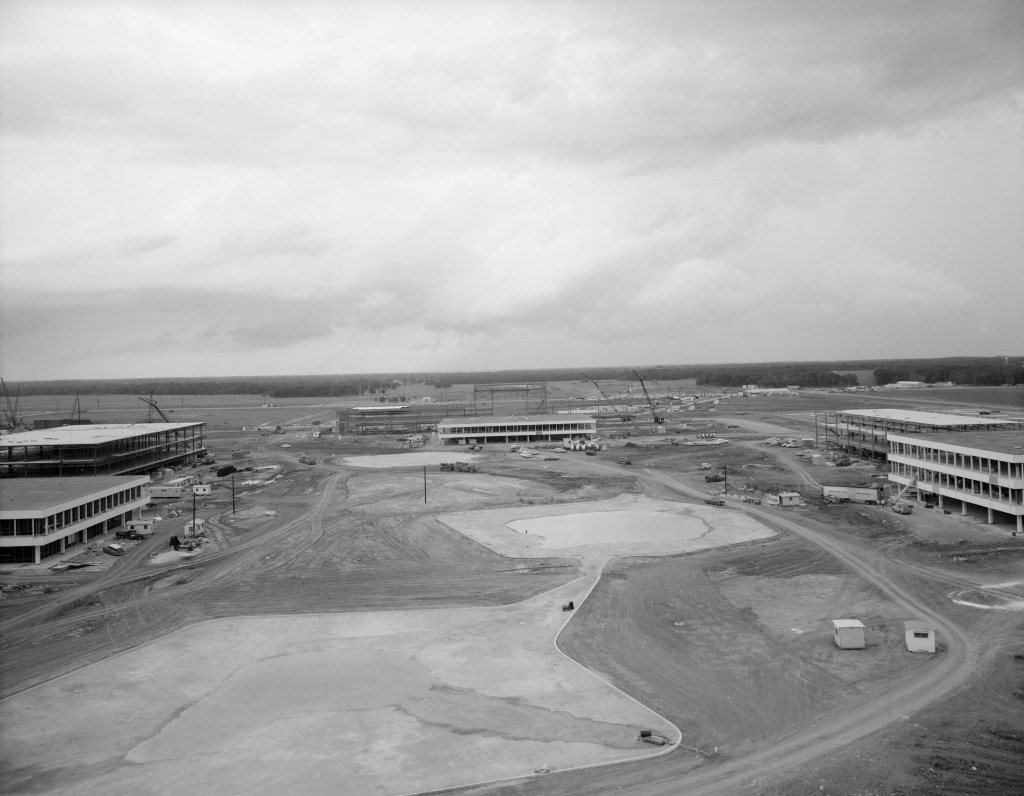
The Manned Spacecraft Center officially opened on Nov. 1, 1961, and while construction continued on the Clear Lake site, employees worked in 13 leased buildings in southeast Houston. The design phase took six months and construction of the first buildings took 18 months, with the first employees moving onto the new site in late 1963.
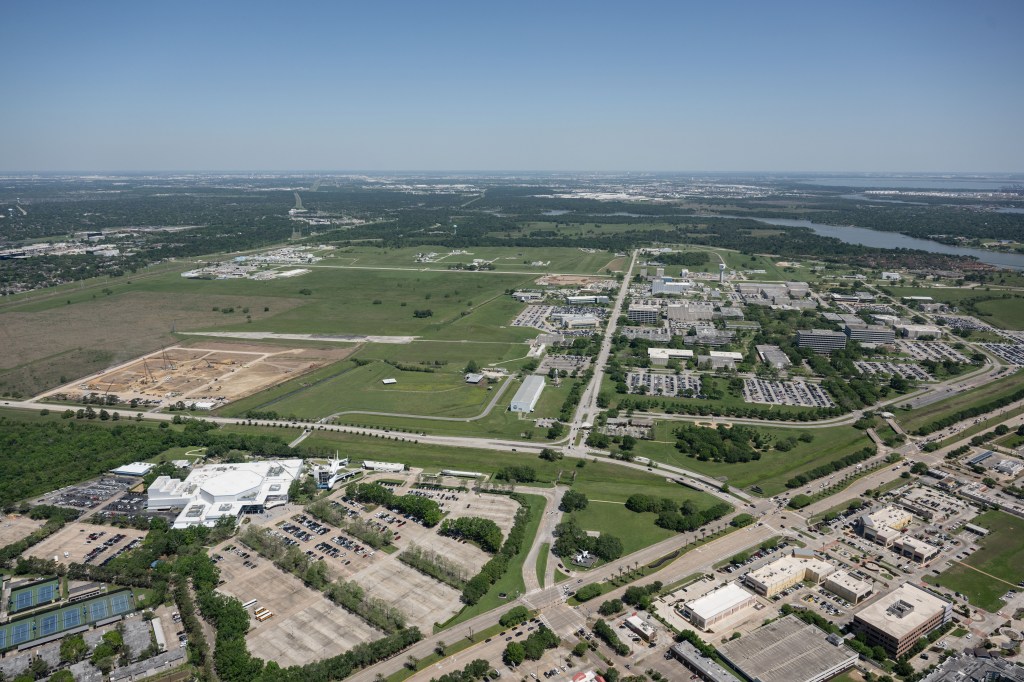
Over the decades, the number of buildings grew, and continues to grow, to meet the demands of new spaceflight programs.
Project Management Building
Construction of the nine-story Project Management Building began on Dec. 5, 1962, and concluded on March 15, 1964. Robert Gilruth, the center’s first director, moved into his office on March 5, 1964, on the top floor of the edifice then known as Building 2. The building swapped numbers with the Public Affairs Building, originally known as Building 1, on June 30, 1974.


Neutral buoyancy spacewalk training
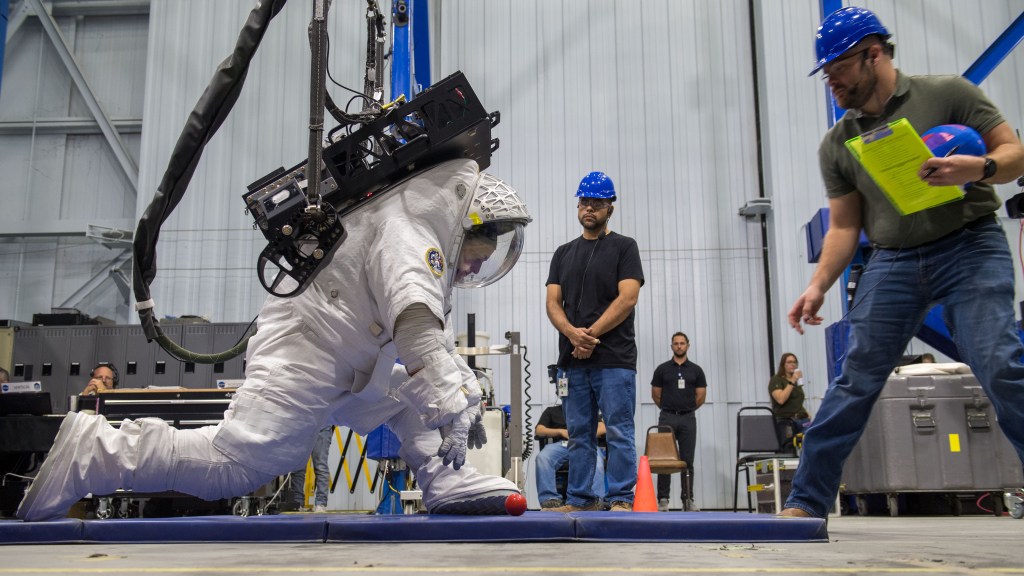
The use of neutral buoyancy for spacewalk training began with the Gemini XII mission in 1966. In 1967, workers installed an above-ground circular pool called the Water Immersion Facility for astronaut training that supported Apollo and pre-Shuttle spacewalk training.. To accommodate the larger size of the space shuttle payload bay, spacewalk training moved to the Weightless Environment Training Facility iin 1980. Astronauts used it for nearly all shuttle spacewalk training until 1997, when the Neutral Buoyancy Laboratory in the Sonny Carter Training Center entered operations for both shuttle and space station training, as well as testing future space suits and lunar surface activities.


Lunar Receiving Laboratory (Building 37)
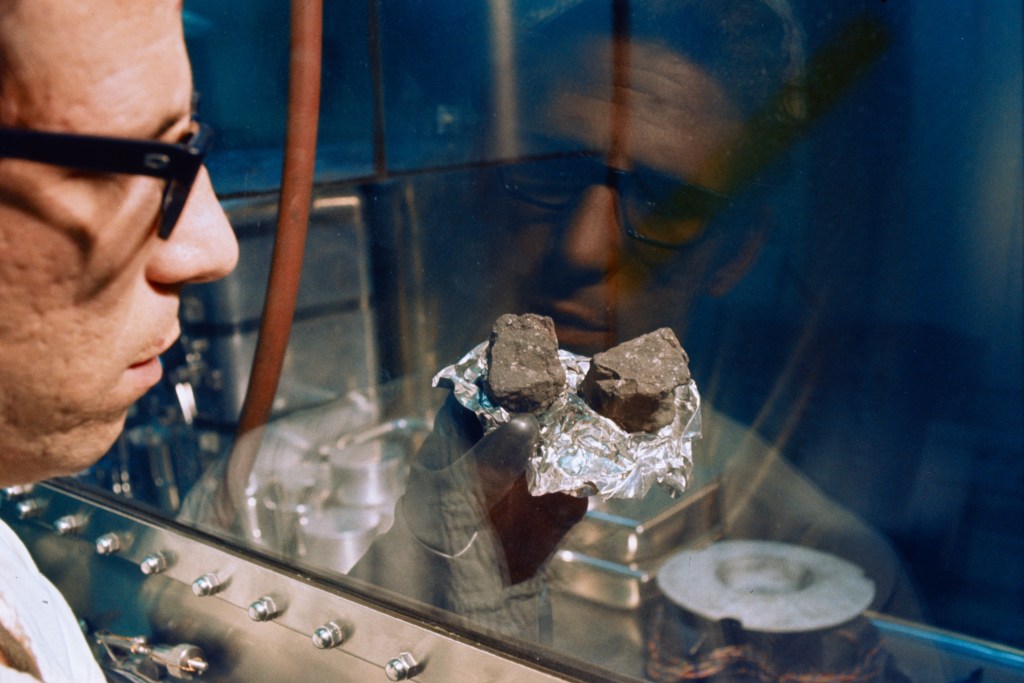
To prevent any back contamination from any possible lunar microorganisms, NASA designed the Lunar Receiving Laboratory in Building 37. Construction began in August 1966, with the first employees moving into their offices in June 1967. The astronauts from Apollo 11, 12, and 14 completed their three-week postflight quarantine in the lab, and scientists in the various laboratories studied the lunar samples all the Apollo missions returned.
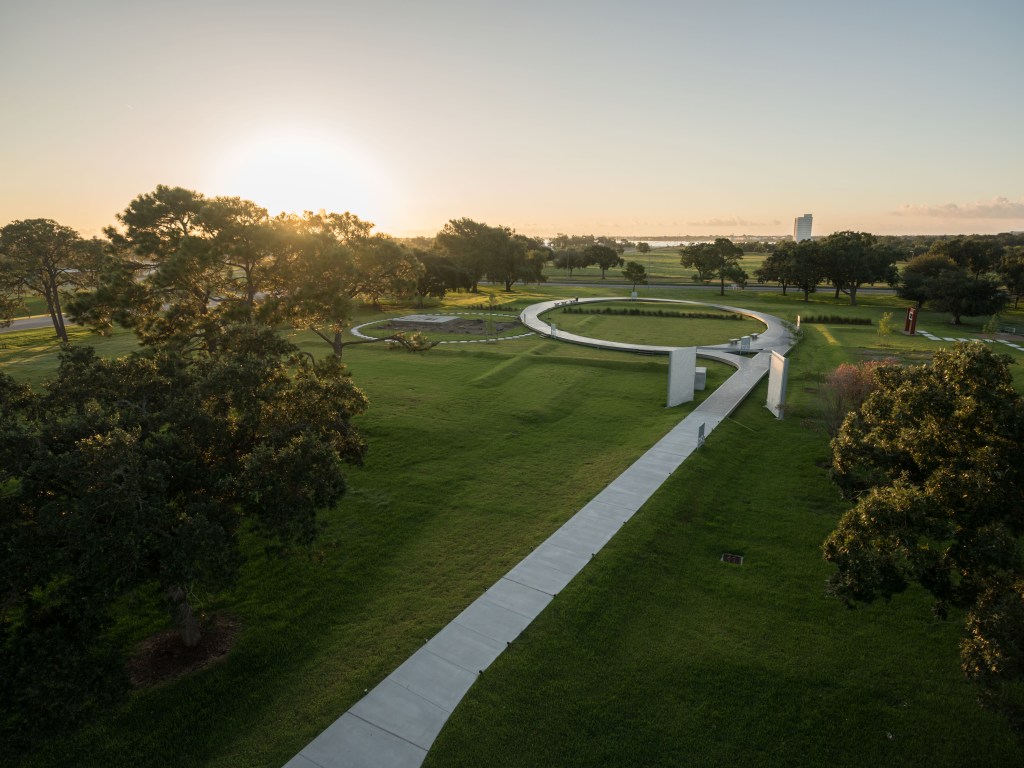
Following the Apollo program, Life Sciences division and laboratories moved into the building until they relocated in 2017. Following demolition of Building 37, the Lunar Receiving Park, dedicated in 2026, honors the history of the laboratory.

Spacecraft mockup training facilities (Building 9)
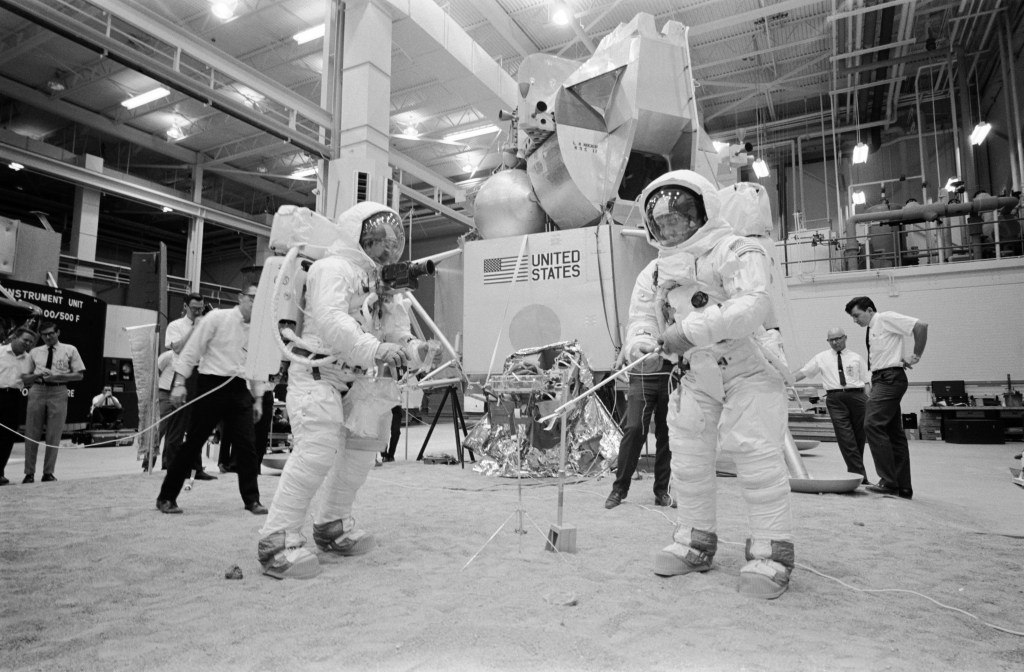
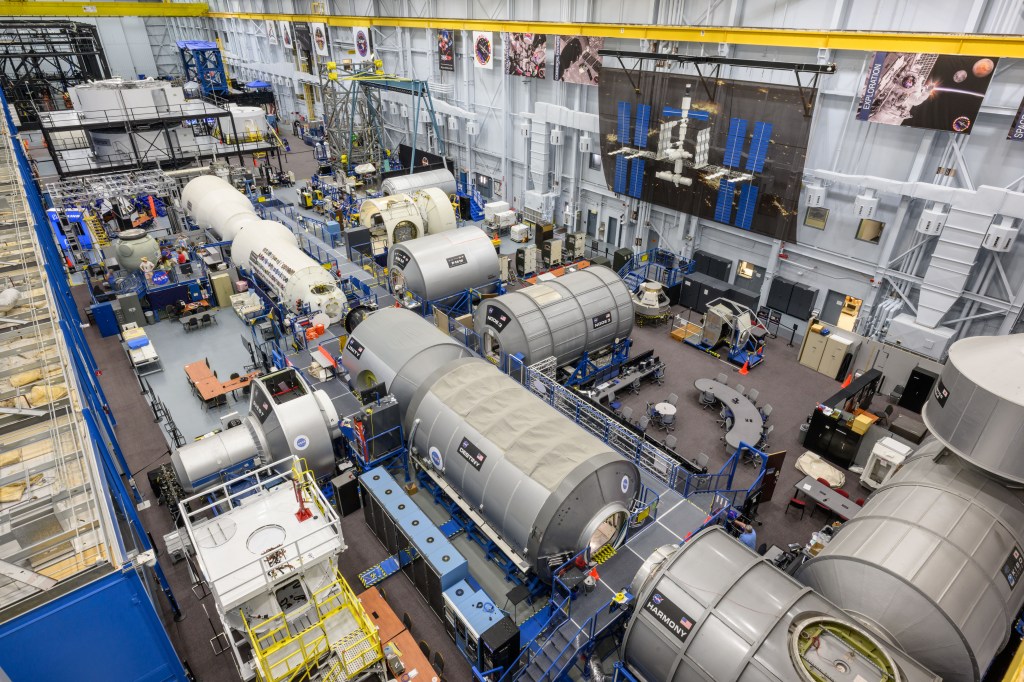
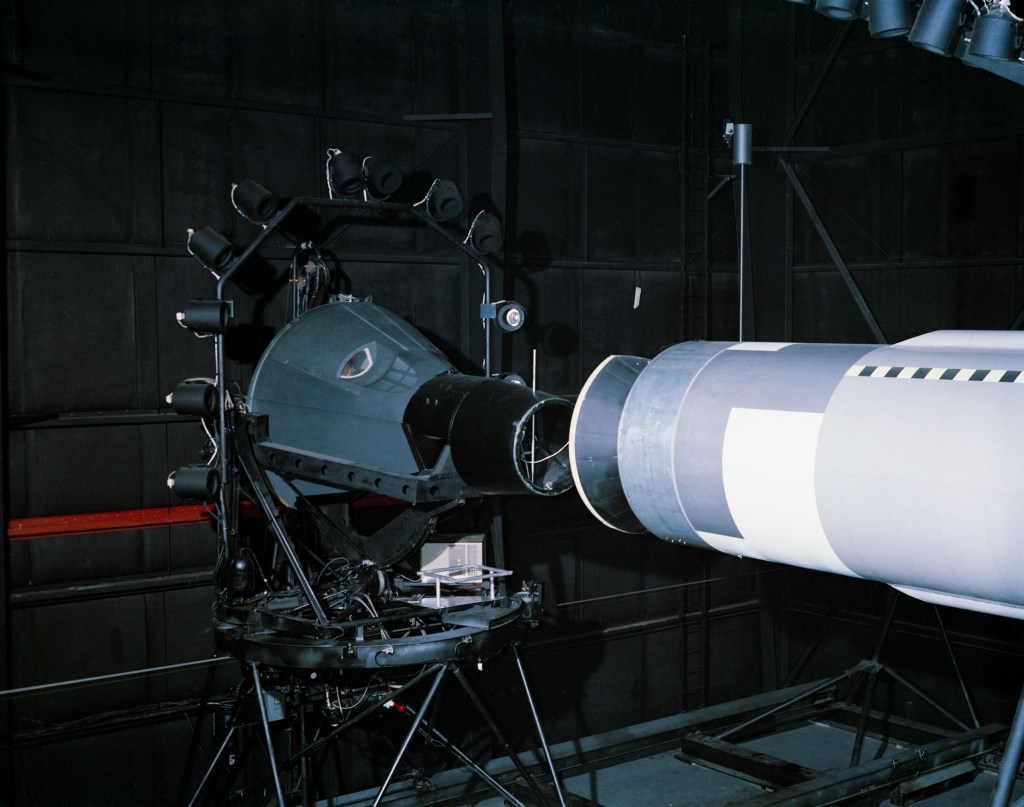
Construction of Building 9 began in December 1965 and finished in March 1967. The building initially housed the Technical Services Facility. In April 1969, workers converted a portion of the building to include a mock lunar surface scene, complete with a mockup of a Lunar Module, used by Apollo 11 astronauts. To support the space shuttle program, workers completed an addition that housed the Mockup and Integration Laboratory in September 1974. Astronauts for all 135 shuttle missions used the mockups for training. An extension on the northwest side of thebuilding begun in 1986 and completed in 1988. It received mockups of Space Station Freedom and later of the International Space Station, and the building was renamed the Space Vehicle Mockup Facility. Today, the facility also houses training mockups of NASA’s Orion spacecraft, commercial mockups, and the Active Response Gravity Offload System, known as ARGOS.

Mission Simulation and Training Facility (Building 5)
Construction of Building 5, the Mission Simulation and Training Facility completed inApril 1965 and began supporting missions beginning with Gemini IV in June 1965. The building originally contained the Gemini spacecraft simulator and a Gemini translation and docking simulator. Apollo program simulators, including a command module and lunar module simulator, began arriving in December 1965. From 1967 and 1978, astronauts used the Water Immersion Facility for spacewalk training. In the early 1970s, the building also housed full-scale, high-fidelity trainers and simulators of Skylab’s components, which all nine Skylab astronauts used for mission training. In the late 1970s, the facility underwent major renovations to support the space shuttle program, with the addition of fixed base and motion base simulators. The Space Station Training Facility addition, completed in 1991, supported first Space Station Freedom and now International Space Station crew training, and also contains Orion and Starliner simulators.

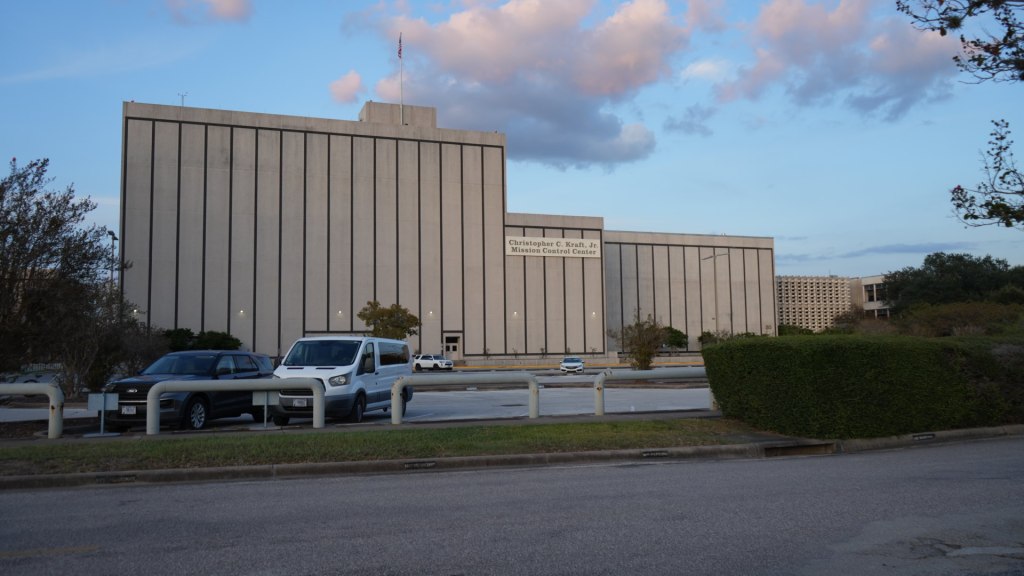
Mission Control Center
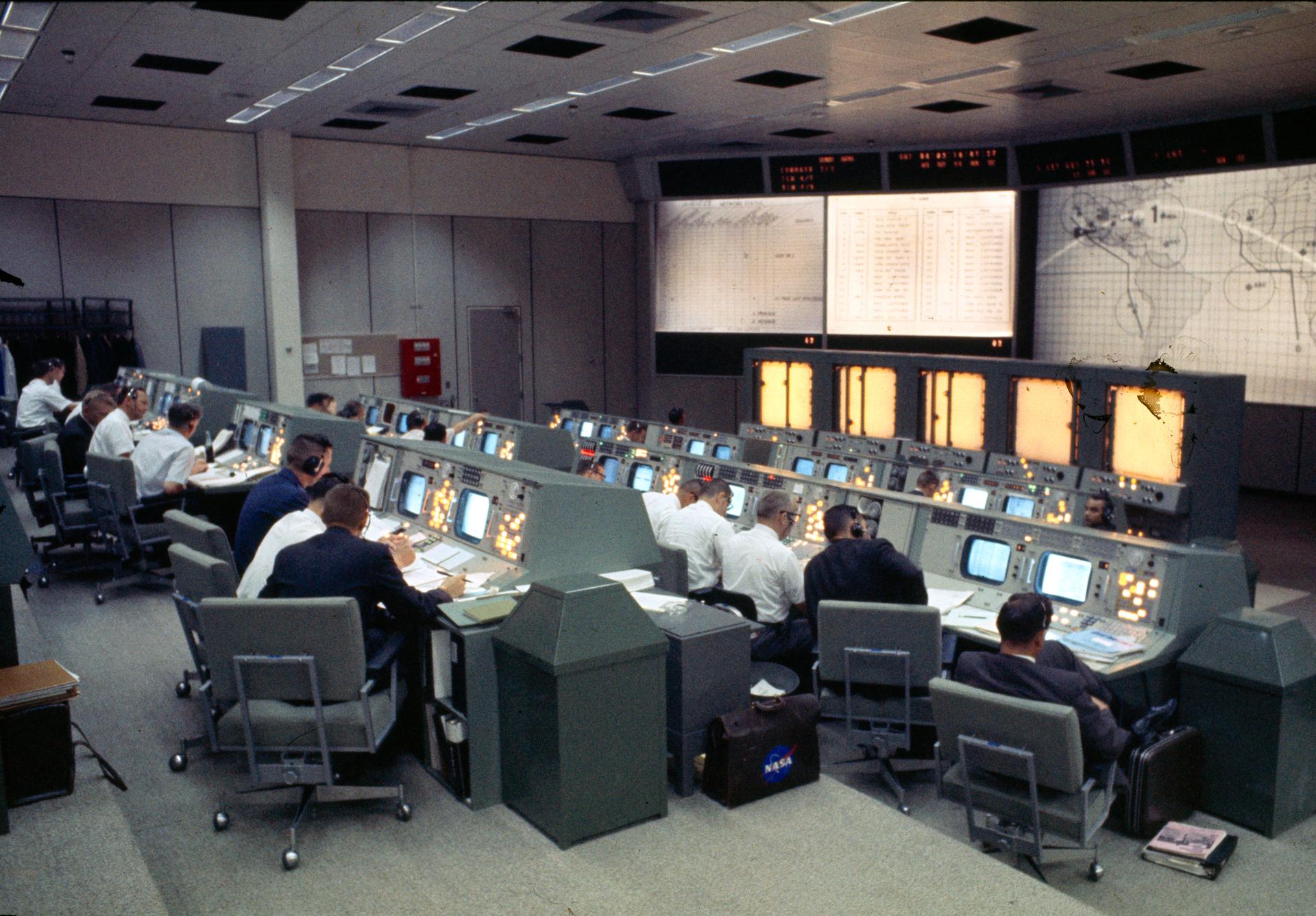
Construction of Building 30 housing the Mission Control Center began in June 1963 and finished in November 1964, with technicians installing the real-time computer in April 1964 and the first employees moving in two months later. The center initially housed two mission operations control rooms to support Gemini and Apollo missions and simulations. By January 1965, the center monitored the uncrewed Gemini 2 mission and the crewed Gemini 3 mission in a flight following mode.
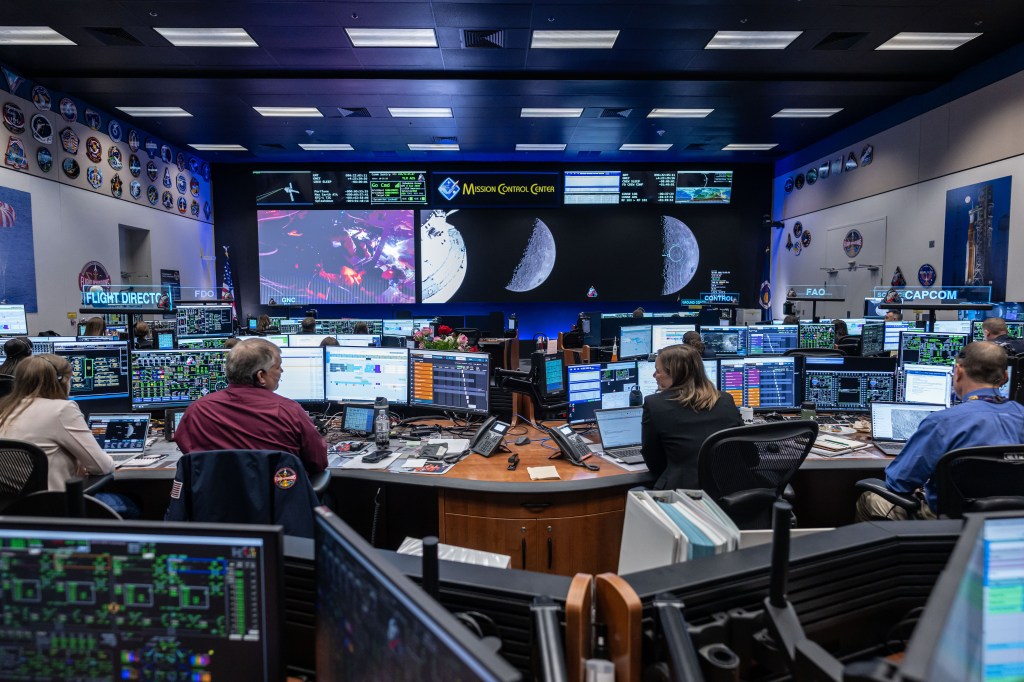
In June 1965, Houston had full control of Gemini IV and has controlled each of NASA’s human space flight missions ever since. The control center received a major upgrade to its computer systems in the mid-1970s to support upcoming space shuttle flights. On April 4, 2011, the building was renamed the Christopher C. Kraft, Jr. Mission Control Center, in honor of the man who created the concepts still in use today in human spaceflight control. The control center continues to support the space station around the clock as well as Artemis missions taking humans back to the Moon.

About the Author
John Uri
Share
Details
Related Terms
Explore More






TB 26-09 Measured Hammer-Tap Inputs
2026-11-02 20:47
For more information, contact Joel W. Sills, Langley Research Center, joel.w.sills@nasa.gov.
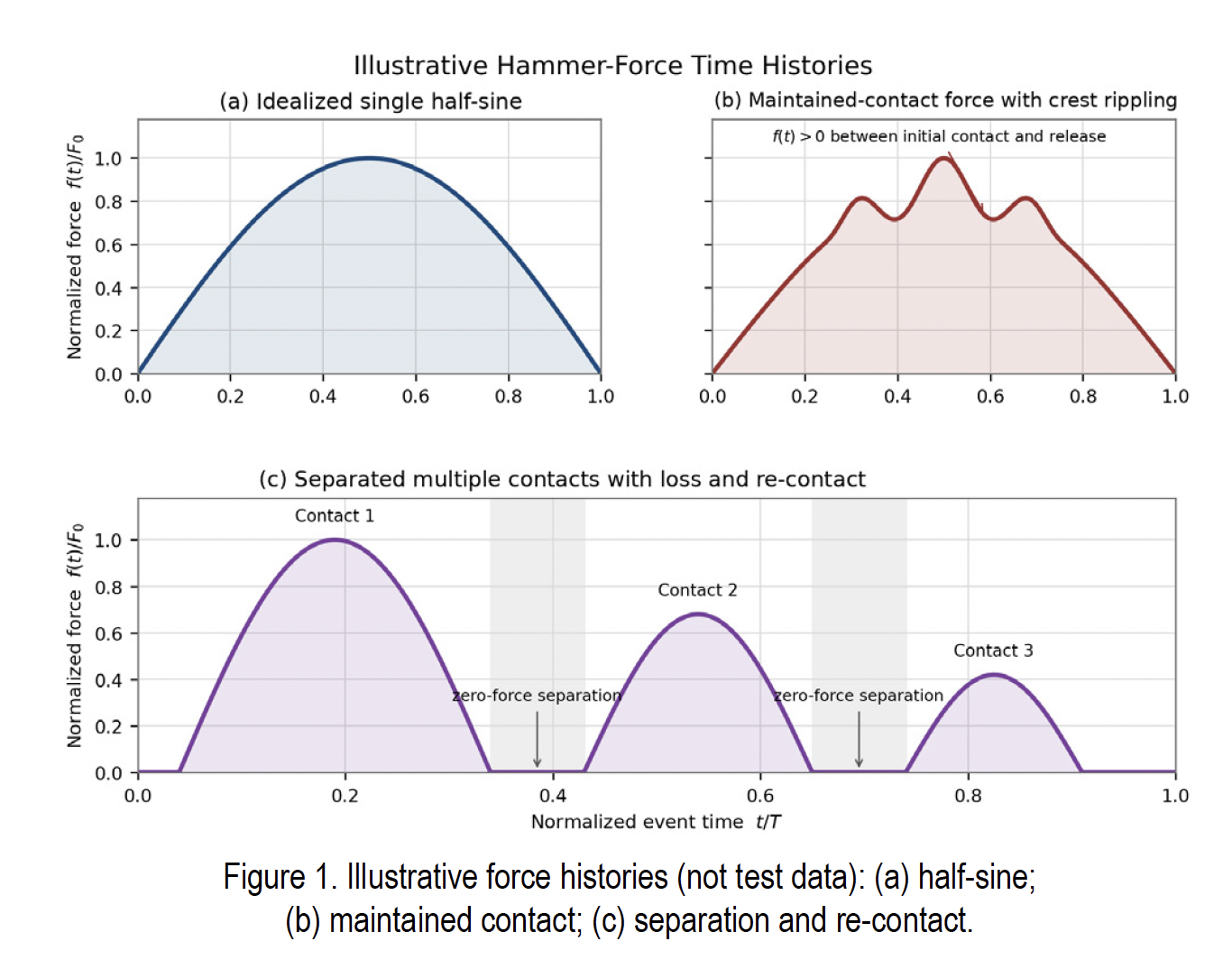
An instrumented hammer test does not require an idealized single half-sine waveform. When the complete force and response are measured accurately, crest ripples and separated contacts remain known inputs. Force shape changes excitation, but does not inherently invalidate the record. Adequacy depends on measurement accuracy, bandwidth, signal-to-noise ratio, and coverage of the test objective.
Background: What the Hammer Actually Measures
Hammer tests support modal analysis [2–4] and can precede pyroshock testing [6]. Figure 1 compares a half-sine, maintained-contact rippling, and separated contacts. During a zero-force interval, the structure continues to vibrate; re-contact acts on that vibration.
If an exact model and test article receive the same force and initial conditions, uniqueness gives identical responses for each bounded measured history. An approximate model can show different errors as inputs excite different frequencies, amplitudes, or nonlinear states. See [1] for the exact-model derivation.

Analysis: A Half-Sine Is Broadband, but Not Flat
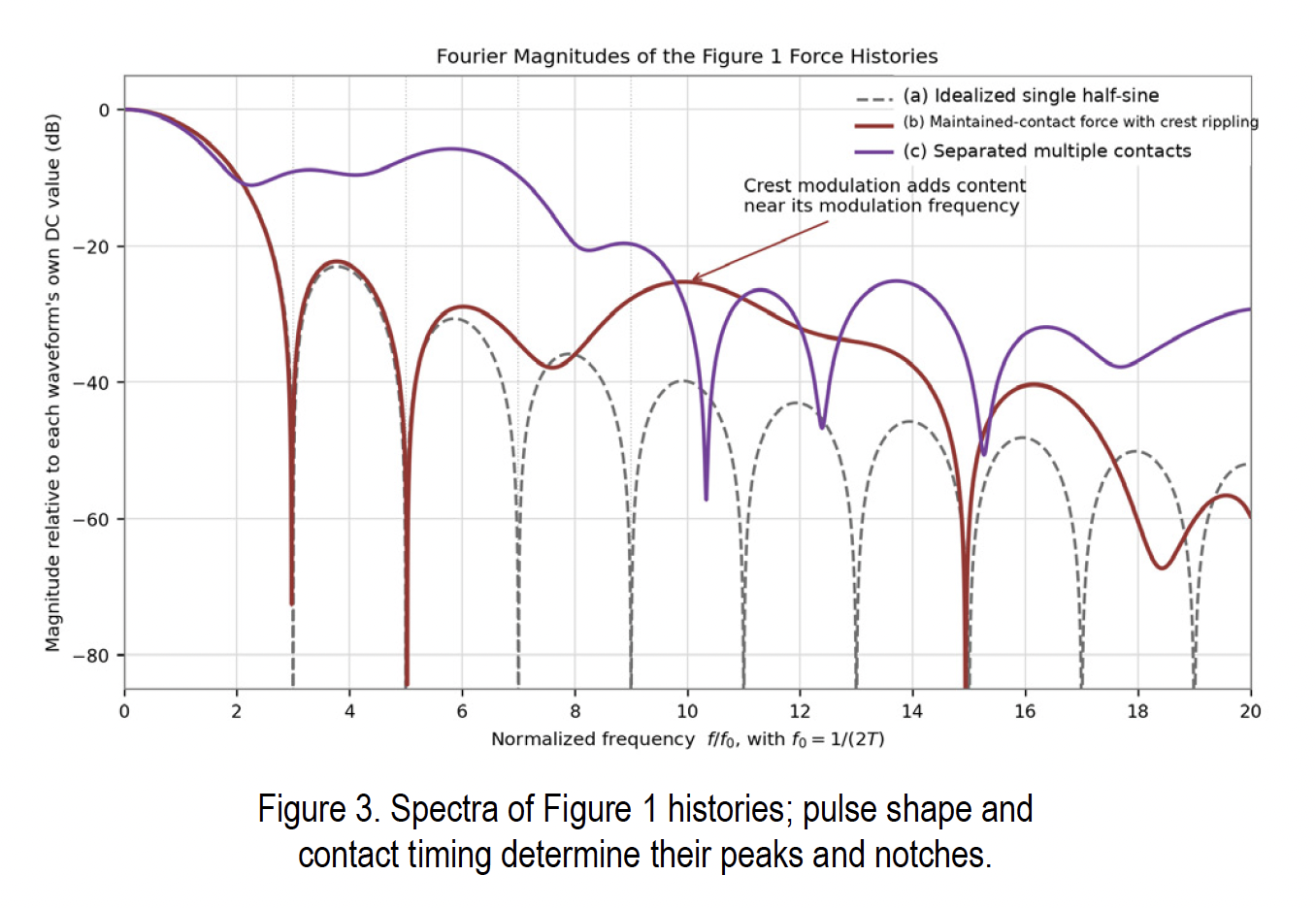
Figure 2 shows that a finite half-sine is broadband but contains spectral zeros at f/fo = 3, 5, 7, …, with fo = 1/(2T) for pulse duration T. Its appearance alone cannot establish adequate excitation.
Analysis: Spectral Content Is Determined by the Measured Force History
Figure 3 normalizes each spectrum to its own DC value. Crest rippling adds content and can fill half-sine notches. Timing between separated contacts creates deterministic interference. For adequacy, inspect the unnormalized measured spectrum and response signal-to-noise ratio.
Recommended Practice: Evaluate Test Adequacy Against the Intended Objective
• Measure the complete applied force with adequate bandwidth, calibration, dynamic range, and time synchronization.
• Verify that the response measurements have adequate bandwidth and signal-to-noise ratio and are not clipped or saturated.
• Confirm that the excitation covers the frequency, amplitude, and nonlinear-response ranges required by the intended test objective.
• Reject or repeat a test only for an identified measurement, excitation, or coverage deficiency.
Conclusion
Half-sine appearance neither establishes validity nor guarantees adequacy. Judge each hammer test by its purpose and by accurate, complete force and response measurements over the required range.
References
1. A. Majed, J. Sills, E. Henkel, V. Babuska, S. Yunis, D. Hamilton, J. Akers, and T. Kinney, Validity and Predictability of Measured Hammer Tap Inputs: Linear and Nonlinear Structural Systems, September 2026.
2. D. J. Ewins, Modal Testing: Theory, Practice and Application, 2nd ed., 2000.
3. ISO 7626-5:2019, Mechanical Vibration and Shock—Experimental Determination of Mechanical Mobility—Part 5
4. K. G. McConnell and P. S. Varoto, Vibration Testing: Theory and Practice, 2nd ed., 2008.
5. A. H. Nayfeh and D. T. Mook, Nonlinear Oscillations, 1979. 6. NASA-STD-7003, Pyroshock Test Criteria, 1999
NASA’s CHAPEA Crew “Returns” to Earth
2026-11-02 18:50
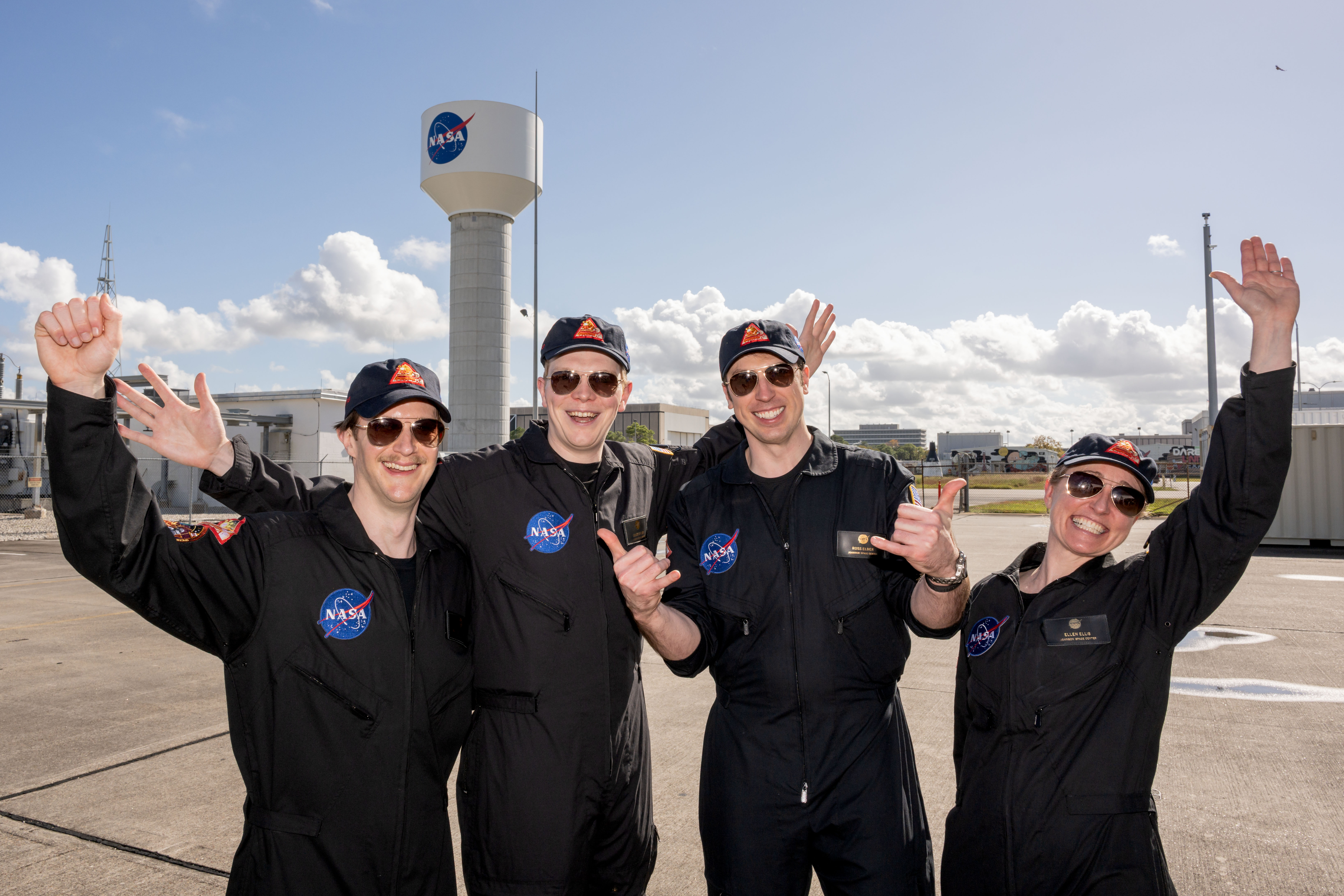
The four-member Crew Health and Performance Exploration Analog (CHAPEA) crew poses outside for the first time in more than a year following the end of their simulated Mars journey on Oct. 31, 2026. Crew members Matthew Montgomery (left), James Spicer (middle left), Ross Elder (middle right), and Ellen Ellis (right) spent more than a year testing systems, maintaining crops, managing limited resources and communication delays, conducting extravehicular activities and more in efforts to help NASA better understand how crews adapt to long-duration stays. Insights from their experiences will help NASA design its future Moon Base and plan for missions on Mars.
Image credit: NASA/James Blair
What’s Up: November 2026 Skywatching Tips from NASA
2026-11-02 18:19
Meteor Showers, a Spacecraft Milestone, and a Supermoon
Catch Taurid and Leonid meteors, spot Mars near Jupiter, celebrate Voyager 1’s light-day milestone, and watch November’s supermoon.
Skywatching Highlights
- Around Nov. 5: Southern Taurids peak; occasional bright fireballs
- Around Nov. 12: Northern Taurids peak; around five meteors per hour under ideal conditions
- Nov. 15-16: Mars and Jupiter appear 1.2 degrees apart before sunrise
- Nov. 17: Shine Bright for Voyager’s Light-Day activation
- Nov. 17-18: Leonids before dawn after moonset; up to around 15 meteors per hour under ideal conditions
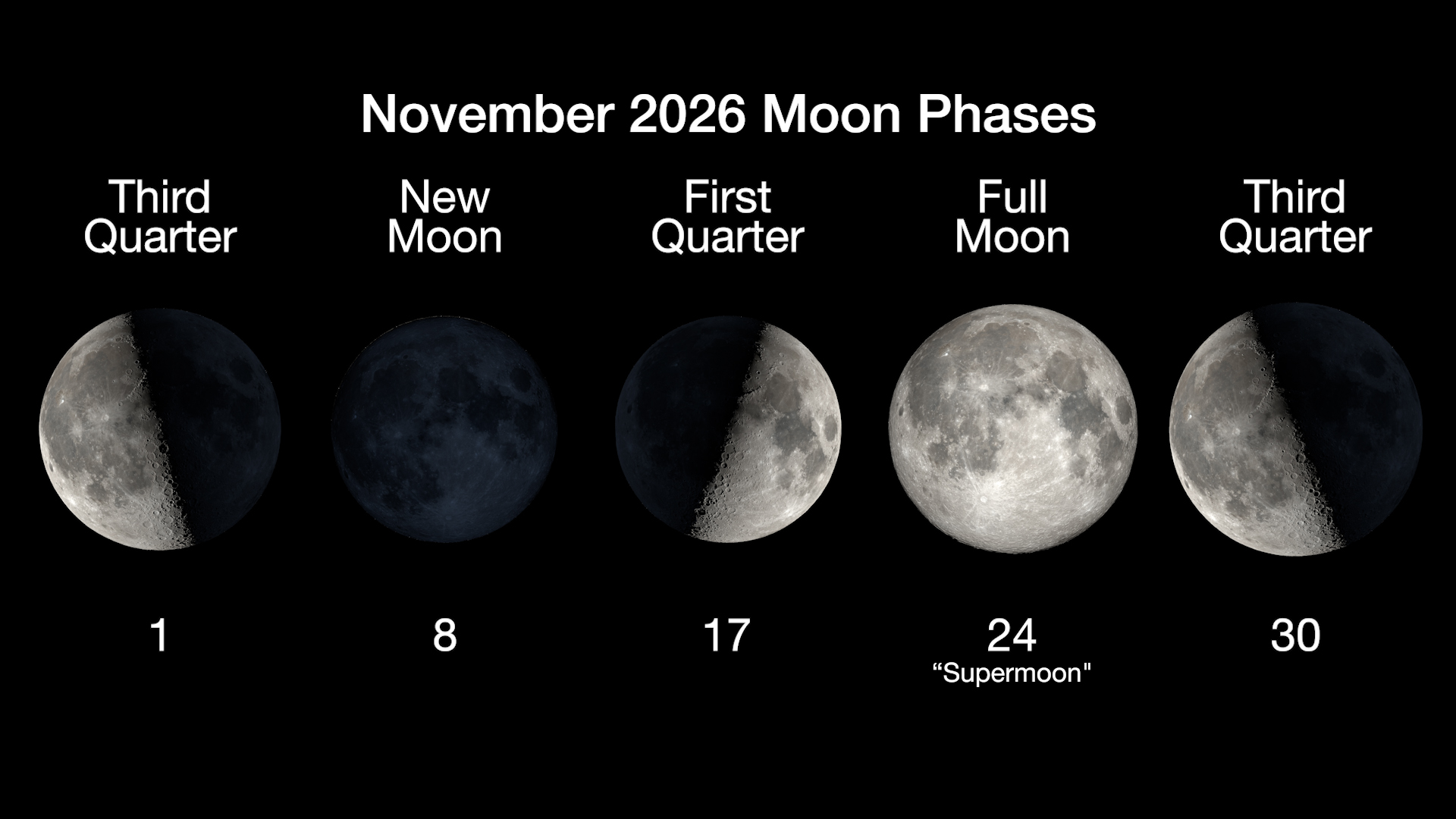
- Nov. 24: Full supermoon; first in a series of three consecutive supermoons

Transcript
A month of meteor showers … a close pairing of Mars and Jupiter … and a supermoon!
That’s What’s Up for November.
November offers a buffet of opportunities to see a meteor streak across the sky!
The Southern Taurids peak around November 5th, followed by the Northern Taurids around November 12th.
Those names refer to the two areas in the constellation Taurus, where the meteors appear to originate.
Each Taurid shower produces only a handful of meteors per hour—around five, under ideal conditions—but an occasional bright fireball can make the wait worthwhile.
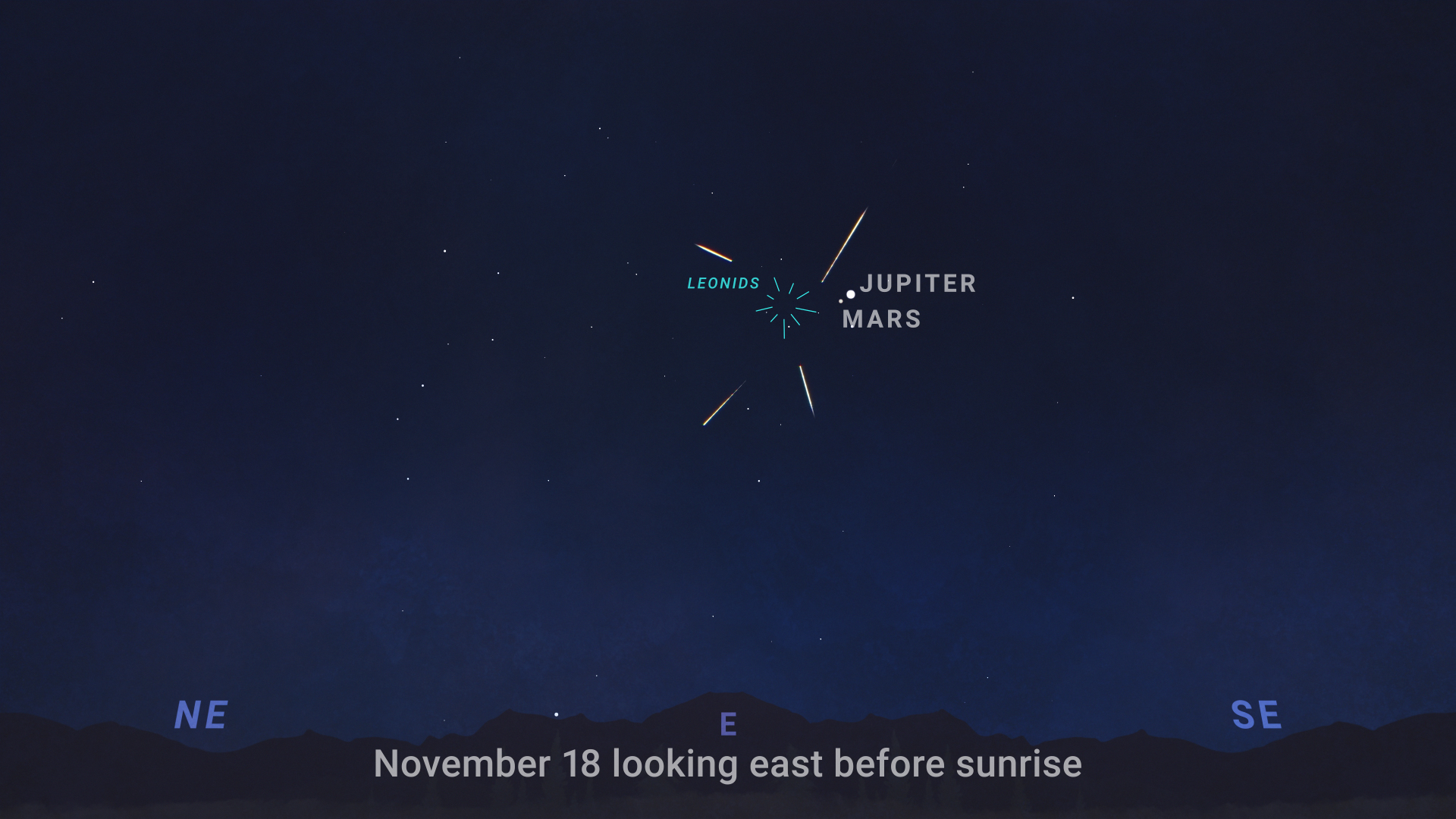
Next up are the Leonids. For the best viewing times, try the early morning hours of November 17th and 18th, after the Moon sets. Under ideal conditions, the shower could produce around 15 meteors per hour, though most viewers will see fewer.
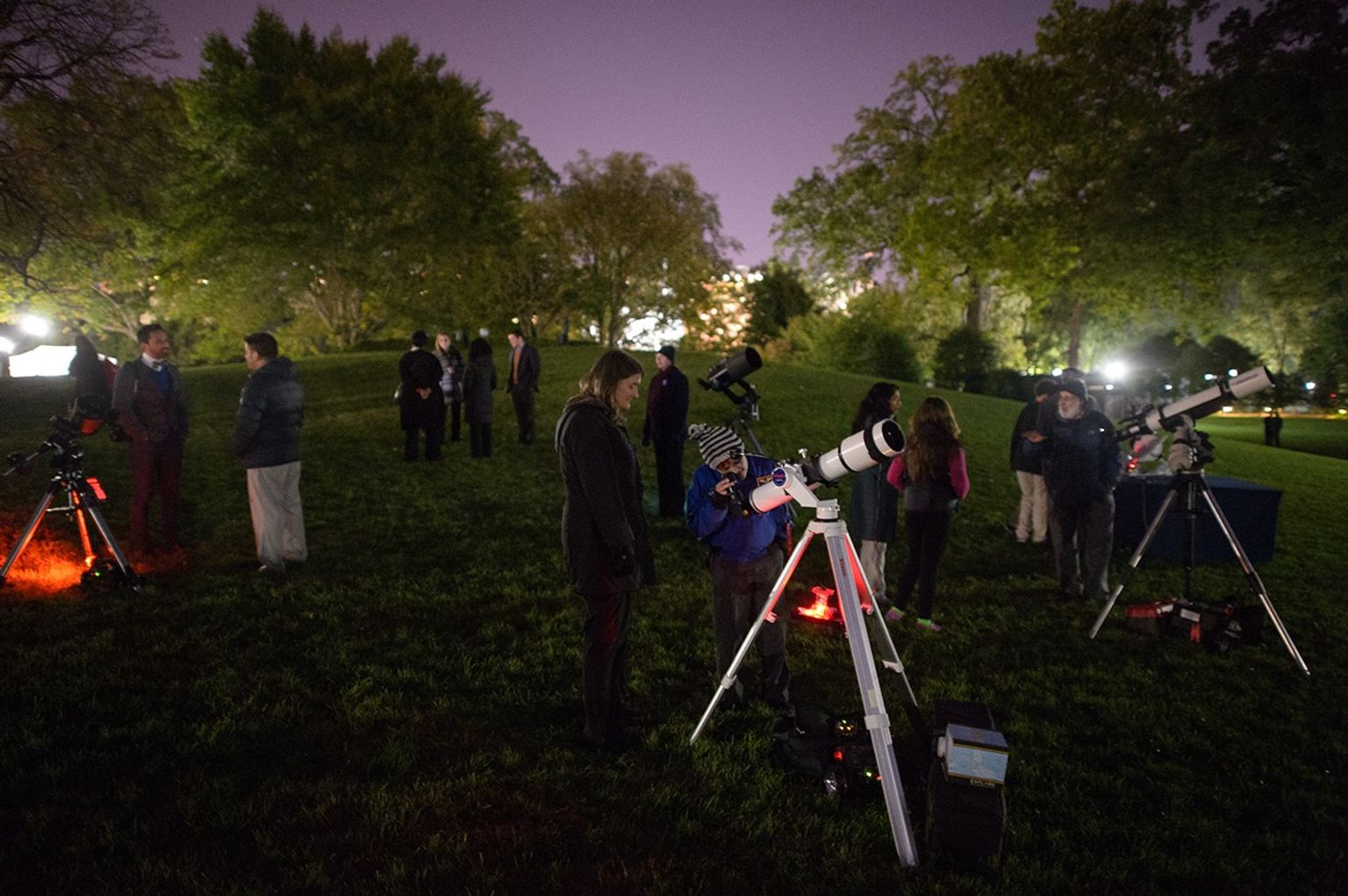
To level up your viewing experience, you will want to find a dark location, give your eyes about half an hour to adjust, and take in as much sky as you can.
Around mid-month, there’s another reason to head outside early. On the mornings of November 15th and 16th, look southeast before sunrise to see Mars and Jupiter close together.
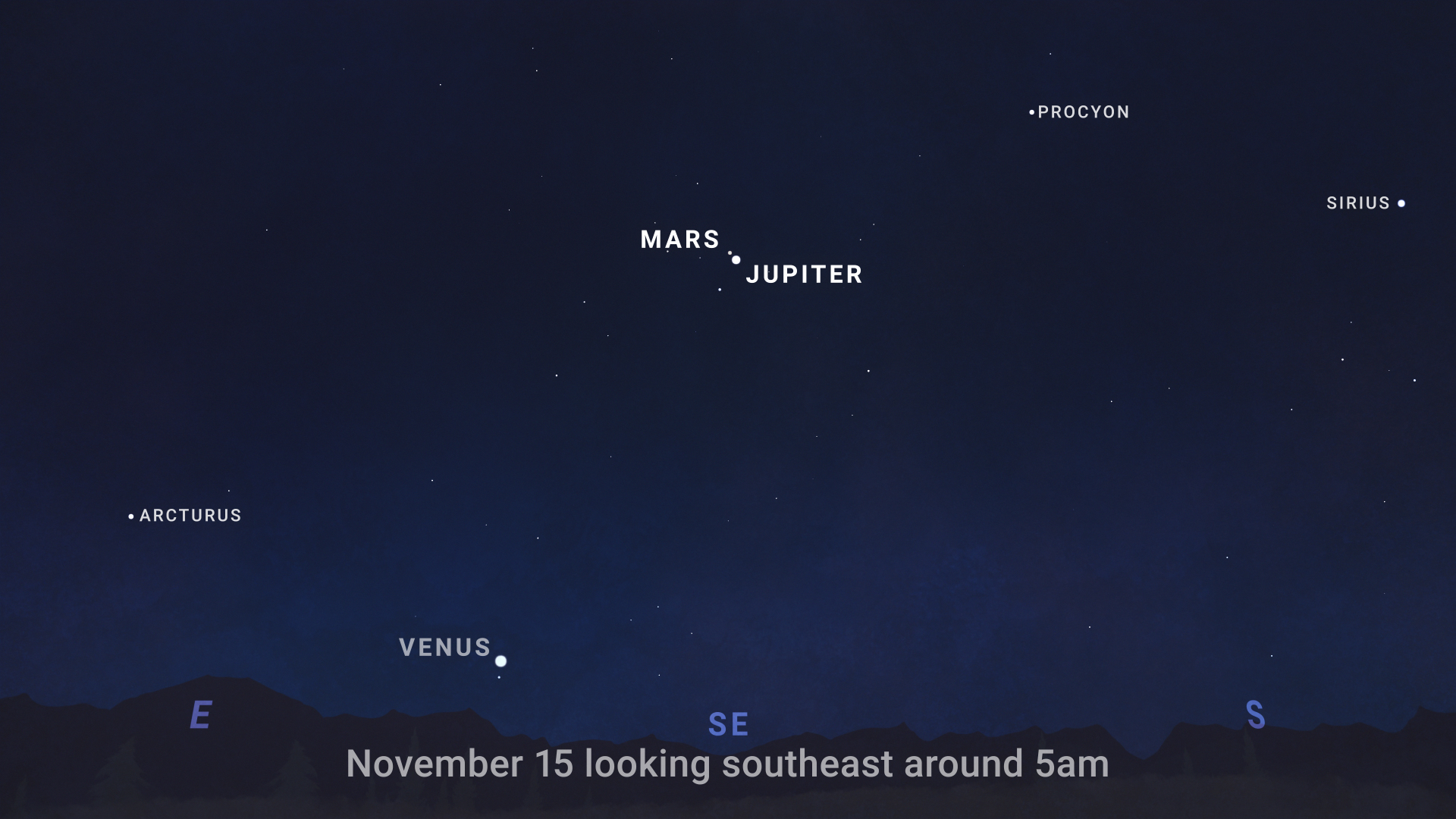
They’ll appear about 1.2 degrees apart—a little more than the width of two full Moons side by side. Jupiter is the brighter point of light, with reddish Mars nearby.
Both planets are easy to see with the unaided eye. They’re still far apart in space, but from Earth, they appear almost side by side.
Watch over several mornings to see them draw closer together – and then go their separate ways.
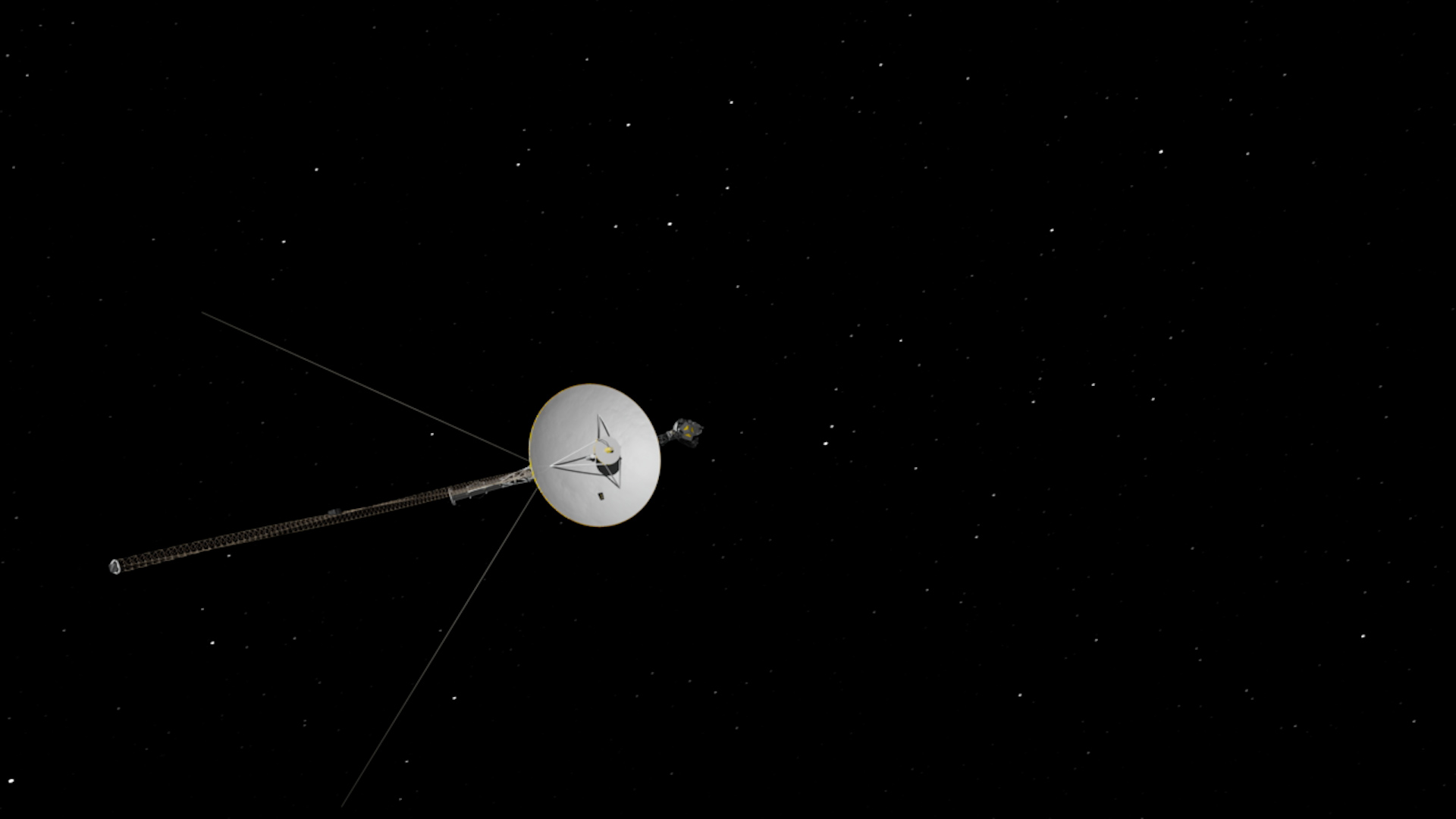
This month, NASA’s Voyager 1 spacecraft will reach a historic milestone, becoming the first human-made object to travel one light-day from Earth.
That means a signal traveling at the speed of light takes 24 hours to reach the spacecraft – and another 24 hours for us to hear back from it!
If you want to imagine where Voyager 1 is currently traveling, look in the direction of the constellation Ophiuchus, the Serpent Bearer.
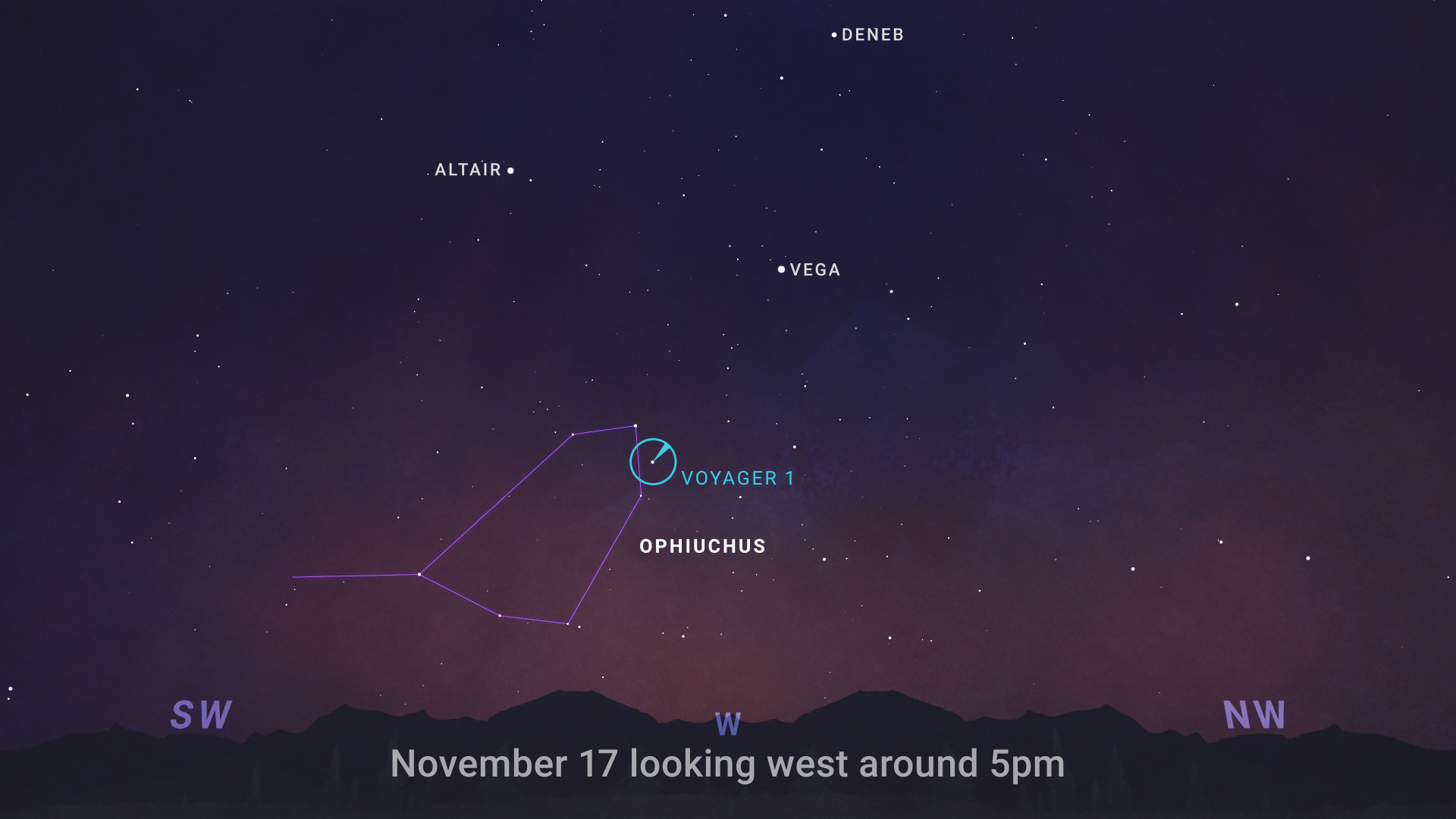
And on November 17th, join us in celebrating this milestone by participating in our Shine Bright for Voyager’s Light-Day activation. Learn more at nasa.gov/voyager.
On November 24th, the evening sky will be lit by a supermoon.
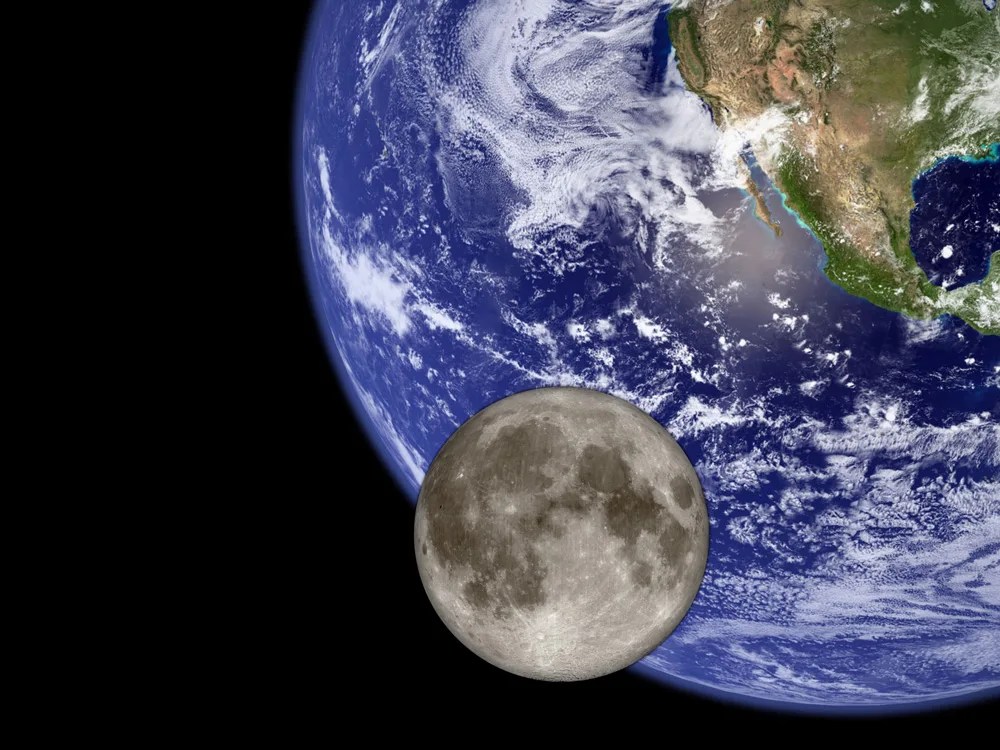
Because the Moon’s orbit is slightly oval, its distance from Earth changes. When it’s closer, the full Moon appears larger and brighter than average – though the difference can be subtle.
This kicks off a series of three consecutive supermoons in November, December, and January.
Look east around sunset to watch it rise. It may look even bigger near the horizon, but that’s the Moon illusion —a common effect with any full Moon.
Here are the phases of the Moon for November:
You can stay up to date on all of NASA’s missions exploring the solar system and beyond at NASA Science.
I’m Raquel Villanueva from NASA’s Jet Propulsion Laboratory and that’s What’s Up this month.


Share
Details
Related Terms

NASA Invites Media to Northrop Grumman CRS-25 Station Resupply Launch
2026-11-02 17:33
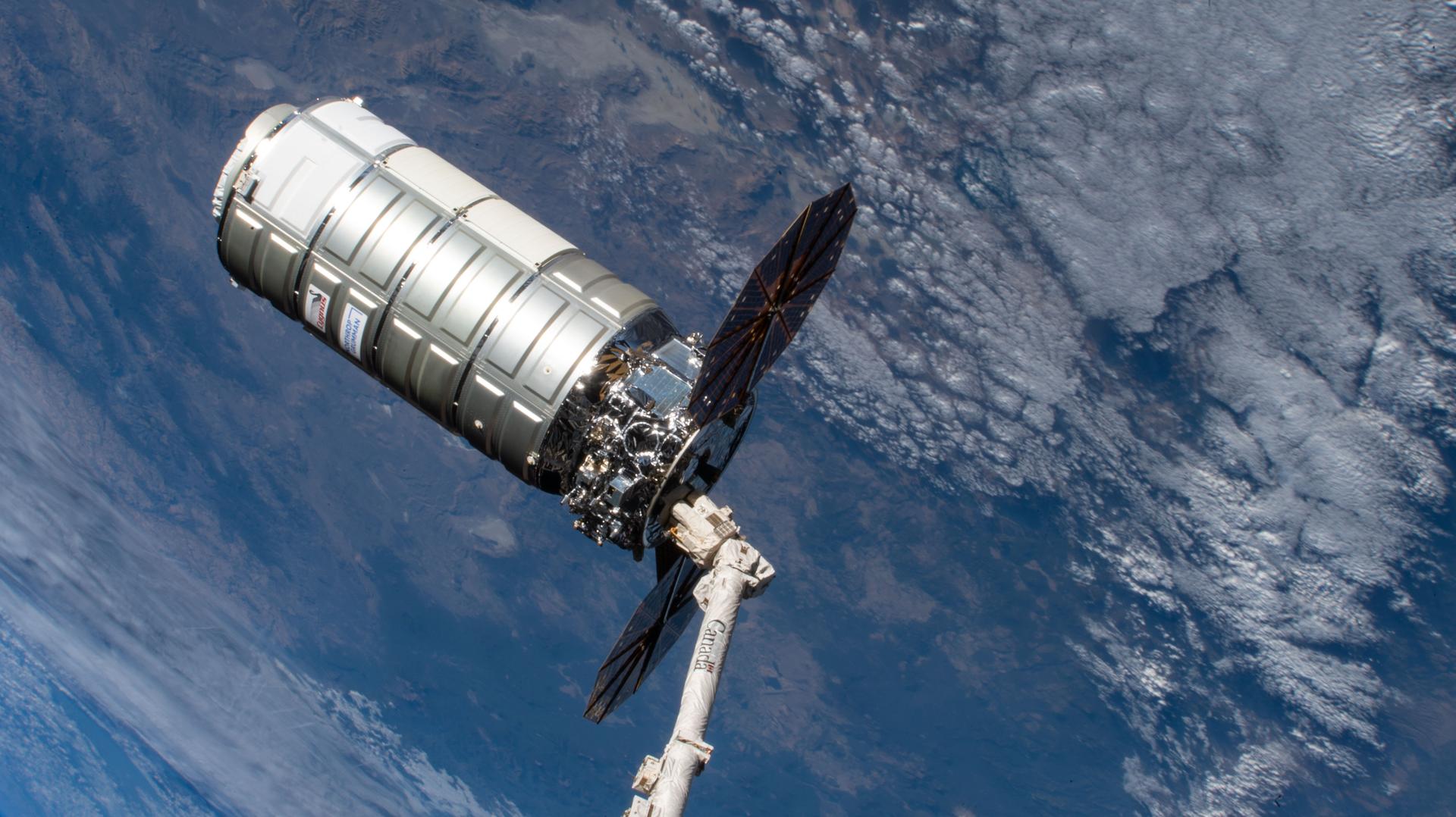
Media accreditation is open for the next launch to deliver NASA science investigations, supplies, and equipment to the International Space Station. A Northrop Grumman Cygnus XL spacecraft will launch in November to the orbital laboratory on a SpaceX Falcon 9 rocket for NASA.
The mission is known as NASA’s Northrop Grumman Commercial Resupply Services 25, or NASA’s Northrop Grumman CRS-25. Liftoff is targeted for no earlier than 10:49 a.m. EST, Sunday, Nov. 29, from Space Launch Complex 40 at Cape Canaveral Space Force Station in Florida.
Following launch, astronauts aboard the space station will use the Canadarm2 robotic arm to capture Cygnus and install the spacecraft to the Unity module’s Earth-facing port for cargo unloading. The spacecraft will remain at the space station until May 2027. This is the company’s 25th spacecraft built to deliver supplies to the International Space Station under contract with NASA.
Credentialing to cover prelaunch and launch activities is open to U.S. media. The application deadline for U.S. citizens is 11:59 p.m. EST, Thursday, Nov. 12. All accreditation requests must be submitted online at:
Credentialed media will receive a confirmation email following approval. NASA’s media accreditation policy is available online. For questions about accreditation, or to request special logistical support, email: ksc-media-accreditat@mail.nasa.gov. For other questions, please contact NASA’s Kennedy Space Center newsroom at: 321-867-2468.
In addition to food, supplies, and equipment for the crew, Cygnus will deliver several new experiments, including hardware to manufacture tiny, DNA-inspired particles in space that could improve drug delivery for cancer and osteoarthritis, as well as a study that could guide cancer treatments by predicting whether a patient’s cancer is likely to spread to other parts of the body. Cygnus also will carry human muscle cells and medications to test therapeutics for muscle loss associated with spaceflight and aging on Earth, and a compact radiation sensor designed to improve crew safety on future missions.
Each resupply mission to the station delivers scientific investigations in the areas of biology and biotechnology, Earth and space science, physical sciences, and technology development and demonstrations. Cargo resupply from U.S. companies ensures a national capability to deliver scientific research to the space station, increasing NASA’s ability to conduct new investigations aboard humanity’s laboratory in space.
For 26 years, people have lived and worked continuously aboard the International Space Station, advancing scientific knowledge and making research breakthroughs that are not possible on Earth. The space station is an important testbed for NASA to understand and overcome the challenges of long-duration spaceflight and to expand commercial opportunities in low Earth orbit. As commercial companies concentrate on providing human space transportation services and destinations as part of a strong low Earth orbit economy, NASA is focusing its resources on deep space missions to the Moon as part of the Artemis and Moon Base programs to build on our foundation for the first astronaut missions to Mars.
Learn more about International Space Station research and operations at:
-end-
Josh Finch / Jimi Russell
Headquarters, Washington
202-358-1100
joshua.a.finch@nasa.gov / james.j.russell@nasa.gov
Steven Siceloff
Kennedy Space Center, Fla.
321-876-2468
steven.p.siceloff@nasa.gov
Sandra Jones / Leah Cheshier
Johnson Space Center, Houston
281-483-5111
sandra.p.jones@nasa.gov / leah.d.cheshier@nasa.gov
TechCrunch - Latest
Apple says it’s ‘hard to predict’ when iPhone Duo constraints will improve
2026-11-02 23:25
Trajectory raises $45M to make AI model training accessible to nontechnical experts
2026-11-02 23:13
Apple’s inventory surges 154% as memory chip costs climb
2026-11-02 23:04
Anthropic warns that it’s very close to RSI capability, aka self-building AI
2026-11-02 22:14
Germany says lawmakers’ iPhones may have been hacked with spyware
2026-11-02 19:45